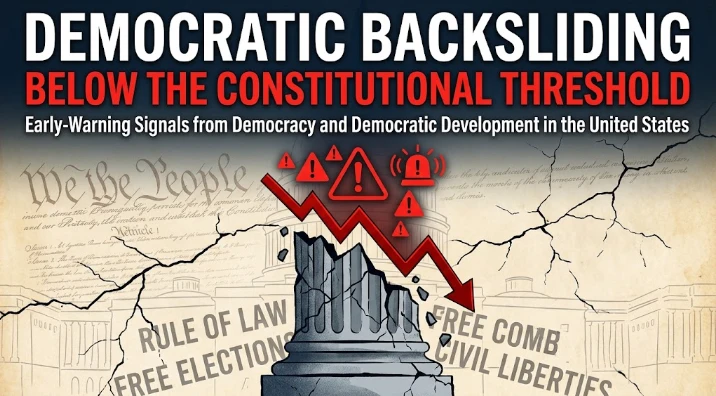
Democratic erosion often begins long before elections are cancelled, courts are suspended, or constitutional government formally collapses. This article identifies early-warning signals of backsliding in the United States while elections, legislatures, agencies, courts, and media organizations continue to operate. Warning signs include attacks on electoral credibility, intimidation of election officials, replacement of professional administrators with loyalists, selective law enforcement, weakened ethics rules, restricted access to records, politicized oversight, and normalized threats against opponents. No single action may prove regime change, but accumulated practices can redefine what public authorities are permitted to do without consequences. The article recommends monitoring patterns across institutions, jurisdictions, and time rather than waiting for an unmistakable constitutional rupture. Administrative records, court decisions, staffing changes, enforcement data, public statements, and independent reporting can help expose deterioration. A credible warning system should remain transparent and nonpartisan, distinguish lawful political disagreement from coercion, and examine whether accountability, competition, rights, and administrative neutrality are being systematically weakened.
It's easy to tell when it is a Democratic break down, because the institutions have broken down. However, it is more difficult to establish the early stages of erosion as legal documents generally still exist. Elections are held, courts make rulings, Legislature convenes, agencies function and the media exists. The more pressing issue in the United States in November 2025 is finding backsliding below the constitutional floor – changes that decrease competition, accountability, rights and neutrality in administration without outright overturning the constitutional system.
A threshold model gives "false secure" security. For the analysts, the lookout is for cancellation of elections, suspension of the courts, or direct military rule, or for explicit dictatorship. The typical way that backsliding will take place today is by a process of “accumulation.”
Officials contest veracity of elections, threaten oversight institutions, shift professionals with partisan loyalists, use enforcement selectively, make an effort to hide records, relax ethics laws and make threats to opponents commonplace. Regime change is not a simple affair to prove by means of a single act. Those acts taken together are able to shift the expectations of what power can do without repercussions.
Hence, a monitoring trend of behaviour, capacity and institutional response should take place at the early-warning analysis level. Attacks against judges, journalists, election workers, inspectors general, civil servants, universities and civic organizations; are considered to be behaviour. Capacity encompasses appointment, budget, data, procurement and enforcement. Response relates to the body or absence of ability of legislatures, courts, professional groups, state governments and citizens to expose, delay, reverse, or disapprove of abuse. When aggressive behaviour increases and capacity for response decreases, risk also increases.
V-Dem's 2025 Democracy Report sheds light on democratic decline in the context of the overall global wave of autocratization, and examines warning signs in the United States. These indices are useful for providing long-term context, but should be used in conjunction with specific indicators within countries. The large civil society, varied state institutions and the federalism and decentralized elections provide reprieve and resilience. This complexity may also mask the fact that erosion is not even in local areas that are averaged with other local areas to produce the national average.
A significant clue in election administration is offered. Systematic monitoring of professional turnovers, threats against the officials, partisan interference in certification, restrictions on access to voters' lists, opaque procedures for the maintenance of voters' lists and attempted manipulation of counting procedures are deserving of systematic monitoring. It's a normal occurrence that disagreement arises about election law. A warning arises when rules are frequently and arbitrarily altered to give opponents an unfair advantage, when administrators are retaliated against for making their proper decisions in this regard, or when it is the practice of losing candidates to make a mockery of certification.
Another indicator is provided by the civil service. Political leadership in democratic governments could be elected or appointed but when it comes to large scale replacement of professional personnel it could become a private instrument of administration. Factors to watch for are loyalty tests, reclassification of protected positions, pressure put on changing data, refusing to write it down, punishment for talking to an in-house lawyer, and a concentration of acting appointments. Administrative neutrality loses its strength when it comes in the eyes of most members of the public, who seldom pay much attention to the personnel systems.
The cord is being tied around the neck through a lack of funding and access, as opposed to being severed. Documents are necessary along with staff, subpoena veto, secure tenure, and make public to inspectors general, auditors, ethics offices, information officers, and congressional committee. Symbolic Accountability from a body which formally exists but can't obtain records or enforce deadlines. Indicators of further delayed response, posts left vacant, recommendations not acted upon, classification practices, and marking investigators for retaliation should be included in early-warning systems.
Operating indicators are also needed to ensure judicial independence. General criticism of the judiciary does count, but appellate success percentage, emergency appeals, case referrals, security concerns and lack of resources, as well as manipulation of jurisdiction, also count. When agencies slow down implementation or limit agencies through administrative red reins, court judgments have limited value of protection. Monitoring should be conducted following judgements into practice, and not ending at doctrinal outcomes.
Information environment can be the indicator of shift in norms of democracy. Limits of scrutiny can be further tightened due to government pressure on media, limitations and selection of access, defamation campaigns and threats against public broadcasters, and retaliation investigations. Meanwhile, more private ownership and platform algorithms mean there is no need for direct state censorship to "bend" the visibility. Early warning needs to monitor both Governmental interference and structural conditions, which make the capacity for independent reporting low, in particular at the local level.
One needs to be cautious in dealing with violence that is politically motivated. Isolated incidents may not necessarily be signals of a regime change, but threats could normalize, thus changing participation. Election officials, school-board members, judges, journalists and local officials can opt-out of their public jobs when there is an increase in the level of personal risk. Data needs to be differentiated between rhetoric, credible threats, organised intimidation and violence. Enforcement consistency is also important as it can make people think that there is partisan protection if it is selective.
Federalism works as both a security and as dangers. States are able to withstand illegal pressure from the Federal authorities, maintain electoral administration and experiment with democratic reforms. States also have the potential to serve as exclusion zones or majority bastions. State to state comparisons helps to uncover initial trends in voter access, the rules governing protests, legislatures processes, compliance with public records, judicial appointments, and civil-service protections. Institutions at the national level can move and variation offers pre-evidence.
Development outcomes are an inside problem that needs to be addressed within the analysis. Transforming the discourse from institutional toward anti-institutional in regions can be effective when the local economy is in decline, service growth is muted, there is housing stress, and inequity in the provision of services can be found. Although material frustrations are not directly and automatically catalyzers of authoritarianism, they make it easier to discount the legitimacy of democracy when institutions become unresponsive. Therefore, public performance of services, marginalization by region, social mobility, and the trust in public rules, should be a part of early-warning schemes.
The positive results are behind the data of "posters for democracy" in general. The survey questions need to elicit answers on how tolerant the population is to executive defiance, political violence, selective prosecution, restrictions on the media, and electoral manipulation in cases where partisan interests are at stake. Sex and slim support of democracy among citizens vis-à-vis their preferred leaders have been studied. If the conditional commitment can be detected by behavioral experiments and panel surveys.
No one indicator should be considered a crisis on a practical dashboard. Rather, cross domain grouping should be an impetus for further inspection. So frequent changes in work force coupled with attacks on oversight coupled with selective enforcement are more to worry about than any brand new change. Independent publication of common metrics, explanations of uncertainty and corrections of error by institutional, academic, journalistic and civic groups. Transparency helps to ensure that the dashboard stayed off partisan branding.
Democratic backsliding, if it is indeed occurring and if it does not cross the constitutional limits, is a process of changed expectations. The officials learn that there is room for bending the rules, the institutions learn that resisting the bending of the rules comes at a cost, the citizens learn that there is accountability if the parties are in alignment. The sooner the better to allow for lawful corrections via elections, the courts, oversight, organizing, and administrative restructuring. It's not meant to be a continuous scare tactic. The goal is conscientious care until there has been a full-fledged constitutional breakdown, when things will be much harder to fix.
Soon, budget signals can identify institutional weaknesses as they begin. Capacity can be cut without changing mandates as a result of abrupt reductions in the number of election offices, election inspectors, legal assistance, statistics agencies, public broadcasters and civil rights enforcers. The contribution of comparative tracking of appropriations, vacancies and workload give a tangible idea as to the usability of constitutional functions.
There is a need for this kind of focus to be put on procurement and data systems. An efficient management of the information is achieved through centralised databases, at the expense of increasing surveillance and targeting. Emergency contracting can establish patronage relationships for ongoing beyond leadership change. Some warning signs are unmarked sole-source awards, tougher audit requirements that are not observed, limited access to the data set, and contracts that limit access to public records to the extent that it provides no review capacity.
Distributed guardians are 'professional associations'. Law, medical and engineering societies, schools and other public-administration networks can help maintain records of pressures against standards and will help officials who have experienced pressures, and who may be facing retaliation. SL independence from party organizations is still extremely important. Credible warnings are based on evidence that is open to all to view, based on consistent criteria, and with a willingness to review every governing coalition.
Baselines of non-degraded conditions from the past help with interpretation. Fluctuations may appear more greatly in one year than they do essential to the natural conditions or may be masked by a gradual decline. Changes over time, between administrations, between states and between institutional domains are considered; looking for unusual changes in these. Public dashboards should send methods and revisions for the disagreements to happen on the evidence and not hidden methods selection of scores to go on the dashboard.
There is a need to coordinate with local observers, as intimidation, administrative delay or informal pressure are not usually apparent in the national data, to be picked up by legal professionals or election scholars. Evidence can be obtained through the use of standardized reporting forms and reporting channels designed to be protected. There need to be verification procedures which help to distinguish rumour from documented events and also retain speedy warning capacity.
There also needs to be clear principles of action for a warning system. The Evidence should call for the attention of the legal profession, for legislation if necessary, for protection, and further investigation and not for publicity alone.
CITE THIS ARTICLE
Amin, M. R. (n.d.). Democratic Backsliding Below the Constitutional Threshold: Early-Warning Signals from Democracy and Democratic Development in the United States. https://www.ruhulresearchhub.com/article/1565a581-8e35-5ccb-8d59-57d79893b5de
M. R. Amin, “Democratic Backsliding Below the Constitutional Threshold: Early-Warning Signals from Democracy and Democratic Development in the United States,” n.d.. [Online]. Available: https://www.ruhulresearchhub.com/article/1565a581-8e35-5ccb-8d59-57d79893b5de
Amin, M. R. (n.d.) ‘Democratic Backsliding Below the Constitutional Threshold: Early-Warning Signals from Democracy and Democratic Development in the United States’. Available at: https://www.ruhulresearchhub.com/article/1565a581-8e35-5ccb-8d59-57d79893b5de
Amin, Mohd. Ruhul. “Democratic Backsliding Below the Constitutional Threshold: Early-Warning Signals from Democracy and Democratic Development in the United States.” n.d., https://www.ruhulresearchhub.com/article/1565a581-8e35-5ccb-8d59-57d79893b5de.
Mohd. Ruhul Amin. “Democratic Backsliding Below the Constitutional Threshold: Early-Warning Signals from Democracy and Democratic Development in the United States.” (n.d.). https://www.ruhulresearchhub.com/article/1565a581-8e35-5ccb-8d59-57d79893b5de.
Amin MR. Democratic Backsliding Below the Constitutional Threshold: Early-Warning Signals from Democracy and Democratic Development in the United States. n.d.. https://www.ruhulresearchhub.com/article/1565a581-8e35-5ccb-8d59-57d79893b5de
@misc{article_1565a5818e355ccb8d5957d79893b5de,
  title = {Democratic Backsliding Below the Constitutional Threshold: Early-Warning Signals from Democracy and Democratic Development in the United States},
  author = {Mohd. Ruhul Amin},
  url = {https://www.ruhulresearchhub.com/article/1565a581-8e35-5ccb-8d59-57d79893b5de},
}
TY  - GEN
AU  - Mohd. Ruhul Amin
TI  - Democratic Backsliding Below the Constitutional Threshold: Early-Warning Signals from Democracy and Democratic Development in the United States
UR  - https://www.ruhulresearchhub.com/article/1565a581-8e35-5ccb-8d59-57d79893b5de
ER  -
This article presents democratic recovery after executive overreach as a process of reopening institutions rather than merely restoring formal legal boundaries. It describes how executive misconduct can leave politicized appointments, weakened oversight, restricted records, altered enforcement practices, intimidated officials, and concentrated agenda control. The article mentions open-democracy theory as requiring continuous accessibility, deliberation, transparency, inclusion, and responsivenes
Climate accountability increasingly operates through routine public and corporate decisions rather than exclusively through litigation. This article examines how international environmental law and the law of the sea influence government budgets, permits, procurement, port operations, insurance, energy planning, investment, and corporate governance. The 2024 advisory opinion of the International Tribunal for the Law of the Sea recognized anthropogenic greenhouse-gas emissions as pollution of the
This article examines how biometric border systems can create unequal experiences of citizenship and migration control in the United States. It describes facial recognition, fingerprinting, iris scanning, and interconnected identity databases as technologies that may improve verification and reduce fraud while also expanding surveillance and distributing errors unevenly. The article mentions false matches, failed identification, secondary inspection, questioning, detention, and weak appeal proce