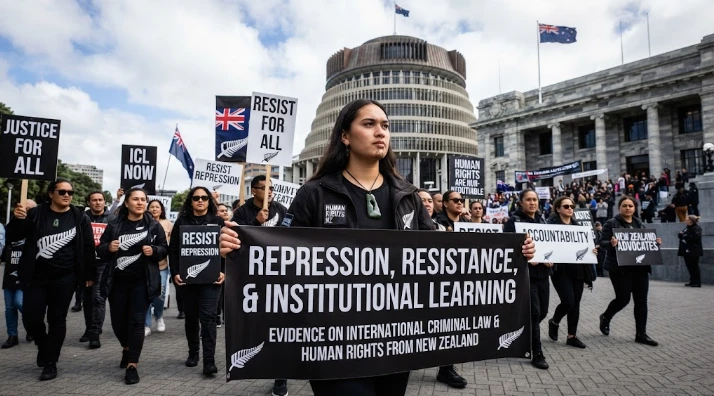
Straddling law, administration and public legitimacy, New Zealand institutional learning at the nexus of repression, resistance and human rights faces a dilemma in how to identify and respond to mistreatment. Between repression, resistance, and human rights, New Zealand institutional learning is trapped between law, administration and public legitimacy in a dilemma to identify and learn from mistreatment. This matter holds special significance in the fifth month of 2026; particularly where it comes to small-scale coercive practices that may not be caught by the international-criminal lens but nonetheless infringe rights and participation in democracy. A force of good will is not enough to establish good institutions. Protective measures have to work in the pressure, disagreement, and a changing political climate.
International human rights obligations and accountability norms, coupled with the New Zealand Bill of Rights Act, Crimes of Torture Act and policing law are included in governance arrangements. Standards are built in those sources, but to be interpreted, implemented and reviewed, you need institutions. The main players are the Police, corrections, the courts, Inspectors, protest groups, Māori organisations, media and Parliament. But that group needs to work in coordination keeping independence, not sharing the responsibility.
Criminal responsibility starts well before a courtroom, one that is international. Evidence may disappear due to the moving of the equipment, evidence may go missing, equipment failure, intentional actions to destroy evidence, or lack of proper evidence collection. Provenance, consent, security issues, translation and analytical limitations should be documented through documentation protocols. The initial decisions on how to store and how to verify can make the difference between events going ahead later on or not.
This is because, unlike more state-centred prosecution models, the new one involves victims. Information, representation, safety, and realism is required to participate. The importance of institutions not making it seem as if the only wisest way to end the situation is through prosecution. These can be equally significant to the affected communities: truth, acknowledgment, reparation, institutional reform, memorialization, and guarantees against occurrence.
Political pressure and ethics involved in case selection. We have to choose – too few resources compel prosecutors to prioritise incidents, perpetrators, regions or legal theories. Non-selective justice can be perceived to be less if there are transparent criteria. Judgement should be based on gravity, representativeness, evidentiary value, interests of the victims and the possibility of determining group patterns.
The institutions can be inter-dependent both within countries and between countries. The balance between national and international institutions is one of proximity, language and access, or independence capacity. Referrals, evidence transfer and witness protection, as well as liability for remedies, should be addressed in the cooperation agreements. Ambiguities in division can result in "limping" cases, where they are "left stranded" between jurisdictions.
There is a need for institutional learning as well to be held accountable. Without altering command systems, detention practice, procurement or political incentives, a conviction will conjure nothing’s permanent solution through ending violence or killing. Recommendations must have assigned owners, budgets, deadlines and have public follow-up. Monitoring must assess if risk is met or not instead of the number of reports.
Independent review, disaggregated reporting, a legal remedy, public hearings, an operational revision and long term monitoring should be the main pillars of a practical reform agenda. The elements are applied namely before failure, when action is taken, after action, and when harm is caused. Order of sequence is important because, there is less accountability from later if others do not have earlier records or reasons.
Values to be included are use of force incidents, detention conditions, arrest of protesters and outcomes of complaints, court rulings, and policy changes. This kind of material enables comparisons to be made between agencies, regions, over time, and, between impacted groups. This can be done in a way to maintain confidentiality while providing information on symptomology, differences, delays, and recurring mistakes and shortcomings at an institutional level.
The focus of equity analysis should be on Māori, Pasifika communities, prisoners, those who use mental health services, migrants and political activists. An government's formal neutrality cannot provide answers to questions concerning whether and how burdens tend to clump at either end of the spectrum or whether access to review varies due to income, status, geography, disability, ethnicity, age and language. The connection between distributional evidence and design and resource allocation should be made.
Evaluation should be done long term after launch of policies. If this change in leadership, crisis or budget occurs, early compliance can decrease. Continuity as a result of scheduled review, public reporting and independent research. It should be possible to take corrective action without a complete failure of the policy.
The relationship between formal rules and incentives should be included in the analysis at the institutional level. Work load, targets, budgets, professional norms, political signals and expected scrutiny are all factors to which the officials react. Reform will be successful when those forces lead to lawful and fair action or behavior. A safeguard, which is only in a manual, can be lost under operation pressure.
There are dangers involved in measurement. Indicators can be used to make outcomes more straightforward and help motivate a strategy for reporting. The combined use of quantitative data and qualitative evidence, independent verification, and clear definitions should therefore be side by side. Disaggregated reporting is important as underlying national average indicators may fail to identify systemic issues in some localities, or for certain groups.
Public communication also has an impact on the legitimacy. The language of technocracy can cloud the sizable effects of the decisions made by administrators, and the bravado of rhetoric can magnify any doubt. Identification of objectives, evidence, trade-offs, affected rights and challenge available should be provided with clear explanation. Accepting imperfections can help to boost confidence, as opposed to proclaiming all things to be under control.
Implementation requires resources. Review bodies should have staff, expertize, job security, access to documentation and authority to make conclusions. Funding, interpretation, accessible venues and time also are important components of community involvement. Unfunded rights may turn into symbolic statements, as well as participation duties.
New opportunities and dangers from digital evidence. Images, messages, satellite information and open source information can give an indication of incidents, but authenticity, situatedness, manipulation and security needs must be carefully dealt with. Investigators must have repeatable methodology and methodologies for disclosure. Private company and platforms also have information that can go missing under regular retention procedures.
There is a need for greater than courtroom anonymity in the area of witness protection. Participation may be a function of relocation, psychosocial support, secure communication, family safety and livelihood protection, and long-term contact. The level of protection should be re-assessed with changing risks. The motivations behind unrealistic promises may generate further damage and jeopardize further collaboration.
For archives, it is not enough to just store data – governance is needed. Preservation format, classification, usage rules and public use should be considered at the outset. Groups of survivors have a right to participate in decisions relating to sensitive data. An archive can be a tool for: Trials, truth process, education, memorialization; if governance is still “good”.
Plan and promote reparation programs – with real delivery systems. Exclusion can also be introduced by eligibility, proof, payment systems, psychosocial, and community interventions that are tailored too much. The determination of eligibility for final relief is a process that can take many months to finish, and interim relief might be needed to respond to urgent needs prior to final adjudication. Public notification should be separated out between public announcement of awards and remedies actually received.
Political independence should go hand in hand with ability to run the operation. Even a publicly independent prosecutor or commission may end up failing by being poorly equipped, inadequately funded, poorly managed and procedures may be unavailable. Independence and performance can be safeguarded through appointment rules and transparent plans, as well as external review. One of the main principles of good accountability institutions is themselves to be held accountable.
Responsibility needs to be identified throughout the governance buildings. The ability of police, corrections and courts as well as inspectors, protest movements, Māori organisations, journalists and parliament to cooperate effectively is dependent on the ability to trace the authorisation, delivery, monitoring and remedy. There should be written protocols and escalation routes needs in the event of an overlapping mandate. Ambiguity is otherwise the safeguarding of institutional boundaries and not affected people.
Risk assessment to be considered including action and inaction. There is evidence that both over-intervention and under or late and disjointed intervention threaten the rights of individuals and children. Decision record should include a discussion on the balance based on evidence and less-restrictive alternative(s). Thereafter, the logic can be reflected upon, instead of having to infer the unstated suppositions.
There is a need for a link between official reporting and community experience, which independent research can supply. Data access and publication rights afford researchers the opportunity to test institutional claims, while secure data access and ethical oversight protects the integrity of that data. Confidentiality and authority of the community must be upheld through partnerships. Any findings should be answered in a formal manner, and not merely acknowledged.
Complaint systems are sources for valuable operational intelligence. Consistent complaints can alert us to the presence of muddled rules, discretion that is applied unfairly, services that are not accessible, or lack of supervision, etc., before significant litigation is started. Themes themselves should be coded on agencies with an individual minimising effect of coding. There needs to be assigned corrective work and published follow-up as a result of the trend analysis.
Results can be determined by diminishing gaps, implementable recommendations, decreased reoccurrence of incidents, clear data, and increased trust in oversight. These measures are both result- and process-oriented and include institutional capacity. Targets need to be clear, definitions need to be consistent, there needs to be an explanation of failures and there needs to be plans in place to correct.
This means moving from general willingness towards concrete institutional practice and independent review, disaggregated reporting, legal recourse, public hearings, operational adjustment and long-term monitoring should present a viable path forward for reform, particularly if the standards for effective reform incorporate decreased disparities, implementable recommendations, fewer repeat occurences, open data and greater trust in oversight. The focus on Māori, Pasifika, prisoner, mental health service user, migrant and political activist groups ensures that some groups don't get lost in the aggregate results of some groups doing well. Resistance is kind of data regarding governance – not a problem that necessitates extra coercion, yet, for learning.