This article examines how conflict-related emergency governance may continue to affect human rights after formal emergency language or declarations have disappeared. It describes the persistence of surveillance systems, detention practices, procurement arrangements, delegated powers, interagency coordination, and broad threat classifications within ordinary administration. The article mentions legality, necessity, proportionality, non-discrimination, temporariness, parliamentary oversight, judicial review, and access to remedies as essential safeguards. It also explains that exceptional practices may develop through ordinary legislation or informal administrative guidance without a nationally declared emergency. A post-crisis audit should therefore identify retained databases, contracts, powers, enforcement units, guidance documents, and pending claims. The article emphasizes accountability through truth, justice, reparations, victim participation, institutional reform, and guarantees of non-repetition. It concludes that long-term human-rights protection requires structured exit procedures, independent investigation, transparent reporting, digital evidence safeguards, and measurable changes in organizational behaviour rather than assuming that institutions automatically return to normal after a crisis.
Emergency governance impacts more than mind your P's upon formal legal power. The changes in information flows, agency coordination, detention, surveillance, and public expectations of acceptable use of force in response to conflict are all myriad and intertwined. Long-run rights impacts is a concern in April 2025 even if there is no state of emergency in the national level. Perhaps by adopting routine measures such as ordinary law, or by choosing who will be arrested or not arrested, politics can create a sense of exceptionality at the local level. Not a dramatic statement but this doesn't mean there's no residue; it may make the residue more difficult to recognize.
Emergency governance can have its particular dangers as it can lay the groundwork for lasting features in administrative practice. New databases are still put in place, other forms of procurement are still shorted, delegated authority ever increasing, procedures which are developed under extraordinary circumstances are still kept. The Venice Commission's guidance on the rule of law is based on the principles of necessity, proportionality, temporariness, parliamentary control and meaningful judicial review. Those principles cover not only blatant abuses in the drama, but residue when a crisis stealthily goes on in silence.
Sunset clauses may still expire, contracts and data systems can remain, as well as staffing and interagency relationships. In a serious rights review, it is thus not only questioned who saw their rights formally declared to end with the emergency, but also who picked up heavier burdens and who had emergency instruments transferred to ordinary governments.
When it comes to protection of rights, women's situation tends to be worse in a conflict situation. The greater the sense of threat, the more that it's acceptable to be secret, to have an emergency competence over the law, to be watched, detained and forced, and the less it's acceptable that any of the people around you will be held accountable. These pressures don't have to amount to civil war to alter institutions; they can also be a series of political manifestations, armed mobilizations, hate campaigns or mere sporadic episodes of violence. State action and lack of state action thus need to be addressed, as do non-state coerce.
Requirements of legality, necessity, proportionality, non-discrimination and remedy are not negated by a government's duties to prevent violence and to protect public safety. Security without that limitation can lead to greater war, the one they're attempting to limit.
Rights and effectiveness are usually treated in opposition to one another when it comes to security but impunity undermines both. Unreviewable coercive power leads to less public cooperation, poorer quality intelligence and public outlet of revenge, and poor performance results if the latter is intended as a consequence of the coercive power. Rights-protective institutions have mandates, documentation of authorization, independent assessment, complaints channels and consequences related to command responsibility. Its duty must extend to policy development as well as to any wrongdoing because of the impact when policies aren't right, even if, at the time, they seem like normal, good policies.
There are also strong measures in place to deal with the wrongful push by officials for political causes. But with professional independence, open standards and records open to examination, security agencies can avoid being required to follow instructions in the service of a partisan interest at the cost of and to the detriment of a legitimate public need.
America is home to a complicated yet dense accountability system. It is a duty shared by federal and state courts, state and federal inspectors general, civil-rights units, legislative committees, professional boards, local prosecutors and judges, journalists, and civil-society organizations. Although the fragmentation establishes numerous access points, it also affords the opportunity to pass the buck between institutions. A legal system of federalism can be both a restraint and an aid to experimentation and local autonomy, but it can also yield disparate regional solutions to comparable illegality.
You need to share evidence, have a jurisdiction and have protected independence and follow-through beyond the media hype to be effective and accountable. A reported non-actualized but non-punitive, or a settled but un-changed, or a proven dissimulated prosecution can treat an event without altering the motivating force.
The accountability framework from moral, criminal conviction to punishment and rehabilitation, is not complete. In addition to truth, justice, reparations and guarantees of non-recurrence, United Nations experience which became clearer in recent times, emphasizes memory and play of victims in the practice of transitional-justice. Criminal cases implement the responsibility of individuals, but constrain issues of capacity and evidentiary threshold so as not to allow for prosecution of all violations. Truth processes can excommunicate patterns of harm: reparations can acknowledge harm done; and institutional reform can minimize the recurrence of harm.
There shouldn't be anything used in place of one of the others. A prosecutor that does not have to take responsibility for a historical truth commission looks like the proverbial show-pony, while a truth commission that prosecutes without the support of the victims can seem impersonal. Equal relevance of complementarity is due to violations of rights sometimes impacting the legal, the livelihood, the health, the family, the political and the public dimension simultaneously.
Formal law alone is not capable of supporting the democratic mode of government. The informal system of operation under written rules is based on institutional forbearance, toleration, professional neutrality and acceptance of bad outcomes. Backsliding can be quickened if all laws can be used as a weapon, every vacancy is judged as a loyalty test and all investigations are partisan tools. Whilst the courts may overturn illegality, these often come with the bitterness of hindsight, and court remedies could be unavailable if the Executive does not do so.
Legislatures have the freedom to do investigations, but it's hard to get oversight in such cases as party loyalty takes precedence. This means that the only way to avoid compromising the protection in the long term is for all players to not take all available chances, particularly in situations where there is a short-term pay off and a long-term legality loss.
A solid evidence-based approach incorporates to a wide comparison with a close institutional analysis. Administrative datasets can show where and when enforcement is happening, and event datasets can shed light on where and when enforcement decisions are being made. Persuasion tests can be conducted using survey experiments, and process tracing can be conducted to trace the key decisions. Additional indicators are court opinions, internal guidance provided, orders placed, personnel turnover, disciplinary results and budget changes.
There are no one-size-fits-all indicators of democratic backsliding and accountability. Public rhetoric can lead people to believe there may be more danger than is actually the case, official statistics can reflect the underreporting of danger, and legal change can never materialize. Trust increases if pointing occurs at several levels of government and that the pointing is done by independent actors pointing to the same mechanism.
Conflict-related exceptionalism can happen through standard legislation, informal coordination and administrative guidance, without a formal emergency declaration. An audit of residual threats should be carried out to determine if temporary threat scenarios continue to guide detention and surveillance, data retention and resource allocation. The rights review is still needed despite the official abolishment of emergency language from official documents.
Participation from the victim in the following areas of evidentiary practice and remedy enhances legitimacy: (1) where it influences the priorities being set; (2) where it influences protection measures being put in place; (3) where it influences evidentiary practice; (4) where it influences the form of remedy that is made available to the victim. Command responsibility, and organizational accountability is key, since many times the acts of reversion into repeated abuses do not stem from one decision, operating at the lowest operational level. Commitment is also given away more readily in the budget than in speeches, as investigation, witness protection etc. deal with resources that need to be sustained in order to make a difference.
In the context of public reporting, it would be helpful to reflect the outstanding issues and any work accomplished, rather than merely procedural work which might be interpreted as work accomplished. Reforming institutional memory. When people doubt the process, they doubt due process, as well because it really looks like punishment was fixed or politically chosen.
Capitalization on Investigative independence means investigations have to be kept protected with regards to appointments, tenure, funding, access to evidence and publication of findings. Witness security has to start prior to making the public disclosure of information; otherwise, it creates the scenario for Witness retaliation, trauma or displacement, or loss of livelihood. When material might lead to legal action it should be verified digitally to keep a record of the origin, changes, where the item is and when it was verified.
Reparations can consist of restitution, compensation, rehabilitation, public acknowledgement or memorialization and institutional guarantees against repetition. By using definitions of harm provided by the community in which the child lives, consequences may be identified that are not included in criminal files such as: educational loss, separation from family, stigma and political exclusion. Monitoring plans should have specific conditions for exit should be present in settlement and benchmarks for organizational behavior change rather than closing the settlement.
Professional licensing authorities may strengthen accountability by also having a professional licensee breach other ethical obligations in addition to criminal or civil offenses. Journalism not only provides avenues to make people accountable, legal structures have to establish their own for evidence verification, rather than relying on informational exposure. An overlapping system requires provisions regarding when and how complaints are to be referred between agencies, otherwise the complaints will continue to be passed around between agencies, or evidence will be lost as deadlines are reached.
When accountability documents, accountability is law, and victims are recognized, accountability is institution, and public explanation, accountability is credible. While a single prosecution may make a difference, no one prosecution can make up for all the broken rules and relationships. The ability of a single report to provide truth can't singularly enact reform. Only real change in budgets, appointments, procedures, training, oversight and access to remedy is when there is durable progress.
That's a tough commitment, but anything less may result in what is known as "visibility without anything. The ultimate instrument of human rights protection is an institution that can learn from abuse, while avoiding the "exceptions" to excess power, and the dissipation of "responsibility" with more diffuse authorization.
CITE THIS ARTICLE
Amin, M. R. (2025). Emergency Governance After the Crisis: Long-Run Rights Effects of Human Rights and Conflict. https://www.ruhulresearchhub.com/article/7f42dfb7-9430-5d5b-8620-a9eebaa79703
M. R. Amin, “Emergency Governance After the Crisis: Long-Run Rights Effects of Human Rights and Conflict,” 2025. [Online]. Available: https://www.ruhulresearchhub.com/article/7f42dfb7-9430-5d5b-8620-a9eebaa79703
Amin, M. R. (2025) ‘Emergency Governance After the Crisis: Long-Run Rights Effects of Human Rights and Conflict’. Available at: https://www.ruhulresearchhub.com/article/7f42dfb7-9430-5d5b-8620-a9eebaa79703
Amin, Mohd. Ruhul. “Emergency Governance After the Crisis: Long-Run Rights Effects of Human Rights and Conflict.” 2025, https://www.ruhulresearchhub.com/article/7f42dfb7-9430-5d5b-8620-a9eebaa79703.
Mohd. Ruhul Amin. “Emergency Governance After the Crisis: Long-Run Rights Effects of Human Rights and Conflict.” (2025). https://www.ruhulresearchhub.com/article/7f42dfb7-9430-5d5b-8620-a9eebaa79703.
Amin MR. Emergency Governance After the Crisis: Long-Run Rights Effects of Human Rights and Conflict. 2025. https://www.ruhulresearchhub.com/article/7f42dfb7-9430-5d5b-8620-a9eebaa79703
@misc{article_7f42dfb794305d5b8620a9eebaa79703,
  title = {Emergency Governance After the Crisis: Long-Run Rights Effects of Human Rights and Conflict},
  author = {Mohd. Ruhul Amin},
  year = {2025},
  url = {https://www.ruhulresearchhub.com/article/7f42dfb7-9430-5d5b-8620-a9eebaa79703},
}
TY  - GEN
AU  - Mohd. Ruhul Amin
TI  - Emergency Governance After the Crisis: Long-Run Rights Effects of Human Rights and Conflict
PY  - 2025-04-14
UR  - https://www.ruhulresearchhub.com/article/7f42dfb7-9430-5d5b-8620-a9eebaa79703
ER  -
This article presents democratic recovery after executive overreach as a process of reopening institutions rather than merely restoring formal legal boundaries. It describes how executive misconduct can leave politicized appointments, weakened oversight, restricted records, altered enforcement practices, intimidated officials, and concentrated agenda control. The article mentions open-democracy theory as requiring continuous accessibility, deliberation, transparency, inclusion, and responsivenes
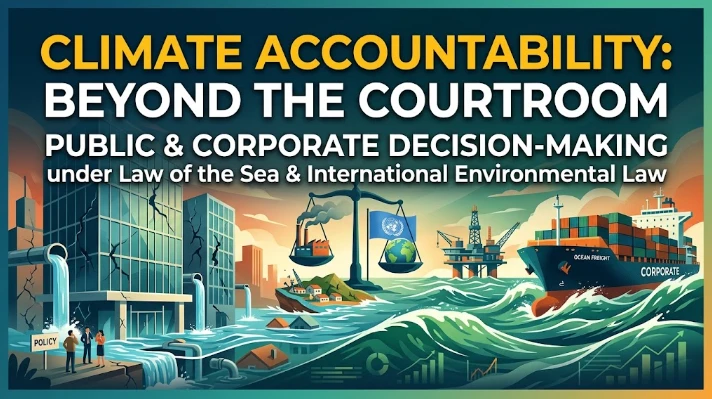
Climate accountability increasingly operates through routine public and corporate decisions rather than exclusively through litigation. This article examines how international environmental law and the law of the sea influence government budgets, permits, procurement, port operations, insurance, energy planning, investment, and corporate governance. The 2024 advisory opinion of the International Tribunal for the Law of the Sea recognized anthropogenic greenhouse-gas emissions as pollution of the
This article examines how biometric border systems can create unequal experiences of citizenship and migration control in the United States. It describes facial recognition, fingerprinting, iris scanning, and interconnected identity databases as technologies that may improve verification and reduce fraud while also expanding surveillance and distributing errors unevenly. The article mentions false matches, failed identification, secondary inspection, questioning, detention, and weak appeal proce