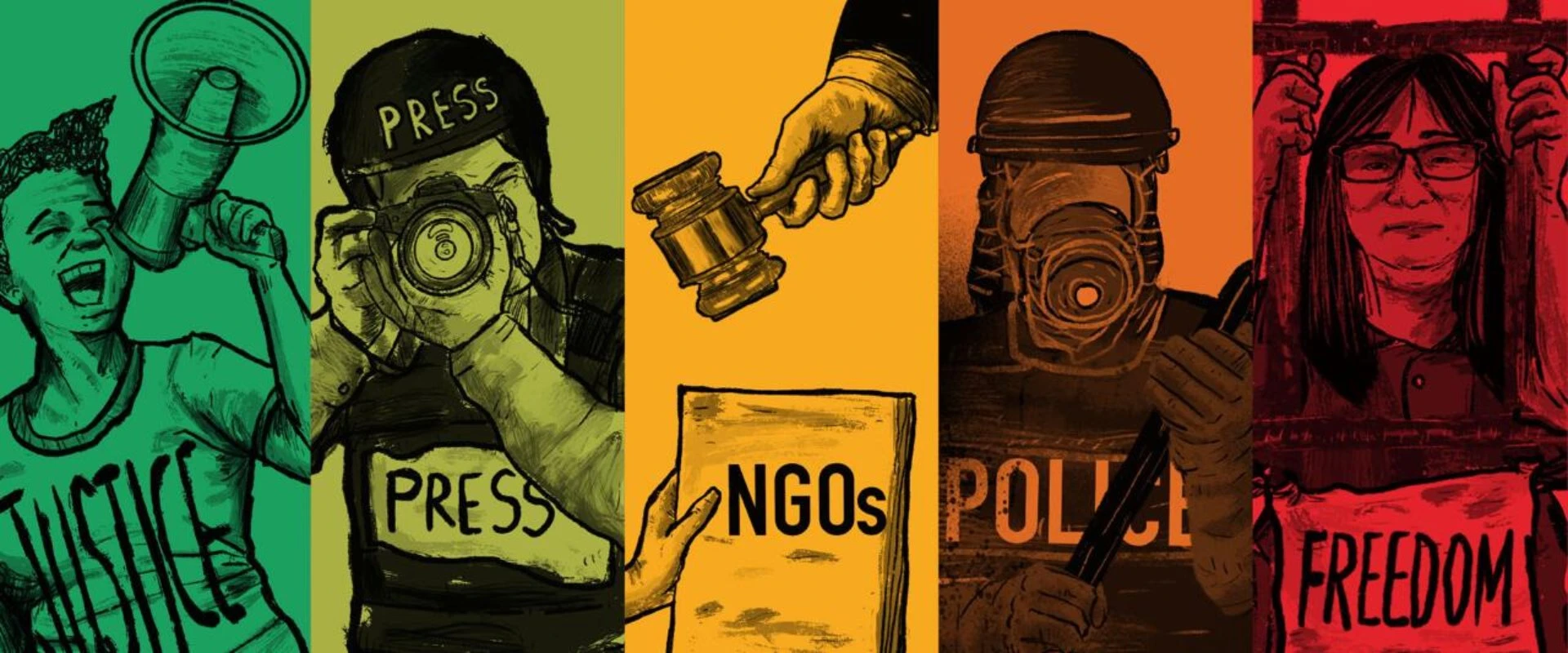
This article presents a framework for protecting human-rights organizations while maintaining accountable and effective security institutions. It describes how advocacy groups may face surveillance, legal harassment, financial pressure, digital attacks, administrative restrictions, and physical threats while documenting abuse, supporting victims, litigating, and communicating publicly. The article mentions that rights-protective security requires clear authority, documented decisions, independent oversight, accessible complaints, and consequences for command-level and frontline misconduct. Human-rights organizations also carry responsibilities concerning evidence verification, informed consent, data protection, staff safety, conflicts of interest, and correction of public errors. The analysis emphasizes financial independence, diversified funding, digital security, source protection, transparent methodology, and advocacy linked to specific institutional decision points. It concludes that democratic security treats lawful advocacy as essential infrastructure rather than a tolerated exception. Credible advocacy and legitimate security depend on the same institutional principles: reliable evidence, independent review, accountability for misuse, transparency, and protection against selective political control.
Human-rights groups often seek to hold the security bodies to account and are subject to surveillance, legal harassment, and financial pressure, and even physical threats. Public safety and independent advocacy will need to be protected by rights-protective security design in June 2025. Without accountability, impunity cannot provide for efficient security, as irresponsible coercion undermines trust, the quality of intelligence and integrity of institutions. Meanwhile, civil society's credibility relies on data that is backed by strong evidence, open methodology and sensitivity to the issues they wish to communicate to policymakers. The best design of architecture considers lawful advocacy as democratic infrastructure, not as an exception and tolerated abuse.
Security and rights are claimed to be contradictory values, but an impunity can affect the effectiveness of the operational processes. Unreviewable power leads to a reduction in public cooperation, to strained intelligence, to flattering of bad workmanship and to escalation. Rights-protective institutions have clear responsibilities, documented authorizations, independent oversight, easy complaints procedures and consequences extend to command level decisions as well as the misconduct of frontline staff. This helps to safeguard staff against unclear and biased instructions. Professional standards are achieved by having mechanisms of promotion, budget, training, procurement, and punishment that promote accuracy (versus being "seen to be forceful") and the validity of the law over volume of arrest.
Human-rights organizations are in a delicate balance between documenting, advocating, service delivery, litigation and communicating in the public sphere. Research and monitoring in communities can result in illumination, whereas relying on grants, partnering or formal authorization can lead to vulnerability. Security measures must safeguard freedom of legitimate expression on the other hand without transforming the civil society into an intelligence body or managed arm of State. Registration controls must be viewpoint neutral and so do financial reporting, controls on foreign funding, regulations on protest, and digital surveillance. Independent organizations should also have procedures in place to prevent errors in the verification of evidence; to ensure informed consent; to protect data; to keep staff safe; for conflicts of interest; and to correct public errors.
Institutional power and advocacy work is only as powerful as the connection between the documentation of the problem and the point that can be targeted for a decision. The generic criticism can influence the focus of attention; lasting reforms are typically less readily achieved without a specific requirement being targeted at a person or persons who have the legal or budgetary power to create a change. These are the paths of litigation, legislative testimony, for example, IG referrals, shareholder pressure, professional discipline and public procurement rules. Fragmentation is important as fragmented campaigns can facilitate “missing” responsibility.
The use of transparent methods, a careful use of the language of uncertainty and the admission of mistakes are also important aspects of credibility. When advocacy is robust, steering evidence into becoming an accountability chain can be the difference between evidence being a fleeting media moment and being absorbed into the system.
There are feedbacks between repression and resistance. Authorities see which tactics don't work to stop people mobilizing, court cases show which legal theories don't in legal terms, organizations find out which coalitions are successful in gaining supporters and donors update their assessments of risk. Learning has the potential to build up rights if wrongdoing results in improved policy, training, documentation and oversight. Restrictions or surveillance can be legally more "savvy" or more targeted; either of these factors can make the coercion more effective.
Using sequence analysis can be a more suitable way of analysis than using event counts alone. Changes in policy, legal findings, allocation of resources, absenteeism of employees, strategies of protest, and decisions on discipline can all indicate a movement towards or to the contrary of more effective regulation within the institutions themselves, or toward a greater efficiency in controlling those institutions.
Civil-society learning entails coalition building, tactical learning and intentional discipline, local leadership, legal resources, and communication in the face of uncertainty. This expansion of legitimacy can come at the cost of broad alliances, while as coalition increases there is a growing conflict among coalition members about the objectives and acceptable levels of risk. While usually it is nonviolent discipline that ensures participation and nonviolent discipline also lays bare the disproportional coercion, disciplined action needs preparation and is not purely a moral argument. Evidence of deployments is recorded and all aspects are checked with legal personnel and verified, there is secure communication, welfare assistance in place and a well-defined escalation system to minimize avoidable harm to legal observers.
There's a need for reviews at the end of every campaign at the organizational level as well. Within the internal learning should be asked: Which communities were the most vulnerable? What was the validity of public claims? What was the institutional access to do that tactical success did not have a permanent impact?
Fundamental rights are resilient when protection persists in uncertain, fear-filled and politically-asymmetric contexts. The most difficult scenarios are related to the involvement of unpopular groups, controversial speech, migrants, prisoners, protesters and communities perceived as being a security threat. Equal protection in periods of calm provides some limited knowledge on constitutional strength. Resilience is evident when institutions 'under pressure' maintain the need to provide individual assessment, due process, legal representation, review, and justification.
Distributional analysis continues to be vital as a formally neutral rule could have a concentrated and geographical effect through such a policy, for example as in the case of disability, language, income, immigration status and unequal access to digital systems. Therefore, it is necessary that problems of rights protection be dealt with not only on a doctrinal level but also from an empirical perspective regarding the implementation of rights.
There are institutional constraints which operate via independence, capacity, transparency and coordination. An independent court that has only nominal jurisdiction and access, no remedy of which is enforceable, provides scant protection. No security of tenure for the civil service means there can be loyalty tests. The election administrator must have resources, physical security, legal clarity and the public will trust the administrator.
Freedom of media in order to access information and free from any retaliatory investigation. Constraints are ingrained the more they are recognized, uncovered, postponed and corrected by many institutions. Redundancy also increases the safety margin against any type of malfunction or capture of one body rendering the entire accountability system inoperable.
Evaluate the difference between commitment, capacity, behavior and outcome in measurement. Commitments in treaty ratification and capacity in budgets and staffing. Behavior is seen in administrative decisions patterns and outcomes are seen in safety, access, equality and remedy. Mixed together, all four categories provide for some less false optimism.
Improvement in documentation can happen with abuse ongoing or an improvement in an outcome with an "unrelated" even in the economic sphere. Mechanisms are identified through longitudinal data and matched comparisons, through case tracking and with affected populations. Data quality is also an issue since official records of violations may underestimate violations; civil society records may focus on "visible" violations and legal records may not include violation of informal settlements or intimidation.
Whether or not human-rights groups can fight strong institutions on an ongoing basis depends on their being financially independent. A sudden and dramatic vulnerability can result from highly focused donor pressure, and use of “transparency” or “causing no national harm” restrictions might apply to certain funds while not to others. Resilient organizations do many things including diversify revenue, keep reserves, publicize and demystify conflicts, and buffer decisions around programs from donor pressures. Public regulation should focus on combating fraud based on certain objective, proportional and above all viewpoint-neutral standards.
The transparency of funding can help build trust, whilst disclosure is important, rules on disclosure should not concern about vulnerable staff, partner or beneficiaries. Combining both financial accountability and freedom of advocacy is an additional way of protecting institutional autonomy and, in this way is the most effective.
Digital security is the responsibility of organization. Information is at risk following theft and unauthorized sharing of case files, sources, locations, legal strategy and staff communications. Protection needs to include data minimization, encryption, role-based access, secure deletion, breach response, and training which needs to contextually apply to actual processes. But technology alone isn't enough; phishing, formal messaging, device seizure and informal messaging can all elude formal controls.
Also, it is important that security policy maintain usability; otherwise, workarounds may occur that are unsafe. A credible organization stores info without impeding the affected community’s acquisition of knowledge about and control over the use of evidence.
It should not be sufficient for human-rights groups to only be protected from torture, murder and overt threats. There are many ways for advocacy to be disabled without a formal prohibition, such as closing bank accounts, losing insurance benefits, having platforms suspended, being denied a visa, facing targeted audits, and names of confidential sources being exposed. Oversight systems must be susceptible to indirect pressure and to see if equivalent measurements are used throughout various political somebodies. There should be quick remedies as delay corrects nothing and there are no protests left that can be carried over.
As well, organizations have responsibilities to communities with regard to evidence providing. Consent should be determined in relation to the potential purposes, security risks and inclusions for publishing. Access controls, retention policies and breach plans must be in place for sensitive files. Public campaigns ought to distinguish between actual fact and allegations and inferences. This disciplining contributes to safeguard the most vulnerable and gives credibility to advocacy in hot political conflicts.
Clear authority, reliable evidence, independent review and consequences for misuse are institutional virtues shared by rights-protective security, and by credible advocacy. Clear authority, reliable evidence, independent review and consequences for misuse are necessary features of rights-protective security as well as credible advocacy. Ensure human-rights organizations are not subjected to selective control to document, organize, litigate and criticize. There is the freedom, and internal rigor enhances that. Democratic security can only be established by public institutions when they can provide security against real security challenges and also ensure that legislation does not deprive citizens of the right to openly voice their opposition. Trustworthy advocacy is supported by staff security and source protection policies.
CITE THIS ARTICLE
Amin, M. R. (2025). Security Without Impunity: Designing Rights-Protective Institutions for Human Rights Organizations and Advocacy. https://www.ruhulresearchhub.com/article/c7b73d97-39b2-58e3-9cee-dc8b853abdb0
M. R. Amin, “Security Without Impunity: Designing Rights-Protective Institutions for Human Rights Organizations and Advocacy,” 2025. [Online]. Available: https://www.ruhulresearchhub.com/article/c7b73d97-39b2-58e3-9cee-dc8b853abdb0
Amin, M. R. (2025) ‘Security Without Impunity: Designing Rights-Protective Institutions for Human Rights Organizations and Advocacy’. Available at: https://www.ruhulresearchhub.com/article/c7b73d97-39b2-58e3-9cee-dc8b853abdb0
Amin, Mohd. Ruhul. “Security Without Impunity: Designing Rights-Protective Institutions for Human Rights Organizations and Advocacy.” 2025, https://www.ruhulresearchhub.com/article/c7b73d97-39b2-58e3-9cee-dc8b853abdb0.
Mohd. Ruhul Amin. “Security Without Impunity: Designing Rights-Protective Institutions for Human Rights Organizations and Advocacy.” (2025). https://www.ruhulresearchhub.com/article/c7b73d97-39b2-58e3-9cee-dc8b853abdb0.
Amin MR. Security Without Impunity: Designing Rights-Protective Institutions for Human Rights Organizations and Advocacy. 2025. https://www.ruhulresearchhub.com/article/c7b73d97-39b2-58e3-9cee-dc8b853abdb0
@misc{article_c7b73d9739b258e39ceedc8b853abdb0,
  title = {Security Without Impunity: Designing Rights-Protective Institutions for Human Rights Organizations and Advocacy},
  author = {Mohd. Ruhul Amin},
  year = {2025},
  url = {https://www.ruhulresearchhub.com/article/c7b73d97-39b2-58e3-9cee-dc8b853abdb0},
}
TY  - GEN
AU  - Mohd. Ruhul Amin
TI  - Security Without Impunity: Designing Rights-Protective Institutions for Human Rights Organizations and Advocacy
PY  - 2025-06-18
UR  - https://www.ruhulresearchhub.com/article/c7b73d97-39b2-58e3-9cee-dc8b853abdb0
ER  -
This article presents democratic recovery after executive overreach as a process of reopening institutions rather than merely restoring formal legal boundaries. It describes how executive misconduct can leave politicized appointments, weakened oversight, restricted records, altered enforcement practices, intimidated officials, and concentrated agenda control. The article mentions open-democracy theory as requiring continuous accessibility, deliberation, transparency, inclusion, and responsivenes
Climate accountability increasingly operates through routine public and corporate decisions rather than exclusively through litigation. This article examines how international environmental law and the law of the sea influence government budgets, permits, procurement, port operations, insurance, energy planning, investment, and corporate governance. The 2024 advisory opinion of the International Tribunal for the Law of the Sea recognized anthropogenic greenhouse-gas emissions as pollution of the
This article examines how biometric border systems can create unequal experiences of citizenship and migration control in the United States. It describes facial recognition, fingerprinting, iris scanning, and interconnected identity databases as technologies that may improve verification and reduce fraud while also expanding surveillance and distributing errors unevenly. The article mentions false matches, failed identification, secondary inspection, questioning, detention, and weak appeal proce