This article examines how international human-rights compliance may generate extensive institutional activity without producing substantive changes in power, behaviour, or access to remedies. It describes multilevel implementation as a sequence in which international institutions interpret standards, national governments adopt laws, agencies develop procedures, local authorities deliver services, and courts review disputes. Failure can occur at any stage. The article mentions reports, training programmes, declarations, coordinating offices, and formal guarantees as possible indicators of procedural compliance that may not reflect genuine institutional conviction. A credible evaluation should distinguish commitment, capacity, behaviour, and outcome. It should also assess budgets, staffing, administrative decisions, enforcement patterns, safety, equality, access, and remedies. The analysis emphasizes implementation mapping, domestic political incentives, civil-society mobilization, and the ability of affected communities to challenge failures. It concludes that durable compliance is demonstrated when rights standards survive leadership changes, constrain powerful actors, support corrective action, and become normal expectations within ordinary institutions.
International law can produce much impressive paper in the absence of any alteration of the functioning of power. The aforementioned gap is a key issue in human-rights governance in all international institutions, federal government, States, courts, agencies and local levels during the fifth month of 2025. The phrase “University of California, San Diego” in the title suggests a research-inspired tradition, not a take-it-for-granted one, in testing for effectiveness. Incentives, administrative processes and entitlements to relief change only if commitments have a genuine impact on compliance. Membership and isolation are therefore not the main reason for the difference, but (procedural) performance of the institution and a lasting belief in it.
There is no "sovereign" decision, but rather a succession of transpositions of human-rights compliance throughout the sequence of institutions. International bodies interpret standards while national, local and judicial bodies interpret obligations that are translated into laws; national and local bodies make procedures and daily choices as they affect the rights. At every level, you can increase the security, or make a roadblock. Systems of formal acceptance will therefore be used only to provide a beginning.
A believable evaluation poses the questions: Where does an obligation inspire action? Where does an obligation hit a dead end? Where is there a legitimate source in authority to house the failure of implementation? Multilevel governance also affords strategic possibilities to pass the buck, as each layer of government can look to its neighbors when remedies are not forthcoming, underfunded or even available.
Compliance, but without conviction can be seen in the generation of reports, trainings, declarations of intent and guarantees of state operation from states while safeguarding existing incentives. Procedural density can appear to be wonderful even though affected groups don't change much. In times of political discomfort, true internalization becomes apparent, particularly if the implementation costs burden high-ranking institutions or institutions popular among special interest groups, or if they involve high-ranking commercial institutions. Stable support, independent evaluation, clear motivations, and easy corrective action give much more proof of commitment than does pompous announcement. The notion of conviction does not rule out a lack of unanimous moral consensus, but it does impose a requirement on institutions: they must also consider the standards on rights to be normal restrictions instead of being something external that they can use when talking to outsiders.
Emilie Hafner-Burton's research work has time and again contradicted the (prevailing) belief that the adhesion to treaties leads automatically, and invariably, to better human-rights practices. Usually, literature that addresses international regimes and trade agreements will turn to the four mechanisms: incentives, enforcement, domestic institutions and social mobilization. A practical question for multilevel governance from this point of view leads to what shifts the costs and benefits of abuse and compliance. Yes, the monitoring can be important, but there is a divergence on what sort of pressure a particular government can have on its reputation. International standards become more effective when there are links between international and domestic standards that are reinforced by processes such as domestic court cases, organized constituencies or professional networks, also by market-related access or administrative procedures.
An implementation map should be based on an obligation in international text through to national legislation, agency guidance, frontline decision, complaint, review and remedy. Fractures have a tendency to happen in seemingly trivial locations. A form may not include a protected category, a database may prevent the ability to correct it, a contractor may have an outside the-normal-disclosure rule or an appeal deadline may pass before an affected person sees it. These details are associated with the usage of law.
Administrative design thus is a part of human-rights analysis. This assigns responsibility for what happens, ensures a system of information that is compatible, trains staff, assigns duties with reasons, and provides a platform for grievances to occur separately.
There needs to be a distinction between commitment, capacity, behavior and outcome in measurement. Budget and staffing provide information about capacity and ratification of a treaty provides information about commitment. Behavioral patterns are evidenced through administrative decisions and enforcement patterns, and outcomes are evidenced through patterns of safety, access, equality and remedy. Simply, aggregating all four categories gives a more accurate perspective and avoids "false optimism.
A country may gain from better documentation within the ongoing of abuse or it may incur a gain on one or more of the outcomes as a result of another kind of economic gain. Mechanisms can be identified from the following types of evidence: longitudinal evidence, matched comparisons, case tracing and interviews of affected communities. Data quality is also important because official reports of violations are incomplete, civil society knowledges are focused on the visible cases, and legal databases miss cases on informal settlements or intimidation.
Risking turning effective when there is institutional action to the advocacy, a campaign is one that represents a documented harm and has a decision point. Attention can come in the form of a general condemnation, and enduring reforms tend to result from a specific demand to an actor, with the authority to act legally and budgetarily. There are various avenues, including litigation, giving testimony before the legislature, referring a matter to the inspector-general, shareholder pressure, professional discipline, and rules covering public procurement. Coordination is important, as otherwise the campaigns can become ‘gone rogue’ where responsibility for their outcomes can disappear.
Transparency of methods, the use of appropriate uncertainty language as well as the acknowledgment of wrongdoings are further factors for credibility. It is through strong advocacy that evidence becomes more than a buzzword and has a more lasting impact than even a media cycle.
Independent, capacity, transparency and coordination are the channels for the influence of institutional constraints. A “separate” judge who does not have timely access to or enforceable remedies provides limited protection. Society will be subject to loyalty tests with an insecure civil service. Resources, physical security, legal certainty and confidence in their work are essential for election administrators.
Media freedom goes hand-in-hand with access to information and freedom from intimidatory investigation. Perceptions of constraints are further strengthened by multiple institutions that have the capacity to detect abuse, expose it, put it on hold and correct it. Redundancy can also help to decrease the risk of a single body failure impacting the overall accountability system.
Fundamental rights are the top of the line when protection prevails amid uncertainty, fear and political imbalance. These difficult cases, however, are communities defined as security threats, protests, prisoners, migrants and unpopular communities. Usually, equal protection in times of peace offers some insights into constitutional strength. During stress, resilience is manifested as a capacity for due process, individualized assessment, legal counsel, review and reasons.
Even if the impact of a rule is formally neutral, distributional analysis will still be crucial as impacts will be concentrated along distributional lines related to geography, disability, language, income and immigration status, and unequal access to digital systems. Protecting rights thus needs to take place both doctrinally and empirically regarding implementation.
International rules can also have an influence on behaviors, through changing domestic political opportunities. A treaty can provide vocabulary and standards of evidence, and provide external validation, for litigators, journalists, union organizers, professional organizations, and community groups. Once mobilized, the claim moves from the distant and more abstract realm to the local realm and into the hands of a court, agency, legislature or employer. Access and protection is a determinant of effectiveness since if they are not granted, it can tip the balance against the programmatic pathway. Research should thus address whether, beyond mere mention of the law in international instruments, it provides any greater scope or opportunities for organizing, information gathering, and for recourse.
A research design centered on UC San Diego can be used to make comparisons between the pressures associated with a treaty and policy areas of government. Variability in federal reporting, state laws, case law, policy and procedure of agencies, and local outcomes all can be represented in their own distinct scores, instead of being rolled up into a single national measure for compliance. Why then similar obligations generate different routines can then be identified at the level of the communities impacted and regulators and advocates by interview. This type of design is desirable to prevent the domestic implementation to be treated as a black box and ensure causal claims can be made in terms of enforcement, mobilization, or institutional capacity.
When compliance is expensive, the most telling situations are involved. Protection is credible when agencies make public that they have failed, or review the procurement process, or provide monetary and yes, financial, support for independent oversight, or offer solutions that limit discretion. Durability of windows is often shaped by domestic constellations; external tensions can open a window. Norms can be translated into locally meaningful standards by service providers, unions, journalists, unions and litigators who are professionals. The international institutions ought thus to be located within an accountability system and not as alternatives to domestic political accountability.
Compliance with international law is strengthened over time by its repeated good use, rather than simply by belonging to everybody. The last test is within ordinary institutions institutions to which those affected have access, where the reasons are apparent, and where officials know that the institutions are subject to review. Although multilevel governance can lead to a diffusion of responsibilities, through careful implementation, mapping can be undertaken to identify critical point of failure and the actor that can correct it. Compliance by conviction I guess it transcends: change of leadership, budget cuts, and politics.
Weaker arguments run the risk of merely getting human rights rhetoric right, and leaving prevailing power more or less intact. Administrative reason-giving provides a Documentation for Courts, Auditors, Legislators and Communities of Concern. The notion of continuity in budgets often gives a starker view of institutional certitude than does diplomatic language. Patterns should be disclosed by independent complaint systems without revealing information about the complainant that is sensitive.
Implementation in true when failure leads to correct. Administrative reason-giving provides a Documentation for Courts, Auditors, Legislators and Communities of Concern.
CITE THIS ARTICLE
Amin, M. R. (2025). Compliance Without Conviction? Governing International Law and Human Rights Across Multilevel Institutions. https://www.ruhulresearchhub.com/article/ccc611bb-c2e7-51e3-ab5a-7750c4accfa7
M. R. Amin, “Compliance Without Conviction? Governing International Law and Human Rights Across Multilevel Institutions,” 2025. [Online]. Available: https://www.ruhulresearchhub.com/article/ccc611bb-c2e7-51e3-ab5a-7750c4accfa7
Amin, M. R. (2025) ‘Compliance Without Conviction? Governing International Law and Human Rights Across Multilevel Institutions’. Available at: https://www.ruhulresearchhub.com/article/ccc611bb-c2e7-51e3-ab5a-7750c4accfa7
Amin, Mohd. Ruhul. “Compliance Without Conviction? Governing International Law and Human Rights Across Multilevel Institutions.” 2025, https://www.ruhulresearchhub.com/article/ccc611bb-c2e7-51e3-ab5a-7750c4accfa7.
Mohd. Ruhul Amin. “Compliance Without Conviction? Governing International Law and Human Rights Across Multilevel Institutions.” (2025). https://www.ruhulresearchhub.com/article/ccc611bb-c2e7-51e3-ab5a-7750c4accfa7.
Amin MR. Compliance Without Conviction? Governing International Law and Human Rights Across Multilevel Institutions. 2025. https://www.ruhulresearchhub.com/article/ccc611bb-c2e7-51e3-ab5a-7750c4accfa7
@misc{article_ccc611bbc2e751e3ab5a7750c4accfa7,
  title = {Compliance Without Conviction? Governing International Law and Human Rights Across Multilevel Institutions},
  author = {Mohd. Ruhul Amin},
  year = {2025},
  url = {https://www.ruhulresearchhub.com/article/ccc611bb-c2e7-51e3-ab5a-7750c4accfa7},
}
TY  - GEN
AU  - Mohd. Ruhul Amin
TI  - Compliance Without Conviction? Governing International Law and Human Rights Across Multilevel Institutions
PY  - 2025-05-17
UR  - https://www.ruhulresearchhub.com/article/ccc611bb-c2e7-51e3-ab5a-7750c4accfa7
ER  -
This article presents democratic recovery after executive overreach as a process of reopening institutions rather than merely restoring formal legal boundaries. It describes how executive misconduct can leave politicized appointments, weakened oversight, restricted records, altered enforcement practices, intimidated officials, and concentrated agenda control. The article mentions open-democracy theory as requiring continuous accessibility, deliberation, transparency, inclusion, and responsivenes
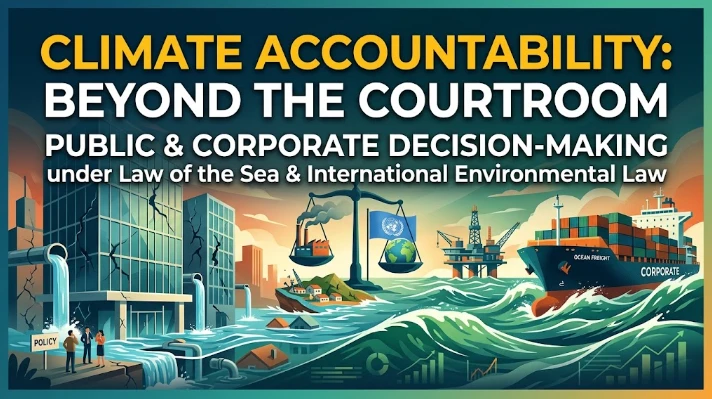
Climate accountability increasingly operates through routine public and corporate decisions rather than exclusively through litigation. This article examines how international environmental law and the law of the sea influence government budgets, permits, procurement, port operations, insurance, energy planning, investment, and corporate governance. The 2024 advisory opinion of the International Tribunal for the Law of the Sea recognized anthropogenic greenhouse-gas emissions as pollution of the
This article examines how biometric border systems can create unequal experiences of citizenship and migration control in the United States. It describes facial recognition, fingerprinting, iris scanning, and interconnected identity databases as technologies that may improve verification and reduce fraud while also expanding surveillance and distributing errors unevenly. The article mentions false matches, failed identification, secondary inspection, questioning, detention, and weak appeal proce