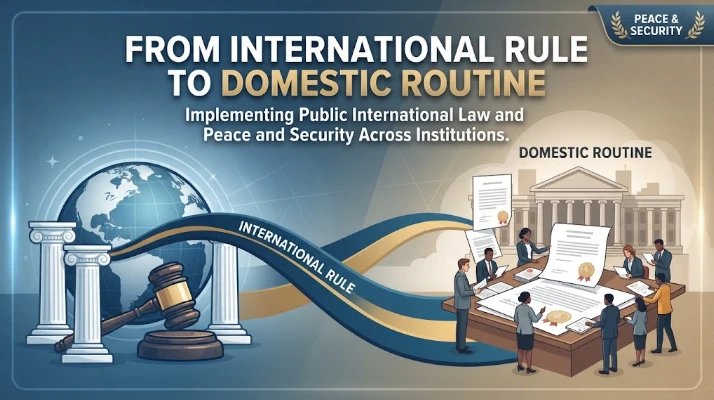
The article explains how international peace and security obligations must be translated from diplomatic commitments into ordinary domestic routines. It proposes mapping each obligation to legal authority, responsible agencies, implementation methods, information sources, training needs, monitoring bodies, and remedies. Legislation, administrative manuals, scenario-based training, humanitarian-law committees, procurement rules, secure data systems, judicial remedies, parliamentary scrutiny, local implementation, and civil-society feedback are presented as core parts of this chain. The article repeatedly emphasizes recordkeeping, named responsibility, escalation routes, version control, compliance calendars, exercises, professional ethics, protected reporting, affected-community participation, and periodic review of outdated security laws. It also calls for surge capacity and continuity when leadership changes. The central argument is that compliance becomes reliable when it is embedded in routine administration rather than dependent on exceptional leadership. International rules matter in practice only when institutions have clear authority, resources, professional judgment, documentation, oversight, learning processes, and accessible correction mechanisms.
International norms must be made the normal way of working for institutions to take effect. Even with a treaty clause, or a decision by the Security Council, it takes legislation, budget, training, databases. . . professional judgment, and review to provide a legal structure for front-line implementation. A gap that is all too familiar in public international law as it concerns peace and security is the one between the obligations states enter into at the diplomatic level, and a domestic system that is poorly, or inadequately, resourced, is afflicted by fragmentation or is uncertain of responsibility.
There's a framework in the UN Charter to address sovereign equality, good faith performance, peaceful settlement and force. Domestic officials seldom act on those questions, quite apart from their liability, as abstract questions. Foreign ministries define mandates, defence ministries draw up plans for operations, legislatures approve budget amounts, courts evaluate actions taken, police police on local level is responsible for implementation of sanctions, and customs agencies monitor transfers. Implementation is a cross–body challenge due to different bodies having different mandates and cultures.
One way to make a rule-to-routine map is to create a flow chart to help understand the chain. Each obligation needs to specify the legal source of authority, the agency having responsibility, the manner in which it will be realized, the information source, training needs, the body that will monitor the process of fulfillment and the remedy in case of non-fulfilled obligations. This type of mapping reveals areas of need in a precrisis situation. For instance, licensing, customs, intelligence and banking systems may not be sharing information or have a similar risk definition and analysis system, thus failing to provide a duty to prevent prohibited transfers.
Legislation is the source of authority – legal text needs to be exact. Broader power provisions can result in 'chilling effects' and disruptive application. Need clarity of definitions, thresholds, procedural safeguards and reporting requirements. A principle of delegated regulation with a political oversight by Parliament should still apply. During emergency situations, emergency provisions should not be in force unless they are renewed in a transparent assessment process.
Administrative rules are derived from the law in the form of administrative manuals. Military officials require them to have rules of engagement and targeting procedures. There is a need for advice on controlled goods to border officers. There is a need for sanctions instructions by banks.
Prosecutors require guidelines as to what is permitted as evidence. Manuals should be revised following changes of the law, piloted with exercises and evaluated independently. Secret guidance must be subject to special oversight since there can be basic rules that come from secret guidance which can shape fundamental rights.
Judgment should be emphasized in training for the accompaniment on not memorization. Ambiguous cases, competing obligations, escalation and reporting can all be included in scenario-based exercises. When senior leadership is involved, it indicates that the institution is interested in providing a service. Training records are an insufficient index, it must be based on decisions under pressure. Repeat learning from the incidents should be incorporated back into curricula.
One approach towards international humanitarian law coordination is through national committees. These bodies might be able to get ministries, armed forces, legal professionals and humanitarian agencies together to go over legislation and policies. For effectiveness to be achieved it is essential that the mandate is there, that there is regular meeting, technical staff and access to decision makers. Committees which do not have the money or the follow through can turn into show committees.
Another implement that can be used in procurement is the instrument of implementation. The contracts related to weapons and surveillance, logistics, detention, cyber security and transport should contain legal standards, audit powers, data security and clauses for termination to get bound. Contractors doing a public-security job should continue to be held accountable. There should never be an "outsourcing free zone".
Data systems can help to achieve compliance but can also pose risks. There is a need for accuracy and appropriate access controls, accuracy correction and limits of holding for sanctions lists, travel controls, intelligence databases and biometric tools. The automated matching can yield false positives which can have dire repercussions. Human oversight and appeal is still very important. There is no excuse and justification for the indefinite retention of, or designation without review, the characteristics of security.
Everyday is routine and accountability is provided via judicial and administrative remedies. Affected persons must be provided with opportunities to contest detention, designation, freezing of assets, monitoring and denial of access to services. Courts must have ample evidence available, and some detailed routines are available to control the handling of sensitive information. Ombuds bodies and inspectors are able to tackle systemic issues; they can respond to cases and have systemic options.
Parliamentary oversight is to be thorough and check legality and performance. Committees can see implementation reports and classified briefing, civilian-harms assessment, sanctions outcomes, procurement. Greater the number of opponents that participate, greater the credibility. Oversight bodies require personnel who are legally and technically informed and also have a good grasp of regional issues. The provision of information without any analytical ability leads to formal scrutiny and not effective control.
There are hidden responsibilities of local institutions. The national security measures are being carried out by Police, local Councils, port authorities and service providers. Local context and rights should be taken into consideration with guidance. Central agencies require lines of feedback to allow operational issues to be made apparent. But unfunded mandates or vague directions can result in disparities in enforcing the policies.
Civil society participation in evidence and early warning. Humanitarian organizations articulate constraints to humanitarian assistance; journalists shed light on cases of problems; professional associations craft standards; and affected communities demonstrate real-life effects. Consultation – maintain independence and confidentiality. The ability for outside parties to criticise the government should be respected and governments should not think of criticism as disloyalty; because it is often the case that one should anticipate that criticism from an outside party would be able to detect a failing in the state before the actual official systems did.
Along with new commitments, implementation support should be provided in the context of international cooperation. Capacity can be developed through model laws, peer exchange, technical assistance and exercises. Any assistance must be aligned with the domestic legal system and will not establish parallel systems which fall apart at the end of the funding period. Local ownership equates to local responsibility and resources in local permanent institutions.
Domestic custom is the ultimate and final word on international law. Rules are important when an official with "fire in the belly" can recognize legitimate authority, to have a means of secure advice, to have an opportunity to record reasons, to solicit advice and to know it will be looked at. The most effective implementation is achieved when compliance is a part of the normal system than relying on remarkable leadership. In between the international "rule" and the domestic "routine" lie the "administration" and administration is legitimized only by transparency, capacity and remedy.
Responsibility for operations should be clearly indicated on the organisation's charts and on its website. Staff should be aware who to refer to in the office and the affected members should be given a liaison. Spread responsibility, delays and variable interpretation of the rules. Named senior ownership allows for escalation and follow up.
Compliance includes Recordkeeping. Preserved reasons and evidence necessary for decisions of force, detention, sanctions, transfers and surveillance. Records facilitate courts, audits and historical accountability and institutional learning. Any destruction, informal direction or messaging, or undocumented oral direction, may effect the ability to lawfully review.
Multiple agencies and stress factors should be included in exercises. During a table top, incompatible definitions, missing data and unclear command can be identified. Scrutineers who are appointed by accountability check bodies also have testing power. Post-deployment debriefs should distinguish between operationally-sensitive material and material appropriate for publication.
good habits become good rules when they obtain the sanction of professional ethics. Duties that support Lawful Refusal and Escalation exist within the professions of lawyers, soldiers, police, analysts and civil servants. Codes must be implemented in a practical manner that offers protection from reprisal actions. An improper or formal responsibility, without secure reporting can leave individual officials in impossible situations.
There needs to be involvement of victims or affected communities in implementing. Complaint information, civilian-harm reports and humanitarian feedback offers information outside what a command system can offer. Retaliation should not be a risk to complainants as a result of engagement. The confidentiality can be maintained if independent intermediaries are utilized.
Security law duly reviewed on a regular basis to prevent the piling up of outdated law. Sunset clauses, statutory reports and post-legislative scrutiny allow for determination of what measure(s) are no longer needed. There should be evidence required for a renewal and not automatic renewal.
There is a need for a calendar for domestic implementation as well. Deadlines for report, updatings of treaties, cycles of trainings, renewal of permits, and legislative updates should be coordinated. The creation of a central compliance register can help identify outstanding actions and ownership and public summaries can help for a better accountability.
before deployment, testing of guidance should be done as part of the quality assurance. Different officials at various places and at various positions can pick out ambiguity, if any, that may not be picked up by the drafters at the centre. Evaluation by pilot use, legal counsel, and feedback by users increases clarity.
Surge capacity to be part of resource plan. Those who may be accidentally thrust into a role because of conflict or emergency sanctions or mass displacement can easily do the job and do it twice as fast. Response plans, mutual assistance, pre-planned procurement can help enable response without compromising safeguards.
Senior officials should be inducted renewing their international obligations. In cases where knowledge is still technical, and spread out, frequent changes of leadership stall implementation. Hidden handover books, briefings and board-level check management ensures continuity.
The auditor should check the implementation chains as the functioning of individual agencies. Failure may happen at the interface between the provision of law advice, sharing of information, procurement and on front lines. Those gaps are identified by cross-system audit in the process.
Version Control for public guidance is required. Officials actors should be aware of the rules in force and when it changed. There will be archived versions that retaining fairness in the case during investigation or appeal.
Some form of escalation should be possible for new cases in a routine fashion. Documentation without delay is needed, but with specialist guidance for frontline staff to not diverge from it.
CITE THIS ARTICLE
Amin, M. R. (2025). From International Rule to Domestic Routine: Implementing Public International Law and Peace and Security Across Institutions. https://www.ruhulresearchhub.com/article/01d56c53-ea9f-508c-98c9-1269534a4ffa
M. R. Amin, “From International Rule to Domestic Routine: Implementing Public International Law and Peace and Security Across Institutions,” 2025. [Online]. Available: https://www.ruhulresearchhub.com/article/01d56c53-ea9f-508c-98c9-1269534a4ffa
Amin, M. R. (2025) ‘From International Rule to Domestic Routine: Implementing Public International Law and Peace and Security Across Institutions’. Available at: https://www.ruhulresearchhub.com/article/01d56c53-ea9f-508c-98c9-1269534a4ffa
Amin, Mohd. Ruhul. “From International Rule to Domestic Routine: Implementing Public International Law and Peace and Security Across Institutions.” 2025, https://www.ruhulresearchhub.com/article/01d56c53-ea9f-508c-98c9-1269534a4ffa.
Mohd. Ruhul Amin. “From International Rule to Domestic Routine: Implementing Public International Law and Peace and Security Across Institutions.” (2025). https://www.ruhulresearchhub.com/article/01d56c53-ea9f-508c-98c9-1269534a4ffa.
Amin MR. From International Rule to Domestic Routine: Implementing Public International Law and Peace and Security Across Institutions. 2025. https://www.ruhulresearchhub.com/article/01d56c53-ea9f-508c-98c9-1269534a4ffa
@misc{article_01d56c53ea9f508c98c91269534a4ffa,
  title = {From International Rule to Domestic Routine: Implementing Public International Law and Peace and Security Across Institutions},
  author = {Mohd. Ruhul Amin},
  year = {2025},
  url = {https://www.ruhulresearchhub.com/article/01d56c53-ea9f-508c-98c9-1269534a4ffa},
}
TY  - GEN
AU  - Mohd. Ruhul Amin
TI  - From International Rule to Domestic Routine: Implementing Public International Law and Peace and Security Across Institutions
PY  - 2025-12-08
UR  - https://www.ruhulresearchhub.com/article/01d56c53-ea9f-508c-98c9-1269534a4ffa
ER  -
This article presents democratic recovery after executive overreach as a process of reopening institutions rather than merely restoring formal legal boundaries. It describes how executive misconduct can leave politicized appointments, weakened oversight, restricted records, altered enforcement practices, intimidated officials, and concentrated agenda control. The article mentions open-democracy theory as requiring continuous accessibility, deliberation, transparency, inclusion, and responsivenes
Climate accountability increasingly operates through routine public and corporate decisions rather than exclusively through litigation. This article examines how international environmental law and the law of the sea influence government budgets, permits, procurement, port operations, insurance, energy planning, investment, and corporate governance. The 2024 advisory opinion of the International Tribunal for the Law of the Sea recognized anthropogenic greenhouse-gas emissions as pollution of the
This article examines how biometric border systems can create unequal experiences of citizenship and migration control in the United States. It describes facial recognition, fingerprinting, iris scanning, and interconnected identity databases as technologies that may improve verification and reduce fraud while also expanding surveillance and distributing errors unevenly. The article mentions false matches, failed identification, secondary inspection, questioning, detention, and weak appeal proce