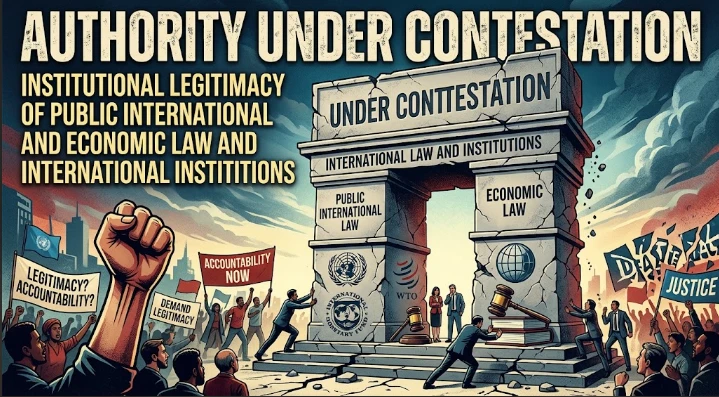
International institutions operate in an environment of incomplete consent, unequal power, and limited public trust. This article examines how such institutions establish and maintain legitimate authority when their decisions affect governments, businesses, communities, and individuals who may have little influence over negotiations. Legal mandates and state consent remain important, but they are insufficient when procedures are inaccessible, decisions appear selective, or affected groups cannot challenge institutional errors. Authority depends on procedural fairness, relevant expertise, transparency, consistency, participation, effectiveness, and credible correction mechanisms. Institutions may possess formal jurisdiction yet lose practical legitimacy through unexplained reasoning, unequal enforcement, weak performance, or disregard for distributional consequences. The article recommends publishing evidence and decision criteria, disclosing conflicts of interest, improving representation, providing accessible review processes, and documenting responses to criticism. Legitimate international authority does not require universal agreement with every outcome. It requires institutions to demonstrate that decisions were lawfully made, reasonably justified, fairly administered, and open to correction when evidence or circumstances change.
International institutions have power in part of an incomplete consent world, with unequal power and no presumption of public trust. The obligations are discussed in court; organizations establish standards; expert institutions check the conduct on the state level and economic structures impact domestic regulation. During the month of December, contention is about results and power itself! Questions raised by critics are: who was acting who got to be heard, whose interests were represented and how to correct errors. It is important an institution as a whole has credible responses, not demands for defers me.
Authority is rather than coercion. An institution is authoritative if its agents choose to take action based on decisions or guidance, even though they may have more immediate preferences for some other action. One basis is legal mandate; this is not enough. Much depends on the following elements Procedure and fairness Expertise Consistency Transparency and effectiveness. An institution may have formal jurisdiction, but have no actual authority due to selective application, unexplained reasoning, and a failure to produce results.
Many times, public international law is a product of state consent; manifested in treaties, membership and accepted procedures. While consent is important, modern institutions also have an impact on individuals and companies who, as such, have only limited influence on the negotiations of treaties. Thus, the domestic legitimacy becomes a component of international legitimacy. International decisions have immediate consequences through Ministries, Local Governments, Courts, Regulators and Civil Society as a consequence of the role parliaments play in this regard. There is a sense that weak domestic linkage results in a perception that the rules come from far away and don't go through accountable mediation.
The tension shows in the international economic law in particular. There are employment, prices, public services and regulatory space impacts from trade, investment, taxation, finance & sanctions. There can be underlying distributive decisions behind technical terminology. Smaller enterprises, workers, consumers and vulnerable areas are identified in an impact analysis to enhance the legitimacy of institutions. There needs to be more than an efficiency measure to determine the rules, allocating social risk.
The first step to procedural fairness is access. Inequality of resources to participate in negotiations, litigation and expert committees is a challenge for less-resourceful states. Reducing inequality can be done through translation, legal support, data facilitation and realistic time frame. Despite formal equality between delegations, huge disparities in staff, information and bargaining leverage exist. Capacity support ensures that the quality of decision making, but also fairness is safeguarded.
Scrutineers at representation are necessary as well as. The extent and nature of the delegation of authority to state representatives is variable and democratic or constitutional. Expert bodies create an output of knowledge, and can become socially limited.
Business groups and existing organizations can more easily access information, as they may be formalized and have already secured a place in the governance process. However, balanced interviews, conflict disclosures and releases of documents can show a rule's influence of the interests. Should take place prior to or before the options are finalized so that the design choice can be affected.
A sense of obligation, of justifying behaviour, is integral to the exercise of power. Explanations of decisions should include: Legal basis; Evidence; Alternatives; Uncertainties; Response to major objections. When reasons are clear, error can be spotted by critics and rules can be added by interior institutions of the country. Language that becomes too unnecessarily technical can prove to be a means of hedging expertise off politics, but its inaccessibility too could be a way of hiding value judgments. Summaries, data access and methodological transparency fortify accountability but do not equate with dumbing down the law into a slogan.
While consistence lends to legitimacy, it can be inflexible, and hence disregard context. There is a need for principled methods of distinguishing cases, within institutions. When criteria, precedent and departure are published, these will help prevent suspicions of political favoritism. Failing to enforce weaker acts, but ignoring responsible (and powerful) actors is similar to damage for although strong actors may escape punishment, it highlights weaker actors to have committed a crime. Proportionate support should be provided where there are different levels of capacity and equal standards should go hand in hand.
Effectiveness is important since an institution that is unable to alleviate issues under its mandate, loses power. But effectiveness is not just about do-ers versus the degree or rate of compliance! A hasty settlement without the participation of affected groups can be a cause of the loss of legitimacy. When a rule is hard, but causes extreme unwanted consequences, it can deter cooperation. Balanced evaluation takes into account: Problem solving, rights, distribution and institutional learning.
Contestation can be a source of strengthening institutions where a mechanism is put in place to review. Appeals, reconsideration, dissenting opinions, parliamentary scrutiny, peer review, and independent evaluation, transform disagreement into structured correction. Signs of repression of criticism can lead to increased distrust. A valid institution welcomes challenge and knows the difference between challenge with good intention, and the doomed challenge designed to undermine its very existence.
A key critical mediating role for domestic courts. The interpretation of international obligations by the courts can be done using constitutional principles that can safeguard procedural rights and arbitrate the interplay between international and domestic laws. Too much justicization can raise questions as to whether freedom of choice is fulfilled. Transparent doctrine, legislative response and respect for the competence of the institutions, maintains balance. International law should not be viewed as necessarily prevailing in all scenarios, and international obligations as politically optional.
Chosen politicians too influence authority, via rhetoric. Sometimes, governments are happy after good decisions of international bodies and take on them after bad decisions. This legislatively laundered party legality imparts to citizens a sense that law is partisan tactics. Lawful procedures and the continuing participation can be maintained as a responsible leader can criticize decisions. But being loyal to an institution does not mean being silent; it means having at all times a consistent attitude of criticism.
The private governance issues further questions. Financial indices, corporate standards, audit schemes and digital platforms could have an impact on access to markets, without public-law protections. Transparency, competition, attraction and control of regulators becomes imperative. While private involvement in international governance is contractual, private authority should not escape accountability because of the contractual nature of the involvement.
Institutional reform, therefore, should be targeted towards mandate, inclusion, reasons, review, capacity and outcomes. There is no one unity which can give it legitimacy. A representative body does not necessarily have to be transparent.
An expert body is still capable of disregarding distribution. It is possible for an effective body to employ double standards. The legitimacy based upon a pattern of conduct, which makes the authority understood and contestable.
When authority is under contention it is not in a state of emergency and not to be resolved by messaging. Much like in plural domestic order, some contestation is an ever-presence of global international order. Public international and economic institutions are legitimate when disagreement can find its way in the processes, evidence can be put to the test, weaker parties are effectively given access and decisions are subject to multiple checks and balances, rules limit the power of the more powerful parties. Power is not developing if you feel removed from attacks but, when you are open with a certain discipline.
Another crucial element of institutional legitimacy is the ability to correct errors. Public bodies should communicate adapted versions of the interpretations and make compensation if appropriate and explain the reform of the procedures. Failing to admit whatever incorrect or erroneous can yield the immediate preservation of authority but wrecks credibility in the long run. Transparent correction points to the fact that the power in institutions is limited to Reason.
Advising must have multi-facet foundations. Different questions are addressed by the economic models, the legal analysis, and the scientific evidence and the local knowledge, and the lived experience. Just as the audience ought to have the chance to listen to both sides of a case, decision processes ought to reveal how contradictory evidence was taken into account. Disciplinary, regional and social diversity of expert panels are very helpful where there is a multi-disciplinary group reference to technical rules that have uneven effects.
Institutions are allowed to preclude points for deliberation; this is referred to as agenda control, which also needs to be considered. States and civil society must have channels to recommend review, request interpretation and put new harms on the agenda of competent bodies. The decision of whether or not to grant agenda access cannot rest fully on geopolitical influence thanks to clear rules defining the threshold.
Independent or not, financing can make a difference in the end. A few large contributors, very important institutions, state and local government entities, and other entities can be under real or perceived pressure. Surface floor funding, various funding, inspection, and conflict prevention mechanisms contribute towards autonomy. VEC should not shift mandates from priorities agreed to collectively and quietly to preferred activities that are randomly earmarked by contributors.Directed gifts, especially if not part of collective agreement, should not distract from priorities decided on collectively.
There need to be public comparisons between what institutions say, and what they do. The consistency, participation, implementation and distribution can be analyzed by independent researchers. Free access to Data is necessary. Those that are open to assessment and make ass necessary improvements gain authority through evidence, and not through "managing your reputation".
The second element in legitimacy is time. Using exclusion as an emergency procedure may be acceptable in cases of acute disruption, there is a risk that it will become the standard practice. Temporary measures must be subject to expiry, review and for good reasons that must be available to the public. There is a need to inform institutions when the normal procedures will resume.
But regional bodies may enhance authority if they link up the worldwide rules with common legal and political traditions. Often there is closer access provided by regional courts, development banks and standard setting bodies. However, duplication and conflicting commitments should be avoided through working with the international bodies.
Another element to legitimacy is institutional memory. Records of decisions, dissent and evidence should be retained on hand throughout leadership changes. Consistency and learning is shown and can be reviewed later using archives.
CITE THIS ARTICLE
Amin, M. R. (2025). Authority Under Contestation: Institutional Legitimacy of Public International and Economic Law and International Institutions. https://www.ruhulresearchhub.com/article/0ba01043-6948-5e4d-90ab-38213043bd16
M. R. Amin, “Authority Under Contestation: Institutional Legitimacy of Public International and Economic Law and International Institutions,” 2025. [Online]. Available: https://www.ruhulresearchhub.com/article/0ba01043-6948-5e4d-90ab-38213043bd16
Amin, M. R. (2025) ‘Authority Under Contestation: Institutional Legitimacy of Public International and Economic Law and International Institutions’. Available at: https://www.ruhulresearchhub.com/article/0ba01043-6948-5e4d-90ab-38213043bd16
Amin, Mohd. Ruhul. “Authority Under Contestation: Institutional Legitimacy of Public International and Economic Law and International Institutions.” 2025, https://www.ruhulresearchhub.com/article/0ba01043-6948-5e4d-90ab-38213043bd16.
Mohd. Ruhul Amin. “Authority Under Contestation: Institutional Legitimacy of Public International and Economic Law and International Institutions.” (2025). https://www.ruhulresearchhub.com/article/0ba01043-6948-5e4d-90ab-38213043bd16.
Amin MR. Authority Under Contestation: Institutional Legitimacy of Public International and Economic Law and International Institutions. 2025. https://www.ruhulresearchhub.com/article/0ba01043-6948-5e4d-90ab-38213043bd16
@misc{article_0ba0104369485e4d90ab38213043bd16,
  title = {Authority Under Contestation: Institutional Legitimacy of Public International and Economic Law and International Institutions},
  author = {Mohd. Ruhul Amin},
  year = {2025},
  url = {https://www.ruhulresearchhub.com/article/0ba01043-6948-5e4d-90ab-38213043bd16},
}
TY  - GEN
AU  - Mohd. Ruhul Amin
TI  - Authority Under Contestation: Institutional Legitimacy of Public International and Economic Law and International Institutions
PY  - 2025-10-27
UR  - https://www.ruhulresearchhub.com/article/0ba01043-6948-5e4d-90ab-38213043bd16
ER  -
This article presents democratic recovery after executive overreach as a process of reopening institutions rather than merely restoring formal legal boundaries. It describes how executive misconduct can leave politicized appointments, weakened oversight, restricted records, altered enforcement practices, intimidated officials, and concentrated agenda control. The article mentions open-democracy theory as requiring continuous accessibility, deliberation, transparency, inclusion, and responsivenes
Climate accountability increasingly operates through routine public and corporate decisions rather than exclusively through litigation. This article examines how international environmental law and the law of the sea influence government budgets, permits, procurement, port operations, insurance, energy planning, investment, and corporate governance. The 2024 advisory opinion of the International Tribunal for the Law of the Sea recognized anthropogenic greenhouse-gas emissions as pollution of the
This article examines how biometric border systems can create unequal experiences of citizenship and migration control in the United States. It describes facial recognition, fingerprinting, iris scanning, and interconnected identity databases as technologies that may improve verification and reduce fraud while also expanding surveillance and distributing errors unevenly. The article mentions false matches, failed identification, secondary inspection, questioning, detention, and weak appeal proce