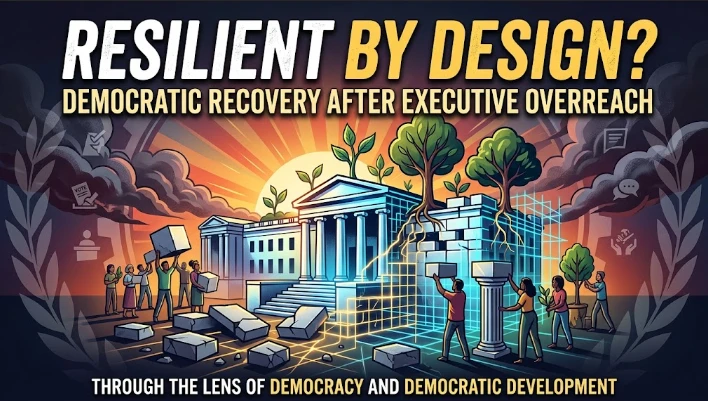
Restoring democracy after executive overreach should not mean returning unquestioningly to the institutional conditions that enabled the crisis. This article connects democratic recovery with democratic development, arguing that resilient institutions must combine constitutional restraint with effective and inclusive public service delivery. Courts, legislatures, electoral bodies, and watchdog institutions need independence and public support, while government agencies must provide reliable education, healthcare, infrastructure, licensing, social protection, and local services. Weak performance can make personal rule and concentrated executive authority appear attractive, especially when citizens associate democratic procedures with corruption, insecurity, inequality, or administrative failure. At the same time, administrative efficiency without transparency or accountability can strengthen authoritarian governance. The article therefore recommends balancing institutional performance with enforceable rights, independent review, professional administration, civic participation, and transparent decision-making. Democratic resilience develops when citizens experience institutions as lawful, useful, fair, and accessible parts of everyday life rather than distant constitutional arrangements activated only during political crises.
A story of transition to democracy is often one of, or in, a return to normalcy. The language itself can be misleading since the past 'normal' often included those issues that allowed executive overreach. In November 2025, a renewed focus on analysis, one based on the premise that recovery should not be resocializing the institutional status quo ante. The structure of recovery should foster moral, strong and inclusive democratic regime, with stronger accountability. Democratic development is then difficult to untie from resilience: resilient institutions need to be seen by citizens as stable aspects of their everyday life, where they feel that they enjoy rights, services, representation and a rule of law that they believe is both realistic and legitimate.
When the state's executive branch begins to overpower it, it will have both development failure and constitutional weakness. You can always justify giving the authority to one group pointing to corruption, insecurity, a lack of policy, inequality or administrative fragmentation. When public governance seems unattainable or ineffective, the voices of personal rule, decisive policy and law are tempted to be attractive. There is some call that guardrails can't respond to. This requires a public mandate for courts, legislatures and watchdogs, and capacity in government to provide necessary services without ignoring the law.
Resilient Recovery – Restraint and Performance. Checks on arbitrary power by independent review and transparency and enforceable rights. Performance of institutions provides citizens with real motivations to back the institutions of democracy. Lawful administration has the ability to address issues with reliable schools, clinics, infrastructure, social protection, licensing and local services. The balance is important because technocratic effectiveness and absence of accountability can lead to increased attention to executive functioning and delivery, while procedural purity and lack of service can cause political weakening of democracy.
V-Dem's research on democratic U-turns demonstrates that there is a possibility to reverse autocratization, but an autocratization recovery is certainly not a foregone conclusion. Even if there is an electoral turnover, the necessary change to curb the pattern of decline may not occur and the factors of entrenched patronage, weak agencies, polarized media and distrust may remain. Hence, there is a need for a "staged" institutional programme for recovery.
A rapid stabilization ensures elections, courts, records, public administration are protected. Medium term reform re establishes supervision and expertise. Long-term democratic development has to do with exclusion, lack of power, uneven access to political power.
Power must be reversible in the design of the constitution. The need for emergency measures should have clear ‘expire by’ dates. There is a need to establish legislative restrictions on delegated powers. Needs to have clear appointments and review of senior appointments.
In order to have public contracts, it is necessary that they be disclosed and competitive. For executive orders to be published, they must have stated legal reasons. These rules are to decrease reliance upon personal restraint. Ordinary processes of democracy are the condition that make it resilient, because they can provide a remedy for the overreach prior to a crisis resorting to politics.
There needs to be attention given to local government. Centralized systems build one single target of quarrels and capture, and render national politics clogged of all social conflicts. Capable municipalities and regions decentralize leadership, establish policy labs and decentralize services to communities. Other forms of decentralization – in particular fiscal decentralization – can create local domination; fiscal authority must, therefore, be accompanied by powers of audit, participation, protection of equality of rights and by national minimum powers. Well-designed local institutions enhance democratic development, link voice and outcomes.
Political parties are still one of the necessary infrastructures. Weakly institutionalized parties are personality party, or campaign party or patronage party. Thus, it becomes dangerous when the leadership changes due to the lack of credibility of internal leadership succession rules. The party finance, internal democracy, policy ability, candidate nomination process and disclosure of funds can all be assisted by Recovery reform. Abuse of partisan control in public regulation should be avoided, while neutrality of the rules may decrease the incentives for a move toward other private funding schemes and executive-access.
Civil-service repair is key, as well. When appointments are considered to be made due to “executive” decisions, expert knowledge is often disregarded and “loyalty” is rewarded. There is pressure on a recovery government to ambulance-chase disgraced politicians; but, wholesale replacements can result in a rerun of the same. The focus of vetting should be on behaviour, conflict of interest, and legal liability and not on political affiliation. Re Building Administration that serves Future Government impartially this can be done with the help of Merit Recruitment, Protected Professional Advices, Whistle Blower mechanism and Documented Instructions.
Development policy should be "a democratic policy. Major infrastructure, energy, housing and digital projects all allocate benefits and costs, and establish long term commitments, and transform power locality. Projects that provide growth but are mandated by closed decision making can further engender distrust. There are early consultation, social-impact assessment, accessible data for procurement and independent grievance systems to enhance legitimacy. More than mere information is required, as where the project will impact something on which the community has cultural rights, on their livelihood or their health, there should be influence.
Social inequality may be a source of political resilience inadequacy, as it may lead political rights to be perceived as abstract. There are significant differences in income, regional investment, education and access to digital in different regions, resulting in the unequal ability to organize and influence policy. While redistribution is not enough to make democracy, an opportunity to participate in a fair manner is needed in the development of democracy. Limits on campaign finance, public interest media, legal assistance, easy access to ballot and help with civic organizations, can soften the edge of the sustained permanent political control that can be gained from economic advantage.
Information institutions are an influence on recovery. Independent journalism, public broadcasting, academic freedom and the access to information laws enable citizens to assess pledges for reform. The problem of disinformation is not remedied by generally restricting people's rights to free speech, for that can be a means for a future overreach. The more effective are clear and transparent ways of government communication, media literacy, accountability of platforms, disclosing the sources and prompt correcting of the false official statements.
There can be no justice without accountability and democratic inclusion in the concept of justice for past abuse. There should be fair and independent investigation and adjudication of criminal activity. Administrative misconduct – should be reviewed and met with proportionate sanctions. There is a need for the recognition, remedy and records for victims.
Human rights of political opponents are not violated. General bans or reprisals can help to entrench the feeling of fear and hinder peaceful alternarion. Applying the tenets of transitional justice can help clarify a legal form of accountability from collective punishment.
Also, economic legitimacy is required for the recovery. Patronage is functioning in many respects by means of public contracts, state enterprises, tax and regulatory favors. Clear contracting, disclosure of beneficial ownership, implementing competition rules and enforcing through audits can break down these networks. In the case of anti-corruption policy, with "selective prosecution" must be stopped. Independent institutions, published criteria and regular enforcement of the laws prevent the transformative process from turning into another means of partisan control.
There should be a combination of national indicators and local experiences in measurements. Vital is Electoral Integrity, Judicial Independence, Legislative Oversight, Media Freedom and Civil-Society space. Additional measures should be put in place to monitor access to services, the fairness of administration practices, the handling of complaints, inequalities between different regions, and levels of trust between different social groups. A key condition for democratic development to be successful is to have institutions to limit power, but also make them more useable. When a citizen is denied access to documents, appeal of a decision or basic services, he or she lives under a different constitutional system than that set forth in formal law.
The most aggressive test is after an recovery coalition's victory. The urge to take advantage of such extraordinary abilities in order to make quick fixes, punish delays, or to bring about changes before it is too late rather than after the fact intensifies. Those decisions may entail an Executive branch overreach mentality. Resilient design understands it's slower processes, independent review and a potential electoral demise.
A democratic recovery is a democratic development when it is made on the basis of new rules which increase the state capacity and control by the people. One of the intent is not one to restore one to a trusted leader. The objective is to have a legal, efficient, and inclusive system that will provide such after trusted leaders are out of office.
Recovery can be supported by regional cooperation through election observation, exchange with the Judiciary, anti-corruption criteria, and promoting independent media. Third parties should refrain from trying to replace templates with indigenous legitimacy. Assistance is effective when the needs are identified by local institutions, public reporting of results is used as a measurement and when the funding is through capability building, not personalities.
Not only governments and civil society organizations have an impact on democratic development, but also private companies. Contractors take care of the data, infrastructure, detention, communications and public services. Rights, access to audit, cybersecurity standards, declaration of beneficial ownership and enforceable remedies shall be included into procurement rules. Holding-in common a public task must not deprive it of constitutional accountability as well.
Education is a means of longer-term resiliency. Constructive argument, critical thinking of evidence, and constitutional literacy can be imparted to students at schools or universities, without it turning the educational institutions into channels for party messages. When the public of a country has a good understanding of what different institutions ought to do, they are not as vulnerable when it is claimed that any measure that is not deemed legal is a tactic of sabotage. Practices of civic education can be most fully valued when coupled with hands-on experiences that enable students to be engaged citizens in their communities.
Practical stress tests are provided by public-health, and disaster preparedness. Transparent coordination and protection of vulnerable populations, publication of evidence, and review of emergency action builds capacity and legitimacy
CITE THIS ARTICLE
Amin, M. R. (2025). Resilient by Design? Democratic Recovery After Executive Overreach Through the Lens of Democracy and Democratic Development. https://www.ruhulresearchhub.com/article/122aa7a0-042d-5c46-8586-57a901cf6a9d
M. R. Amin, “Resilient by Design? Democratic Recovery After Executive Overreach Through the Lens of Democracy and Democratic Development,” 2025. [Online]. Available: https://www.ruhulresearchhub.com/article/122aa7a0-042d-5c46-8586-57a901cf6a9d
Amin, M. R. (2025) ‘Resilient by Design? Democratic Recovery After Executive Overreach Through the Lens of Democracy and Democratic Development’. Available at: https://www.ruhulresearchhub.com/article/122aa7a0-042d-5c46-8586-57a901cf6a9d
Amin, Mohd. Ruhul. “Resilient by Design? Democratic Recovery After Executive Overreach Through the Lens of Democracy and Democratic Development.” 2025, https://www.ruhulresearchhub.com/article/122aa7a0-042d-5c46-8586-57a901cf6a9d.
Mohd. Ruhul Amin. “Resilient by Design? Democratic Recovery After Executive Overreach Through the Lens of Democracy and Democratic Development.” (2025). https://www.ruhulresearchhub.com/article/122aa7a0-042d-5c46-8586-57a901cf6a9d.
Amin MR. Resilient by Design? Democratic Recovery After Executive Overreach Through the Lens of Democracy and Democratic Development. 2025. https://www.ruhulresearchhub.com/article/122aa7a0-042d-5c46-8586-57a901cf6a9d
@misc{article_122aa7a0042d5c46858657a901cf6a9d,
  title = {Resilient by Design? Democratic Recovery After Executive Overreach Through the Lens of Democracy and Democratic Development},
  author = {Mohd. Ruhul Amin},
  year = {2025},
  url = {https://www.ruhulresearchhub.com/article/122aa7a0-042d-5c46-8586-57a901cf6a9d},
}
TY  - GEN
AU  - Mohd. Ruhul Amin
TI  - Resilient by Design? Democratic Recovery After Executive Overreach Through the Lens of Democracy and Democratic Development
PY  - 2025-09-22
UR  - https://www.ruhulresearchhub.com/article/122aa7a0-042d-5c46-8586-57a901cf6a9d
ER  -
This article presents democratic recovery after executive overreach as a process of reopening institutions rather than merely restoring formal legal boundaries. It describes how executive misconduct can leave politicized appointments, weakened oversight, restricted records, altered enforcement practices, intimidated officials, and concentrated agenda control. The article mentions open-democracy theory as requiring continuous accessibility, deliberation, transparency, inclusion, and responsivenes
Climate accountability increasingly operates through routine public and corporate decisions rather than exclusively through litigation. This article examines how international environmental law and the law of the sea influence government budgets, permits, procurement, port operations, insurance, energy planning, investment, and corporate governance. The 2024 advisory opinion of the International Tribunal for the Law of the Sea recognized anthropogenic greenhouse-gas emissions as pollution of the
This article examines how biometric border systems can create unequal experiences of citizenship and migration control in the United States. It describes facial recognition, fingerprinting, iris scanning, and interconnected identity databases as technologies that may improve verification and reduce fraud while also expanding surveillance and distributing errors unevenly. The article mentions false matches, failed identification, secondary inspection, questioning, detention, and weak appeal proce