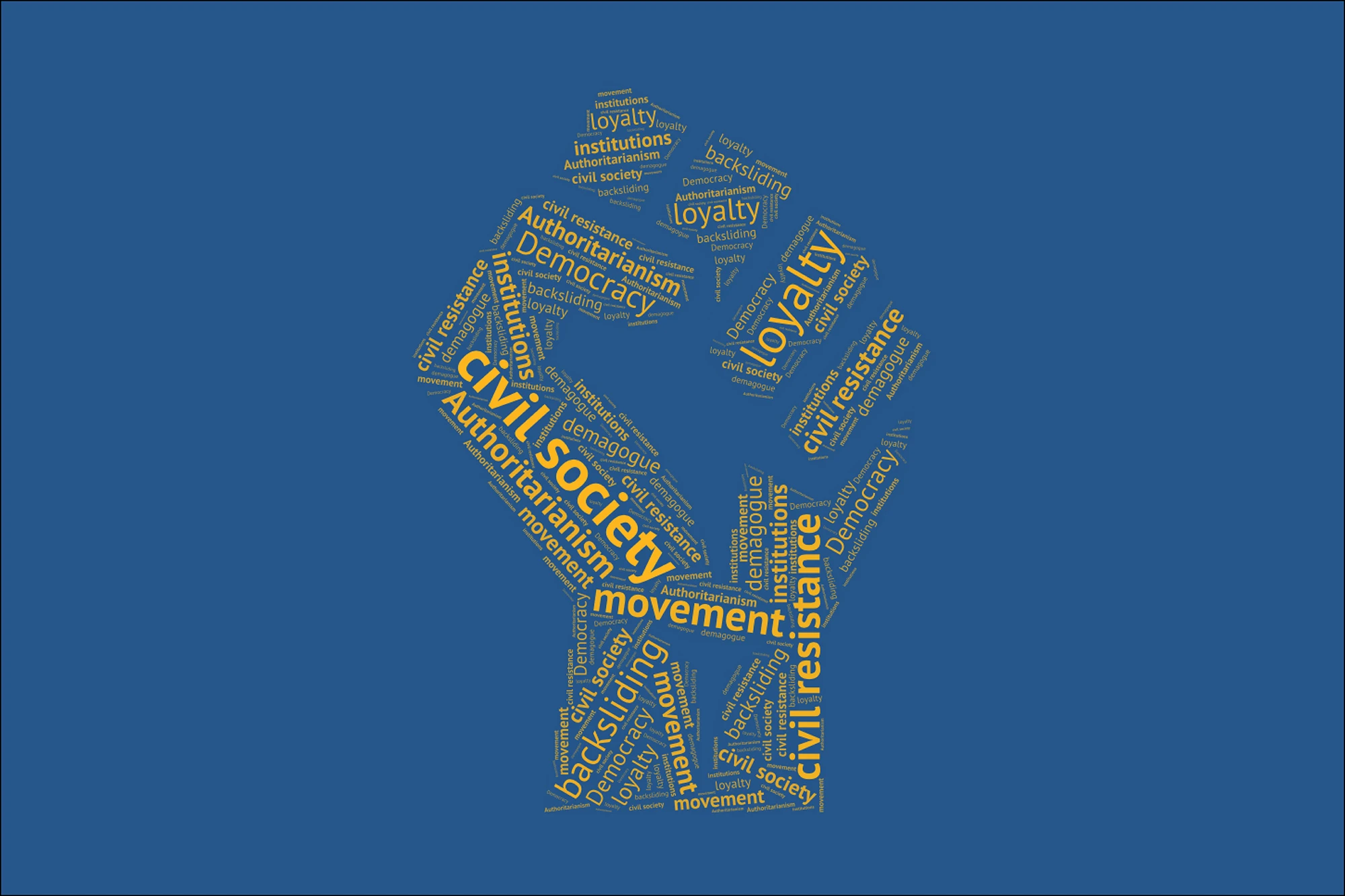
In a democracy, it may be lost without there being anything actually wrong with any part of the constitution. January 2025 in the United States is challenging to gauge in the aftermath of a contentious election season, years of waning trust, and numerous threats against public officials, coupled with protest movements. Language may easily confuse as well as clarify, and normal institutional decay is often much more of a progression than simply one "rupture. Civil resistance and political violence provide a better, more specific, early-warning framework since they both stem from citizens' attempt to challenge power and from authorities' attempts to react to pressure.
Democratic backsliding is more likely to start with the announcement of a constitutional government's suspension or a formal cancellation of elections. Declines tend to happen more as de facto administrative decisions that may be technically legal and yet be a compromise that erodes fair competition, public accountability and institutional restraint. A prosecutor is pressured to choose specific cases, an inspector general's access is curtailed, election administration is increasingly partisan or public agencies begin to view criticism as unpatriotic. While the combined pattern can decrease the actual expense of larger abuses, each of the decisions seems small separately. So, the constitutional threshold is really the bottom of the barrel and the moment for informal protection measures have already been taken away and the message has been sent to the political players that "the buck stops at the end of the levee.
Early Warning means focusing on behaviors, not labels. The indicators that should be incorporated are increasing threats to the local political authorities, targeted actions towards undermining normal election processes, selective application of the law against opposition movements, and the lack of public opposition to political violence. Another indication is where officials talk of lawful opposition as an internal enemy traditionally, not as a competing entity. Polarization, disinformation, and attacks on freedom of expression were among the centerpieces of V-Dem's 2024 democracy report. While such attributes are not necessarily evidence of an authoritarian shift, they may accumulate across a set of institutions to indicate such shifts, even when not formally defined in the constitution's language.
Because civil resistance makes it possible to glean grievance and institutional response, it offers especially valuable perspective as a diagnostic lens. Between October 2023 and mid-June 2024, the Crowd Counting Consortium counted nearly 12,400 pro-Palestinian and over 2,000 pro-Israel protests in the U.S. The vast majority of events were peaceful, and it was clear that even large mobilization does not necessarily lead to strife. More telling questions relate to the policing unevenness, limitations on assembly, campus disciplinary policies, and official rhetoric differentially (according to cause). A democracy that doesn't criminalize big groups of people over a period of sustained protest is a resilient democracy; one that starts to associate dissent with administrations as a security category isn't.
Political violence functions differently from regular crime, in that the symbolic target, the presence of an ideology and public intimidation are all important in addition to physical harm. ACLED's monitoring of the United States covers acts of violence perpetrated by extremist groups, by police officers with excessive violence, by violent mobs, and from hate crime and politically-related motives. If it’s a one-off, it’s one-off, but if it is threats being put out against election workers, judges, journalists, legislators or local officials over and over again without many deaths, it could make a difference to behaviors. Overall, resignations, skimming of candidates, self-freezing of the media and toughened security measures restrict democratic involvement. Event counts are the most critical early-warning indicator, however, not only for the number of events, but also for the chilling effect it has on those supposed to perform routine democratic duties.
A democratic government cannot be accomplished through formal law alone. Below the written rules is an informal operating system of toleration, forbearance, professional neutrality, and acceptance of less than desirable results. Backsliding is happening at an accelerated pace where there is no room for any law in consideration of a candidate, no space for any vacancy without a line of inquiry because of that vacancy, no space for any investigation without taking a line of inquiry. Courts can strike down the illegality, but the courts often come too late to prevent harm, and judicial remedies can only occur if executive acts complied.
Oversight can be vitiated by party agenda and there is a need for legislative investigation. What is required is thus a number of actors who will not use all the available means, particularly when they might be in conflict with the long-term legitimacy of the system.
Civil resistance can, therefore, serve as a way of introducing political costs without mimicking authoritarian politics, saving democratic institutions in the process. The nonviolent independence struggle gains wider traction, draws in various social constituencies, entices departures within ruling coalitions, and sets an open challenge to the official restraint. There's no participation magic number; there's no magic march. Often, more than a headcount description of the crowd matters is the organization, strategic discipline, existing local networks, labor participation, legal support, credibility of the media and clear demands.
Attention may also be diverted from institutional abuse to public order concerns, affording an excuse for repression, and undermining potential alliances, because of violence within a movement. In a democracy, defense tactics should exploit ways in which misconduct is visible, and yet the general legitimacy is not compromised.
The really good evidence approach should involve both comparative analysis and in-depth institutional analysis. Event datasets can determine when and where things were concentrated, administrative records can give insight into enforcement decisions and organizational reactions. Process Tracing and Survey experiments could be used to test public tolerance and reconstruction of key decisions made. Other clues are in court opinions, in official departmental instructions, in staff changes, staff infractions, and budget changes.
There's no one indicator of collapse of democracy or of accountability. That is why triangulation is essential, because there is this public rhetoric of danger; official statistics may give the impression of danger but it's actually underreported; and there's a legal change, but it's not followed through with. By giving independent sources, a consistent indication of the same mechanism at various levels of government, confidence builds.
Earlier-warning analysis should distinguish levels of protest mobilization from experiences of protest repression, as high mobilization may mean the institutions are healthy, and vice versa. Election administration threats cannot be overlooked because, if successful, intimidation may alter the personnel, certification practices and public perceptions without altering the law. But rather than having an "only constitutional violation" debate, a dashboard based on clustered indicators might detect deterioration earlier.
Finally, there is the need to take account of local variation: this is because overall national statistics might mask a high experience of intimidation in particular areas or because of a poor administration of the legislation or a lack of national will. A credible warning system should make its criteria public and avoid lawful disagreement with its assessments being confused for coercion, should not use “chicken” terminology for risk, should not label risks as partisan statements. Ordinary capacities like record retention, professional staffing, routine audit, but also potentially reliable channels of protected dissent, are all essential to the resilience of institutions.
Spectacular incidents can be bigger than one or two, whereas pieces of procedural machinery can shift and change in ways that no one knows about until it impacts them personally and directly, and fail to attract any media attention. Comparative evidence is crucial in identification of danger, but in system of American federalism the state and municipal institutions have to be analyzed along with national conflict. The criterion is not unanimous verdicts but fair competition with a set of rules that is democratic in the sense that it does not change when the tide turns.
Election staff must be physically protected and have a right to protection from legal action, but not to protection that renders the elections out of the reach of public view and legitimate inquiry. Threat assessment can only be democratically handy if there are no distinction with regards to ideology, identity, geography and institutional affiliation. Political elites can influence risk through words, which have the potential to make intimidation seem natural, justified or needed.
Organizations whose purposes do not involve violent confrontation can help to reduce tension by getting reliable information to the public, educating legal observers and debunking rumors of institutional change. When national parties become highly polarized, there are bridging connections in the form of networks in universities, unions, professional associations, faith communities and local media. Public agencies should document the reasons behind decisions made in deviation of the rule, so to enable subsequent decisions to differentiate urgent necessity from opportunistic deviance.
The main point is that protection under the democratic rule of law must start even before a constitutional crisis and persist as soon as the public's agenda shifts. It's not just controversy; early signals get significance in patterns. Institutions are resilient when citizens' resistance to selective enforcement and encouragement of principled restraint affects the cost of enforcement for institutions and officials, judicial enforcement, legislative oversight, media scrutiny, the conduct of professionals and civic participation. Political polarization will be high and by-design protests will be disruptive.
The quiet streets and total trust is not necessary if democracy is to be resilient. It needs institutions which can process conflict and weak opposition into something less than disloyalty, coercion into routine, and short-term gain into a noose.