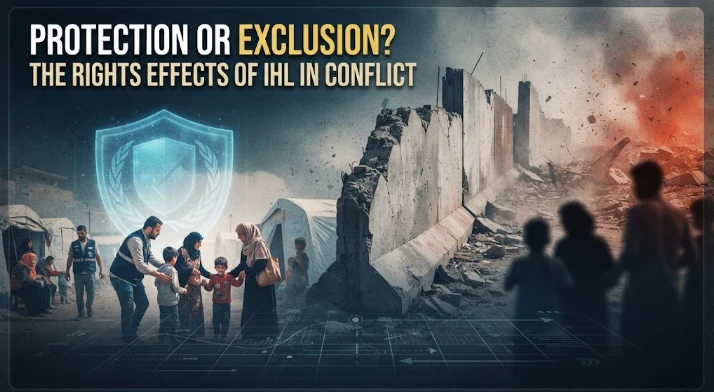
The article examines how administrative design can either protect or exclude people displaced by conflict. It argues that humanitarian and refugee-law commitments are weakened when registration, eligibility, documentation, language, geography, digital access, or fragmented service systems prevent people from receiving protection. Because conflict often destroys identity, school, medical, and property records, the article supports reasonable evidentiary flexibility, corroboration, interviews, and review rather than rigid documentation requirements. It also emphasizes coordinated service access, accountable data sharing, human review of digital tools, offline alternatives, qualified interpretation, trauma-informed administration, family unity, retention limits, and community participation. Evidence should track application outcomes, reasons for refusal, waiting times, appeals, service denials, and protection incidents, with attention to children, disabled people, stateless persons, women at risk, rural populations, and people without identification. The central message is that humanitarian protection becomes real only when administrative pathways are accessible, reviewable, adequately resourced, privacy-protective, and capable of correcting exclusion.
Administrative Design for Humanitarian Protection can be in the spotlight again in April 2026. The core issue is simple; effective registration and eligibility administration may be quite uniform and inadvertent in its consequences, excluding displaced people by documentation, language, geography, or even by being able to access it online. That challenge can only be addressed through legal means, as institutional routines designate who or what can access power in the daily. A credible response has to have Rules, Evidence, Participation and Remedy.
These comprise the Geneva Conventions, refugee law, non-refoulement, equality norms and procedural fairness. Standards need institutions to interpret, implement and review. Standards need institutions that can interpret and enforce and monitor them. The main actors involve the humanitarian actors, border authorities, courts, local providers, interpreters and the affected communities. The coordination within that group needs to maintain the independence, and not confuse responsibility.
International human rights, refugee and international humanitarian law dictate many aspects of protection and conduct during flight or in the event of armed conflict. Administrative systems are located between the jurisdictions of these laws and everyday experience. Registration, eligibility, referral and data-sharing decisions are key factors that either do or don't get protection to individuals in time. Institutional pathways that are also much harder to navigate or are not known to exist can turn legal commitments toothless.
In a conflict, all too often, it is low-tech evidence that gets obliterated. Documents such as birth certificates, passports, property records, school records, and medical records can be lost, or impossible to find. A protection regime that centres on documentation will be certain to put the burden of risk onto the forcibly displaced person. Incorporating the flexibility of reasonable evidentiary, corroboration, interviews, and review procedures are ways to retain the integrity without excluding paperwork.
There is a need for inter-agency coordination for service access. Different rules and databases exist for immigration status, health eligibility, schooling, housing, employment support and welfare. Fragmentation leads to repeated exposure to traumatic information, and produces conflicting decisions. Those burdens are lowered and maintain privacy with shared standards, consent based referral and, accountable, case coordination.
Digital solutions can enhance portability and speed but aside from being technically efficient, they don't necessarily provide justice. Error can easily be encountered on a large scale through biometric matching, automated risk flags, remote interviews and interoperable records. Human review, alternative channels and correction rights, strict purpose limitations are fundamental. Social risks like function creep, and family and surveillance exposure, are imperative to be incorporated in security testing.
It is recommended the displaced communities be involved to strengthen design. People who have been a refugee or migrant, as well as interpreters, disability activists and community sponsors have specific insights that can point to issues not known by those central authorities. Participation should impact Rules of eligibility, communications, where the services are available and how it is evaluated. If it's done without documentation, there is visibility without authority.
The following should be the main points in the discussion of any practical programme of reform: easy registration, presumption against exclusion, notice in several languages, opportunity for review and alternatives which do not require Internet access. Each element covers a different failure point; before taking action, you should ensure that you have authorization; as you are taking the action, make sure that you have documentation; once the action is taken, make sure that there is a review; if there is harm, make sure there is a remedy. The order is important in that regard as subsequent accountability is undermined in the absence of prior accountability records and the motivating rationale of activity.
Application outcomes and the reason for applications being rejected, waiting times, appeals and service denials and any protection incidents should be included. This type of data can be compared between agencies and or regions; across different time periods and across different groups impacted. There can be clearly identified patterns, disparities and delays, as well as repeated institutional failure, without compromising confidentiality.
The centre of the equity analysis shall be children, disabled people, stateless persons, women at risk, rural population as well as people not holding ID documents. Formality alone has no answer as to if and how burdens cluster, or whether and how review access varies by income, status, geography, disability, ethnicity, age or language. Distributional evidence must inform and shape design and to resource allocation.
Implementation requires resources. There is a need for staff and experts to review bodies, need to keep records at their disposal, need to have secure tenure in the review body and need to mandate response. Funding and interpretation are also needed, as is time and accessible venues when involving the community. The absence of funding for rights and participation obligations can turn them into 'aspirational obligations'.
There is no need for a false choice between universals and contextuality to institutional reform. Powers of protection (legality, equality, notice, review and remedy) are general. The use of those protections is effectively put into practice based upon the local knowledge. Durable design includes common protections and culture-, geography- and experience-based procedures.
Use of policies should be followed up in the long term. Initial implementation may decline due to changes in management, for an event, or changing financial situations. Contingency: scheduled review, public reporting and independent research. It is important to collect feedback from corrective action, but that corrective action itself need not involve total failure of policies.
The formal rules in institutional analysis should be related to incentives. There are all sorts of work pressures, goals, funding levels, norms for safe, professional behavior, and cues from politics and expected accountability from officials. The force of reform takes place when those forces direct towards lawful and fair conduct. Safeguard placed only in a manual can be lost due to the pressure of operations.
Any measurement has its own dangers. Socio-economic, financial and environmental outcomes can be easily reflected in indicators, which can foster strategic reporting. Quantitative data should, therefore, be used alongside qualitative data, independent verification and clear definitions. Why disaggregated reporting is important: national-level aggregate figures can mask high rates of failure locally or among groups of children and young people.
The national policy performances are influenced by the local delivery. The settlement location and type of housing market, school capacity, primary care, transport, interpretation, and community networks vary. National entitlements must be backed up by plans for implementation on the local level and with escalation mechanisms. Formal access may cease to exist outside the big centres, which can be spotted by geographic monitoring.
Trauma-informed administration does not mean that there will be no verification. It needs settings in which interviews are conducted which minimise avoidable harms, pace and interpretation for quality evidence. Minimise the number of times the story is retold. Teaching about the effects of memory, fear and cultural variations will remove the false assumption of deception from the equation for staff.
Institutions should coordinate with each other based on family unity. Household separation in files and eligibility rules may be design elements that can result in a "variegated" set of decisions for households. Consent family mapping can detect family dynamics that might not be the same for all families. Harms resulting from poor administration (indirect) should be covered by review procedures.
Language access is more than simply a customer service feature – it's a rights matter. The credibility determination which is assigned in the case can be a result of poor interpretation, and so can be the medical consent, school placement and the rights to appeal. Qualified interpreters, translated notices, and confirmation of understanding enhance the fairness and accuracy. Decisions on (informal) family interpretation should not include decisions on safety or legal status.
There shall be explicitly stated retention limits for data. Knowing what information is gathered in the crisis can continue to be beneficial to agencies long after the crisis. Minimize later misuse by using retention schedules, checking for deletion, access controls and independent audits. Notice to individuals regarding storage and correction should be provided on a basis that is understandable to the individual as long as it is done safely.
Achain governance should be defined by having responsibility at each and every stage. The effective cooperation and collaboration of humanitarian actors with border authorities, courts, local providers, interpreters and refugee communities is dependent on the ability to securely authorise, deliver, monitor and remedy. For an overlap of mandates, written protocols and escalation procedures. Otherwise, ambiguities safeguard institutional boundaries over impacted people.
Risk assessment should involve both "what do you do" and "what don't you do. Rights may be infringed if there is excessive intervention, but some forms of harm may remain unaddressed if there is late or partial (disjointed) intervention. The rationale for the decision should be documented in the decision record by providing supporting evidence and more limiting options. This can be reviewed later for the purpose of evaluating the reasoning and not for the purpose of making unstated assumptions.
In independent research there can be a connecting link between the official reporting and the experience of the community. From a secure access to data, ethical oversight and publication rights, these serve as a means to begin testing institutional claims. Community authority and confidentiality should be given due respect in the context of partnerships. There is a need for a formal response to findings.
Success should be determined by improvements in safe access, minimisation of mistaken downs, quicker waiting times, good appeals and closer of the protection gaps. The scales that make up these measures are a mix of outcomes, procedure and institutional capability. The objectives must be visible, terms of reference must be clear, and when objectives are not met it is important to have a description about what went wrong and how to rectify the issues.
Taking steps towards, but not yet implementing, 'invisible' reforms in the form of accessible registration, presuming not against exclusion, multilingual notification, review processes and offline alternatives, therefore offers a viable path towards reform, particularly where assessments of the system are based not only on the number of adults and students excluded, but also on increased safety, fewer incorrect exclusions, less waiting time, effectiveness of review processes, and fewer protection gaps. Focus on children, the disabled, stateless persons, women at risk, rural areas and those without identification documents is especially important in helping to guard against concentrate harm from being camouflaged by aggregate success.
CITE THIS ARTICLE
Amin, M. R. (2026). Protection or Exclusion by Design? Rights Effects of International Humanitarian Law and Conflict. https://www.ruhulresearchhub.com/article/31cc3b7f-5e7b-5564-9134-4a7f59765e3c
M. R. Amin, “Protection or Exclusion by Design? Rights Effects of International Humanitarian Law and Conflict,” 2026. [Online]. Available: https://www.ruhulresearchhub.com/article/31cc3b7f-5e7b-5564-9134-4a7f59765e3c
Amin, M. R. (2026) ‘Protection or Exclusion by Design? Rights Effects of International Humanitarian Law and Conflict’. Available at: https://www.ruhulresearchhub.com/article/31cc3b7f-5e7b-5564-9134-4a7f59765e3c
Amin, Mohd. Ruhul. “Protection or Exclusion by Design? Rights Effects of International Humanitarian Law and Conflict.” 2026, https://www.ruhulresearchhub.com/article/31cc3b7f-5e7b-5564-9134-4a7f59765e3c.
Mohd. Ruhul Amin. “Protection or Exclusion by Design? Rights Effects of International Humanitarian Law and Conflict.” (2026). https://www.ruhulresearchhub.com/article/31cc3b7f-5e7b-5564-9134-4a7f59765e3c.
Amin MR. Protection or Exclusion by Design? Rights Effects of International Humanitarian Law and Conflict. 2026. https://www.ruhulresearchhub.com/article/31cc3b7f-5e7b-5564-9134-4a7f59765e3c
@misc{article_31cc3b7f5e7b556491344a7f59765e3c,
  title = {Protection or Exclusion by Design? Rights Effects of International Humanitarian Law and Conflict},
  author = {Mohd. Ruhul Amin},
  year = {2026},
  url = {https://www.ruhulresearchhub.com/article/31cc3b7f-5e7b-5564-9134-4a7f59765e3c},
}
TY  - GEN
AU  - Mohd. Ruhul Amin
TI  - Protection or Exclusion by Design? Rights Effects of International Humanitarian Law and Conflict
PY  - 2026-02-02
UR  - https://www.ruhulresearchhub.com/article/31cc3b7f-5e7b-5564-9134-4a7f59765e3c
ER  -
This article presents democratic recovery after executive overreach as a process of reopening institutions rather than merely restoring formal legal boundaries. It describes how executive misconduct can leave politicized appointments, weakened oversight, restricted records, altered enforcement practices, intimidated officials, and concentrated agenda control. The article mentions open-democracy theory as requiring continuous accessibility, deliberation, transparency, inclusion, and responsivenes
Climate accountability increasingly operates through routine public and corporate decisions rather than exclusively through litigation. This article examines how international environmental law and the law of the sea influence government budgets, permits, procurement, port operations, insurance, energy planning, investment, and corporate governance. The 2024 advisory opinion of the International Tribunal for the Law of the Sea recognized anthropogenic greenhouse-gas emissions as pollution of the
This article examines how biometric border systems can create unequal experiences of citizenship and migration control in the United States. It describes facial recognition, fingerprinting, iris scanning, and interconnected identity databases as technologies that may improve verification and reduce fraud while also expanding surveillance and distributing errors unevenly. The article mentions false matches, failed identification, secondary inspection, questioning, detention, and weak appeal proce