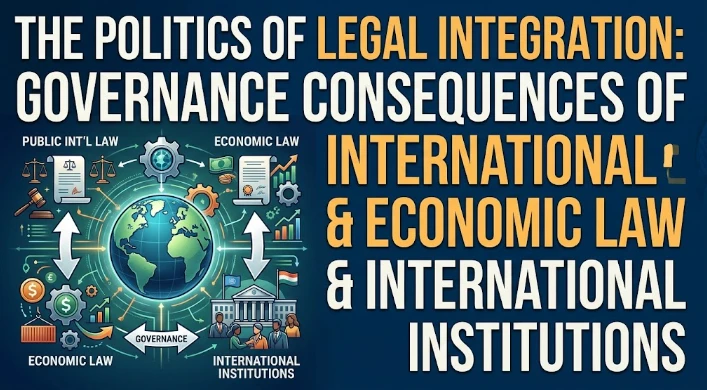
Integrating international legal and economic obligations into domestic governance is a political and institutional process, not a simple act of legislative adoption. This article examines how treaties, international standards, trade rules, and institutional decisions move through national legislatures, ministries, regulators, courts, local authorities, and private contracts. Different actors may reinterpret obligations according to political priorities, administrative resources, commercial interests, and existing legal traditions. Consequently, formal integration can coexist with selective enforcement or significant implementation gaps. The article recommends studying budgets, guidance documents, personnel capacity, enforcement patterns, judicial decisions, procurement systems, and accessible remedies to determine whether international obligations have become operational. It also highlights the role of interest groups, businesses, civil society, and affected communities in shaping implementation. Effective legal integration requires clearly assigned institutional responsibilities, professional training, transparent decision-making, parliamentary scrutiny, and independent evaluation. International law becomes meaningful domestically when it consistently guides routine decisions rather than appearing only in diplomatic statements, formal legislation, or occasional litigation.
Legal integration has been characterized as a ‘technical procedure’ with respect to which international rules are accepted and integrated in domestic law. This all-encompassing description is a political battle over who will have power? The distribution of something, who will get it first? The timing: when will it be available? Institutional identity: What will it be called? Domestic governance by GE 2025: public international law, international economic law through treaties, law, court decisions, standards and administrative cooperation. While integration has an advantage on increasing predictability and to solve cross-border issues, it can also lead to a weakening of the legislative powers, an overload of younger groups, or to compromising obligations that no one is willing to abide by.
First political choice is how to incorporate—route. There are some systems which would run the treaty directly and others that would need legislation. Treatment of different agreements may vary between States. Whilst quickening implementation, the democratic checks and balances can hamper direct effect when there are complex obligations that aren't debated much in transposing into domestic law. Legislative incorporation makes visible and adaptable; nevertheless it can be a problem of compliance if it is not drafted properly or in timely fashion.
Courts frame integration through resolving issues involving the interposition and interaction of international rules and constitutions, statutes, regulations and precedent. By interpretation, conflicts between domestic and international obligations can be avoided. It can also cause clashes if elected institutions consider resolution as encroachments on their decision making domain. Constructive constitutional doctrine, interpretation, and legislative action potentialities are among those ways through which integration can be kept from seeming rule by judges.
Much of the actual work goes on at the administrative agencies. Obligations are turned into procedures by customs offices, financial regulators, environmental authorities and labour inspectorates, competition agencies and migration bodies. Data sharing and good professional cooperation can be promoted by integration. It can also leave open spaces for absconding and non-accountability when decisions are based on informal exchanges out of the scope of parliamentary control, international committees and technical networks functioning outside the scope of the parliamentary system.
International economic law more readily has governance impacts. Trade regulations impact product standards, subsidies, purchasing and regulation. Data, corporate structure and enforcement are impacted by financial and tax cooperation. These systems can help in curbing opportunism and extension of market access, but there is unequal adjustment cost. Small businesses and workers, local producers, and developing regions can be less capable in adapting than large multinational companies.
Networking in the form of distribution, should therefore be part of legal analyses. Rules can be literally neutral, but with the effect of having costs fall on groups with weak political leverage. RIA should involve the identification of transition periods and affected sectors, administrative burden and support. Where international obligations restrict policy options, Honest explanations are required by governments. The presentation of an argument using technical jargon is less valid in democratic terms.
Executive power changes as well: Integration. Typically negotiations go on within ministries specifically tasked with the issue and legislatures come late to the negotiations. Rejection will incur diplomatic cost after the conclusion of an agreement. This imbalance can be trimmed by having parliamentary mandates, publishing negotiating objectives, accessibility of committees, and review after the agreements. But although confidentiality is important when it comes to bargaining, it shouldn't be used as a blanket cover up.
There are different challenges to subnational governments. International commitments may impact on local procurements or zoning environment, licensing or public services. The negotiations are at the national government level and the implementation at local government level. Being consulted early on and being fiscally supported helps to decrease conflict. But in their absence, local government could be left with the responsibility to be compliant, but lack the control over the design.
There are still private standards, as well. Quasi-legal status for certification, accounting, digital rules, credit assessments and supply-chain codes to function overseas. Firms have to meet the requirement because access to the market is based on Firm's recognition. Transparency, competition, methodology and appeal are all items for public regulators to look into. Don't let private bodies to assume public like powers without protection.
Fragmentation continues to pose a significant threat. There is a range of potential directions for trade, environment, security, labour and human rights regime. There is a need to provide officials with conflict resolution processes, instead of defaulting to the easiest rule. The coherence can be generated by inter-ministerial review, opinion of the law, legislative guidance and interpretation of the law. The international and regional organisations, too, must have conversation, otherwise, the different special regimes will be acting in isolation.
Data on how implementation is done should be readily available. Governments can report actions taken at the legislative, regulatory, and enforcement levels, along with the results of these actions in the areas of distribution. Public reporting gives legislatures, civil society feedback on the effectiveness of integration. Institutional bottlenecks are covered under aggregation of claims of compliance. When data is very detailed it can indicate that a rule is present nationally, but unavailable locally.
Legal integration also can help domestic reform coalitions. International standards can be used to exert pressure and mobilize consumers, environment groups, unions, professional groups and businesses. This can help to overcome entrenched interests. But, don't use outside "regulations" to supplant the best in-house organization. For durable integration, these institutions must be present in the local communities; they are needed to interpret, defend and revise implementation.
The need for exit should be considered. Social and technological conditions change but international commitments are for stability. Clauses, amendment procedures, adaptation through review, as long as it is legal to do so, and renegotiation mechanisms provide adaptation.
All of the sudden withdrawal may have a negative impact on trust and the stability of the market. Permanent lock-in can also entail the loss of legitimacy. Optimized design is a balance between predictability and having lawful change.
Politics of integration is thus not about the opposition of sovereignty and internationalism in general. Through options of cooperation, delegation, accountability and implementation, over which the sovereign is choosing, sovereignty is exercised. International law can enforce the domestic law with transparency of law, public deliberations, and accountability of institutions. Integration can be dangerous, when it is necessary for technical reasons to close political discussion.
Behaviors and outcomes will be used to gauge the governance consequences. Good integration enhances joint decision making, coordination, rights and forecasting, alongside retaining democratic accountability. In their weaker form of integration, the elements of formal alignment, fractured administration, embedded costs, and passing the buck are present. The key is the establishment of channels of connection between negotiation with other countries, legislation, administration and practice, local execution, and public review. The method of legal integration is successful when it is turned into watertight co-operation, which is accountable by the constitution.
Increased transparency of the negotiation process can be conducive to increased domestic legitimacy, while not revealing all the tactical positions. Governments are able to issue objectives, Impact Assessments, Stakeholder Inputs and Explanatory Reports. Mandates can be debated by legislatures before negotiations start and can be analysed by legislatures when the final texts emerge and have time to make an informed decision on them. Such action helps to lessen any sense of democratic compression from the take-it-or-leave it ratification process.
Domestic Rulemaking is also impacted by Regulatory Cooperation. Standards can be revised by joint committees, or technical dialogues after entry into force of adjudged agreement. These have to be clearly bounded, published and overseen by the parliament. Failure to do so, policy change can take place through low visibility technical processes and this with limited public involvement.
Acquiring legal integration can result forum shopping. There is a selection of institutions by governments, firms, and advocates: those with rules and remedies conducive to their interests. Opportunities for forum choice can increase access of the individual to the forum, but overlapping proceedings can lead to inconsistent and strategic pressure. Coordination rules, disclosure and respecting final judgements diminish conflicts.
Distributional compensation is evidence based. Concentrated costs can be dealt with by adjustment funds, retraining, regional investment and small-business assistance. A clear and understandable eligibility and assessment of programs are necessary. Stating in the negotiation that something is being offered, indicated on the compensation sheet but then not following through means that there is a lack of faith in future deals.
Testing the comprehensibility of integrated rules should be a part of the administrative review. There is a need for guidance for frontline officials actors. It's a fact that bigger establishments with specialist counsel tend to have higher complexity. Technical "ups" can help to narrow the gap while maintaining high standards.
The last is Democratic reversibility. There should be lawful mechanisms for governments to make changes, renegotiate or withdraw under existing mechanisms. The concepts of procedural discipline, impact assessment and notice should be incorporated into the concept of reversibility. That balance ensures the international stability and national self-government.
There is a job-training and law school education that promotes continuity in integration. Materials for comparison and up-to-date international decisions for judges, regulators, legislators and practitioners. Geographical information needs need to be disseminated to all institutions and not just foreign ministries.
To achieve access to justice, Public Interest Litigation can clear implementation, but 'standing', legal aid and ‘time bound remedy' is needed. Courts ought to be a component of a larger structure of accountability. Problems can be resolved through administrative review and parliamentary screening prior to the initiation of litigation.
Sunset review can be used to determine whether rules still have the purpose they were intended to achieve through integrated review. All less restrictive options and rights, market results and administration costs should be considered in review.
CITE THIS ARTICLE
Amin, M. R. (2025). The Politics of Legal Integration: Governance Consequences of Public International and Economic Law and International Institutions. https://www.ruhulresearchhub.com/article/5453f4f5-743a-514f-9891-c65b43112795
M. R. Amin, “The Politics of Legal Integration: Governance Consequences of Public International and Economic Law and International Institutions,” 2025. [Online]. Available: https://www.ruhulresearchhub.com/article/5453f4f5-743a-514f-9891-c65b43112795
Amin, M. R. (2025) ‘The Politics of Legal Integration: Governance Consequences of Public International and Economic Law and International Institutions’. Available at: https://www.ruhulresearchhub.com/article/5453f4f5-743a-514f-9891-c65b43112795
Amin, Mohd. Ruhul. “The Politics of Legal Integration: Governance Consequences of Public International and Economic Law and International Institutions.” 2025, https://www.ruhulresearchhub.com/article/5453f4f5-743a-514f-9891-c65b43112795.
Mohd. Ruhul Amin. “The Politics of Legal Integration: Governance Consequences of Public International and Economic Law and International Institutions.” (2025). https://www.ruhulresearchhub.com/article/5453f4f5-743a-514f-9891-c65b43112795.
Amin MR. The Politics of Legal Integration: Governance Consequences of Public International and Economic Law and International Institutions. 2025. https://www.ruhulresearchhub.com/article/5453f4f5-743a-514f-9891-c65b43112795
@misc{article_5453f4f5743a514f9891c65b43112795,
  title = {The Politics of Legal Integration: Governance Consequences of Public International and Economic Law and International Institutions},
  author = {Mohd. Ruhul Amin},
  year = {2025},
  url = {https://www.ruhulresearchhub.com/article/5453f4f5-743a-514f-9891-c65b43112795},
}
TY  - GEN
AU  - Mohd. Ruhul Amin
TI  - The Politics of Legal Integration: Governance Consequences of Public International and Economic Law and International Institutions
PY  - 2025-11-03
UR  - https://www.ruhulresearchhub.com/article/5453f4f5-743a-514f-9891-c65b43112795
ER  -
This article presents democratic recovery after executive overreach as a process of reopening institutions rather than merely restoring formal legal boundaries. It describes how executive misconduct can leave politicized appointments, weakened oversight, restricted records, altered enforcement practices, intimidated officials, and concentrated agenda control. The article mentions open-democracy theory as requiring continuous accessibility, deliberation, transparency, inclusion, and responsivenes
Climate accountability increasingly operates through routine public and corporate decisions rather than exclusively through litigation. This article examines how international environmental law and the law of the sea influence government budgets, permits, procurement, port operations, insurance, energy planning, investment, and corporate governance. The 2024 advisory opinion of the International Tribunal for the Law of the Sea recognized anthropogenic greenhouse-gas emissions as pollution of the
This article examines how biometric border systems can create unequal experiences of citizenship and migration control in the United States. It describes facial recognition, fingerprinting, iris scanning, and interconnected identity databases as technologies that may improve verification and reduce fraud while also expanding surveillance and distributing errors unevenly. The article mentions false matches, failed identification, secondary inspection, questioning, detention, and weak appeal proce