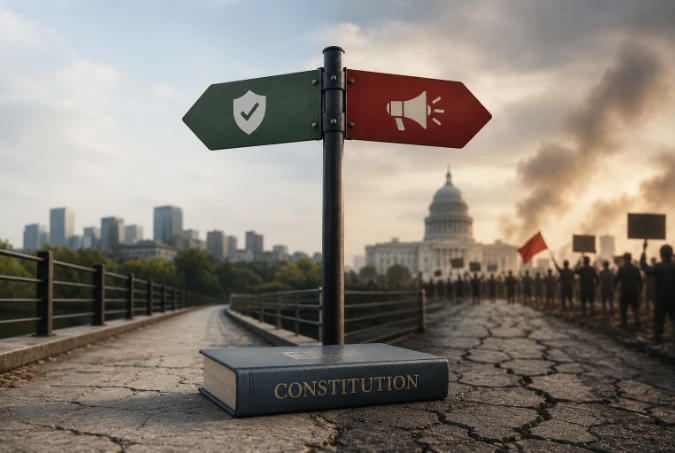
This article discusses the difference between constitutional institutions that genuinely constrain power and those that merely communicate political disapproval. It describes how courts, legislatures, auditors, inspectors, federal institutions, civil servants, media organizations, and civil society may appear active during institutional stress without changing executive incentives or restoring affected rights. The article mentions timing, jurisdiction, access to evidence, enforceable remedies, compliance, institutional capacity, and independence as the factors determining whether a safeguard functions as a true guardrail. It also examines emergency governance, proportionality review, legislative oversight, delegated authority, public procurement, and private contractors performing public functions. Judicial opinions and legislative reports may still have signalling value, but they become protective only when followed by policy revision, data correction, compensation, monitoring, or disciplinary consequences. The article concludes that constitutional resilience requires overlapping institutions capable of detecting, delaying, exposing, reversing, and remedying abuse in real time rather than relying on symbolic declarations after harm has occurred.
Constitutions convey political messages; however, there is more involved in what is constitutional than simply the constitutional signal. A court judgment, legislative hearing, inspector-general report, or federal intervention may be protective but not likely to have a lot of impact in terms of changes as an institution responds to stress. Comparative design is useful for differentiating between what is highly visible and what is effective as a guardrail in the context of a constraint. Force is a matter of: Timing, jurisdiction, evidence access, remedies, and compliance. Safeguarding works when it alters incentives rather than providing "principled" language subsequent to a challenged decision which resulted in the institution of the system or public expectations about it.
A comparison of the constitutions shows that there are a number of ways of limiting the exceptional powers. Some require the legislative consent within a short time frame, others restrict the chances of renewal, provide for non-derivable rights or scatter power among territorial units, or allow for speedy judicial review. There is no one single device which can ensure restraint. Political rules of the game that are not codified can be strong when the political actors take into account the institutional legitimacy, and can conversely be weak in a partisan-capture-ridden situation where strong text is required.
Utilizing redundancy provides for more protection than using only one guardian. If executive incentives to quick action are rewarded over accountability, there are overlapping points of resistance, such as courts, legislatures, federal structures, auditors, professional civil services, an independent media, and organized civil society.
But, access, timing, remedies and compliance must converge to allow courts to operate as the constitutional guardrails they ought to be. A decision issued after the emergency measure has expired may help to limousine the opportunities, but leave the affected alive helpless. The most significant decisions may be subject to "standing" rules, "secrecy", "classification", "cost" provisions or delay in the procedure. Thus, speedy procedures, evidence, effective remedies, and sanctions are needed to effectively stop the abuse of judicial process.
Administrative records which comment on reasons and alternatives are also relied upon by courts. Without any track of executive actions to challenge, there is no way to determine whether other freedoms are being violated; words in the Constitution can turn into a political broadside instead of a limit on what the executive branch can do.
Proper legislative control provides people with a democratic mandate and checks on control, yet formal approval can disguise weak control. For committees to be effective they must be provided with staff, documents, powers of hearing, participation of the opposition, and powers to limit or terminate delegated powers. The question of renewal should be based on new evidence, instead of the original crisis story. Budget review also is important because the good programs carried over on appropriations, despite the lack of legal controversy.
Public reporting can help to promote accountability, though with some sensitive data, carefully designed access rather than blanket secrecy would be the best way to promote accountability. Institutional stress tests for the independence of legislatures (or not) as a bulwark of the executive and party leadership.
There are institutional constraints which operate via independence, capacity, transparency and coordination. If a court is only nominally independent and lack of timely access and a lack of an enforceable remedy provide only limited protection. No security of tenure for the civil service means there can be loyalty tests. The election administrator must have resources, physical security, legal clarity and the public will trust the administrator.
Freedom of media in order to access information and free from any retaliatory investigation. A series of institutions who can identify, reveal, impede and correct abuse, make constraints durable. Redundancy also increases the safety margin against any type of malfunction or capture of one body rendering the entire accountability system inoperable.
In a sense, emergency government turns out to be the true litmus test of a government's constitutionality since responses of speed and consolidation of power are legitimate in times of actual emergency. The very essence of the issue is when the aspect of exceptional power gets blurred. The legality of the action, necessity, proportionality, temporary nature, parliamentary controls and judicial review - are highlighted in Venice Commission guidance. Those principles elevate emergency power from an "open license" to a "supervised" tool.
A constitutional system must also have procedures for renewal, publication, keeping data, procurement, delegating and post-emergency audit. Absent this kind of protection, an interim mechanism might outlast a formal statement through other mechanisms, institutional practices or technology.
Proportionality offers a disciplined way of assessing rights limitations that may be called upon. There needs to be a legitimate objective to be achieved; there needs to be a contribution to the legitimate aim; less restrictive means need to be considered and the burden need to be proportionate to the expected benefit. Where courts give deference without investigation and rely on official representations as that representation, the method finds its fault. Strong review of scope, length and exemptions, data quality, distributional effects and changing circumstances. In addition, proportionality must be periodically reassessed as what may be warranted in the context of an acute emergency may prove relentless or unduly onerous if circumstances evolve or facts and capacities change.
Fundamental rights are resilient when protection persists in uncertain, fear-filled and politically-asymmetric contexts. The most difficult scenarios are related to the involvement of unpopular groups, controversial speech, migrants, prisoners, protesters and communities perceived as being a security threat. Equal treatment in cases of calm gives limited clues to the strength of the constitution. Resilience is evident when institutions 'under pressure' maintain the need to provide individual assessment, due process, legal representation, review, and justification.
Distributional analysis continues to be vital as a formally neutral rule could have a concentrated and geographical effect through such a policy, for example as in the case of disability, language, income, immigration status and unequal access to digital systems. Therefore, it is necessary that problems of rights protection be dealt with not only on a doctrinal level but also from an empirical perspective regarding the implementation of rights.
Evaluate the difference between commitment, capacity, behaviors and outcome in measurement. Commitment is demonstrated by the ratification of treaties and capacity is shown by budgets and staffing. Behavior is seen in administrative follow-up patterns and outcomes are seen in safety, access, equality and remedy. Mixed together, all four categories provide for some less false optimism.
Improvement in documentation can happen with abuse ongoing or an improvement in an outcome with an "unrelated" even in the economic sphere. Mechanisms are identified through longitudinal data and matched comparisons, through case tracking and with affected populations. Data quality is also an issue since official records of violations may underestimate violations; civil society records may focus on "visible" violations and legal records may not include violation of informal settlements or intimidation.
The type of remedy defined by constitutional review is the determinant of how it breathes out from a mere declaratory nature. Possible remedies encompass release, reinstatement, compensation, data corrections, data deletion, policy changes, monitoring, as well as new determination on lawful basis. So, relief will be different, depending on the harm, and will be useless if it is too late. Oversight bodies and courts must also look at recurrence because they could be in a case where a defective rule has only been taken out, and the problem remains.
Remedy design is a linkage between legal doctrine and legal action. When institutions understand that the constitution will be put into effect, if they breach it, with timely action being taken to correct the non-compliance; documented compliance and consequences that go beyond one "crucial incident", a constitution becomes operational.
Where a government has delegated power, it should be subject to the constitutional scrutiny that it seeks for its own actions. Contractors have become more involved in management of data, logistics and detention, identity verification, communication and security infrastructure. The commercial secrecy and the level of difficulty associated with the complex subcontracting and proprietary system may reduce the possibility of oversight despite existing legal responsibilities of the public authorities. Audits, incident reporting, data portability, data correction, and termination should all be included in the contracts.
There is a need for procurement agencies to have technical expertise for looking at technical claims. The requirements of rights protection should not rely on the presence or absence of coercive or classificatory authority within the law, an agency manual or a vendor platform.
Political signaling is still useful! Opposition can be coordinated, as well as the information of officials, and the creation of a public record, through a forceful judicial opinion or legislative report. Where the signal is assumed to be protection, problems might occur. Follow-through should relate to how the policy has been revised, how access has been restored, and if there was a budget change, a disciplinary action, a deletion of data, and a compliance with remedy. When leaders change their institutions' behavior, then it deserves to be called a guardrail.
Two forms of redundancy and evasion in federalism. In a state, the distributed power and authority can lead to unequal rights and the burden of responsibility, though State powers and institutions can also thwart the central government's authority. It is thus necessary for any comparative constitutional study to look at the level of interaction among the levels, instead of simply extolling decentralization in itself. The best scenario permits a combination of actors to fight abuse with definite tiers of minimal protection, across jurisdictions.
Proficiency of constitutional resilience is not demonstrated by the elegance of the text or a well-known decision. Proof exists where power is curtailed in real time, equality is maintained and harm is remedied with universally available solutions by the institutions. There is a redundancy, proportionality, temporariness, evidence and a continuity of review which are supported by comparative design. They also have the benefit of providing protections to legitimate emergency action, provide clarity of authority and preserve trust.
The best way to protect a democracy is to prevent any one interest from being able to make what is a temporary necessity into a permanent gain, and to keep no restraint out of controversy. Emergency review will continue until there is a lawful disposition of the residual data, powers, contracts and restrictions.
CITE THIS ARTICLE
Amin, M. R. (2025). Constitutional Guardrails or Political Signals? Evaluating Comparative Constitutions and Constitutional Design During Institutional Stress. https://www.ruhulresearchhub.com/article/61b1b84d-67ea-560f-bf43-4d042160c5ba
M. R. Amin, “Constitutional Guardrails or Political Signals? Evaluating Comparative Constitutions and Constitutional Design During Institutional Stress,” 2025. [Online]. Available: https://www.ruhulresearchhub.com/article/61b1b84d-67ea-560f-bf43-4d042160c5ba
Amin, M. R. (2025) ‘Constitutional Guardrails or Political Signals? Evaluating Comparative Constitutions and Constitutional Design During Institutional Stress’. Available at: https://www.ruhulresearchhub.com/article/61b1b84d-67ea-560f-bf43-4d042160c5ba
Amin, Mohd. Ruhul. “Constitutional Guardrails or Political Signals? Evaluating Comparative Constitutions and Constitutional Design During Institutional Stress.” 2025, https://www.ruhulresearchhub.com/article/61b1b84d-67ea-560f-bf43-4d042160c5ba.
Mohd. Ruhul Amin. “Constitutional Guardrails or Political Signals? Evaluating Comparative Constitutions and Constitutional Design During Institutional Stress.” (2025). https://www.ruhulresearchhub.com/article/61b1b84d-67ea-560f-bf43-4d042160c5ba.
Amin MR. Constitutional Guardrails or Political Signals? Evaluating Comparative Constitutions and Constitutional Design During Institutional Stress. 2025. https://www.ruhulresearchhub.com/article/61b1b84d-67ea-560f-bf43-4d042160c5ba
@misc{article_61b1b84d67ea560fbf434d042160c5ba,
  title = {Constitutional Guardrails or Political Signals? Evaluating Comparative Constitutions and Constitutional Design During Institutional Stress},
  author = {Mohd. Ruhul Amin},
  year = {2025},
  url = {https://www.ruhulresearchhub.com/article/61b1b84d-67ea-560f-bf43-4d042160c5ba},
}
TY  - GEN
AU  - Mohd. Ruhul Amin
TI  - Constitutional Guardrails or Political Signals? Evaluating Comparative Constitutions and Constitutional Design During Institutional Stress
PY  - 2025-06-10
UR  - https://www.ruhulresearchhub.com/article/61b1b84d-67ea-560f-bf43-4d042160c5ba
ER  -
This article presents democratic recovery after executive overreach as a process of reopening institutions rather than merely restoring formal legal boundaries. It describes how executive misconduct can leave politicized appointments, weakened oversight, restricted records, altered enforcement practices, intimidated officials, and concentrated agenda control. The article mentions open-democracy theory as requiring continuous accessibility, deliberation, transparency, inclusion, and responsivenes
Climate accountability increasingly operates through routine public and corporate decisions rather than exclusively through litigation. This article examines how international environmental law and the law of the sea influence government budgets, permits, procurement, port operations, insurance, energy planning, investment, and corporate governance. The 2024 advisory opinion of the International Tribunal for the Law of the Sea recognized anthropogenic greenhouse-gas emissions as pollution of the
This article examines how biometric border systems can create unequal experiences of citizenship and migration control in the United States. It describes facial recognition, fingerprinting, iris scanning, and interconnected identity databases as technologies that may improve verification and reduce fraud while also expanding surveillance and distributing errors unevenly. The article mentions false matches, failed identification, secondary inspection, questioning, detention, and weak appeal proce