This article examines whether formal compliance with international human-rights law produces genuine institutional change across multiple levels of governance. It describes how treaty ratification, reporting, legal reform, and monitoring may create procedural compliance without changing authority, budgets, enforcement practices, or access to remedies. The article mentions domestic mobilization as a central mechanism through which international commitments become meaningful. Courts, lawyers, legislators, journalists, unions, professional organizations, and advocacy groups translate broad obligations into claims that national institutions can implement. Multilevel governance creates additional complexity because responsibilities pass through international, national, regional, municipal, and organizational institutions. The analysis emphasizes focal points, reporting lines, shared indicators, accessible data, professional training, and mechanisms for resolving conflicts between institutional levels. It concludes that durable compliance is demonstrated when international norms influence routine administrative decisions, survive political change, produce remedies, constrain powerful actors, and improve protection for vulnerable communities rather than remaining limited to reports and ceremonial commitments.
Treaty ratification, reporting, legal reform or acceptance of monitoring is used as an indicator of international human-rights compliance to measure compliance, and is also an area for intervention. There are cause for concern in March 2025. A state can have compliance through documents and procedures without going for greater changes to the base of the authority, budgeting, enforcement and remedy. The complexity of multilevel governance makes it more difficult since there is some "fuzziness" in terms of responsibilities between international organizations, national governments, subnational governments, courts and professional organizations. Norms seem to persist when they are not screened or subject to regular challenges and only disappear after a while of political "inconvenience.
International human rights law does not work in purely enforcing rights from outside of a country. Beth Simmons' work on treaty effects focuses on how "domestic mobilization" can be achieved through a treaty, including language, procedure and leverage that can be extended to local actors. Broad obligations are interpreted by courts, lawyers, legislators, journalists, union, professional and advocacy organizations into claims which are suitable for national institutions. The idea is that, ratification opens possibilities and doesn't automatically result in compliance.
There are four options by which governments can circumvent their international agreements: for reputation, add reservations to the agreement, covenant to enforce it in a limited way, slow reporting, or enforce it selectively. The pragmatic one is whether the local coalitions are able to trigger the commitment and what institutions have the capacity to translate the commitment into regular decisions.
Compliance is not "one size fits all". A government may in various ways evolve, give guidelines, establish a co-ordination center, or report without establishing any real redistribution of authority. Measured compliance might be tactically adapted when it is externally monitored with an emphasis on visible procedures without it being internalized. Persistent compliance occurs when budget allocations and training and judicial arguments, and administrative monitoring, and even compensation to the front line, uphold the norm.
Even when international interest wanes, public officials are more apt to go with the rule. Ultimately, to differentiate between conviction and convenience, one must look at things longitudinally and carry out implementation audits, conduct interviews, consider various litigation outcomes, and look at formal policy versus lived reality. Surface compliance may yet yield benefit, but it is that reliability is fragile compliance that still resides with any political reversal.
Multilevel institutions involve multiple determinations of responsibilities, as international responsibilities are passed through national, regional, state and municipal and organizational levels. Any level could support, misrepresent or slow down. The challenge is further complicated by federal systems with national treaty authority and subnational ongoing, law and administration required for implementation. International monitoring bodies can clear up the standards, but it is generally within domestic institutions that there will be budgets, staffing, remedies and enforcement governed.
For good governance to be effective, there is a need for specific focal points, reporting lines, common indicators, readily-available data and mechanisms for resolving vertical confliction. In absence of this type of architecture, compliance is just a jumble of compliance programs instead of a system.
International institutions' legal power comes only where the relevant actors deem the decisions to be of binding, persuasive or worthy of deference nature. There are six bases for legitimacy: consent, expertise, impartial procedure, consistency, participation, and demonstrated problem-solving capacity. Legitimacy is not necessarily undermined by disagreements – disagreement may reveal failings in reasoning and spur institutional reforms. The problem only arises in the case of the kind of criticism which goes from an attack on a particular decision to an attack on every kind of external constraint.
Selective application also undermines credibility, particularly when the use of international law is reserved for the application against challengers by the powerful and applied to powerful states against challengers is shied away from. The more often standards are applied and the more procedures are clear and easy to understand and the more significant avenues to question error exist between the persons and events affected, the greater the authority.
Legal integration is referred to as a process of international-to-domestic conformity but that process in reality is not uniform. There are varying constitutions (on what matters treaties); there are varying courts (on whether it has direct effect); there are differing legislatures (on how to implement practice); there are varying capacities of agencies. There are many ways to incorporate a norm, such as a legislative way, a judicial way and an administrative way. Convergence in language can thus be achieved through integration, and divergence in enforcement.
Backlash also has a role to play in cases where political players dramatize threats to sovereignty or democratic option as emanating from outside. What is needed is a comparative analysis which will monitor distributional outcomes, institutional veto points and sequences instead of the ultimate destination of ratification.
The key to the implementation process is within the ordinary processes. The interview protocol is used by a border officer, a prisoner admittance is recorded by a prison administrator, a disciplinary team at a school changes policy or a procurement team filters contractors by a judge who raises treaty principles. These actions do not often hit international headlines, but they will help indicate if rights are there or not, other than as expressed in official documents. To implement routinely, enables to need usable guidance, trained staff and supervisory review, complaint systems and information systems which can identify repeated failure.
Abstract commitments can get lost within the complex organizations. Deadlines, forms, decision trees, audit questions and professional standards are the framework of interpretations that make international law into administrative practice.
A well-developed evidence approach is a mixture of macro and micro (institutional) comparisons. Events data are able to pinpoint the timing and localization, whereas administrative data show enforcement decisions and organization’s reactions. This means that survey experiments can also be used to measure public tolerance and process tracing can be used to identify key decisions. Other indicators include court's judgments, directives, procurement books, staff changes, disciplinary action and budget changes.
There is no single measure that can be used to identify either democratic eroding or accountability. The necessity of triangulation is that there is a danger of the public being tricked by "dangerous" rhetoric, a danger of the official statistics being under reported, and a danger of a change of the law and yet not being put into practice. When the multiple sources of confidence point to the same mechanism at the different layers of governance, it gives added confidence.
Compliance appears to be superficially implemented with superficial policy commitment and a lack of change on the frontlines. Multi-level analysis should help to determine at what level an obligation is gridlocked, and which institution would have the jurisdiction to get it unstuck. Political strength shows itself in its ability to sustain implementation despite shifts in people and a waning foreign focus.
The effectiveness of implementation should be assessed in terms of results, not just by the number of meetings, reports, focal points in laws, or references to laws. Administrative agencies may have more impact on the day-to-day fulfillment of guaranteed rights than do domestic courts on integration. Civil society networks can assist to bring the international into an understood local language, bringing the issues to a platform where they could be acted upon.
When institutions are able to clearly articulate legal argumentation and rule equally on friends and foes, political backlash fades in importance. There is a need to differentiate between incapacity and unwillingness in comparative studies since different institutional solutions are required. The legitimacy is achieved over time by repeated applications, rectification of past failures, fairness of procedures, and tangible improvements for communities impacted.
A set of gaps can be identified through treaty reporting and in turn, cycles should be followed up domestically with concrete tasks, timelines and bodies. Reservations and declarations should be closely examined, as they can go hand-in-hand with relatively vital restrictions to the domestic commitment. The influence of Parliaments on implementation is through legislation, appropriations, and looking at how committees operate, as well as appointment powers and scrutiny of Executive reporting.
It is possible to link the international recommendations with the domestic investigations, education, monitoring and complaint mechanisms provided by national human-rights institutions. Even where services are internationally responsibility is at state level, local level control may have important impact on the practical rights. Professional training is best conducted when standards are in context of evaluation, supervision and promotion not solely conducted in the classroom.
Distributional conflict can arise with legal integration if there are changes in the distribution of resources, authority, status or institutional discretion. There is too much uncertainty in the direct effect, interpretation and hierarchy of domestic legal process in relation to the international norms. In an international arena, there is an increase in authority based on its ability to recognize mistakes, publish justifications, and subject both powerful and less powerful nations to similar analysis.
Implementation offices should have access to the highest decision-makers otherwise they are symbolic location and coordination becomes non-focal.
When external norms are internalized, it is international law that really counts. There are opportunities within treaties, monitoring bodies, courts and with diplomacy, but the domestic actors will do most of the work. Commitment beyond a report or ceremony depends upon the legitimacy, capacity, the political incentives for, and the design of the institutions. Thus, in terms of integration, there can be no measurement solely on the basis of the number of ratifications.
The more robust test is whether normal decision-making processes are affected, remedies are made available, there is official tacitly acceptability of a complaint being heard, and vulnerable groups gain more protection in light of it. Selective use of the law entails a play of principle to become a strategy, and repealed, fair application gives the law its power.
Initially, however, this represents merely limited control over violence. It is, however, only a partial control of violence at the beginning.
CITE THIS ARTICLE
Amin, M. R. (2025). Compliance Without Conviction? Governing International Law and Human Rights Across Multilevel Institutions. https://www.ruhulresearchhub.com/article/83cdd397-80dc-509f-8f3b-e09652b65233
M. R. Amin, “Compliance Without Conviction? Governing International Law and Human Rights Across Multilevel Institutions,” 2025. [Online]. Available: https://www.ruhulresearchhub.com/article/83cdd397-80dc-509f-8f3b-e09652b65233
Amin, M. R. (2025) ‘Compliance Without Conviction? Governing International Law and Human Rights Across Multilevel Institutions’. Available at: https://www.ruhulresearchhub.com/article/83cdd397-80dc-509f-8f3b-e09652b65233
Amin, Mohd. Ruhul. “Compliance Without Conviction? Governing International Law and Human Rights Across Multilevel Institutions.” 2025, https://www.ruhulresearchhub.com/article/83cdd397-80dc-509f-8f3b-e09652b65233.
Mohd. Ruhul Amin. “Compliance Without Conviction? Governing International Law and Human Rights Across Multilevel Institutions.” (2025). https://www.ruhulresearchhub.com/article/83cdd397-80dc-509f-8f3b-e09652b65233.
Amin MR. Compliance Without Conviction? Governing International Law and Human Rights Across Multilevel Institutions. 2025. https://www.ruhulresearchhub.com/article/83cdd397-80dc-509f-8f3b-e09652b65233
@misc{article_83cdd39780dc509f8f3be09652b65233,
  title = {Compliance Without Conviction? Governing International Law and Human Rights Across Multilevel Institutions},
  author = {Mohd. Ruhul Amin},
  year = {2025},
  url = {https://www.ruhulresearchhub.com/article/83cdd397-80dc-509f-8f3b-e09652b65233},
}
TY  - GEN
AU  - Mohd. Ruhul Amin
TI  - Compliance Without Conviction? Governing International Law and Human Rights Across Multilevel Institutions
PY  - 2025-03-17
UR  - https://www.ruhulresearchhub.com/article/83cdd397-80dc-509f-8f3b-e09652b65233
ER  -
This article presents democratic recovery after executive overreach as a process of reopening institutions rather than merely restoring formal legal boundaries. It describes how executive misconduct can leave politicized appointments, weakened oversight, restricted records, altered enforcement practices, intimidated officials, and concentrated agenda control. The article mentions open-democracy theory as requiring continuous accessibility, deliberation, transparency, inclusion, and responsivenes
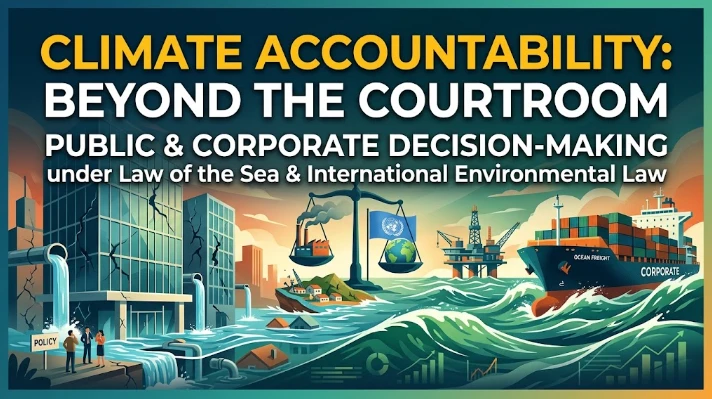
Climate accountability increasingly operates through routine public and corporate decisions rather than exclusively through litigation. This article examines how international environmental law and the law of the sea influence government budgets, permits, procurement, port operations, insurance, energy planning, investment, and corporate governance. The 2024 advisory opinion of the International Tribunal for the Law of the Sea recognized anthropogenic greenhouse-gas emissions as pollution of the
This article examines how biometric border systems can create unequal experiences of citizenship and migration control in the United States. It describes facial recognition, fingerprinting, iris scanning, and interconnected identity databases as technologies that may improve verification and reduce fraud while also expanding surveillance and distributing errors unevenly. The article mentions false matches, failed identification, secondary inspection, questioning, detention, and weak appeal proce