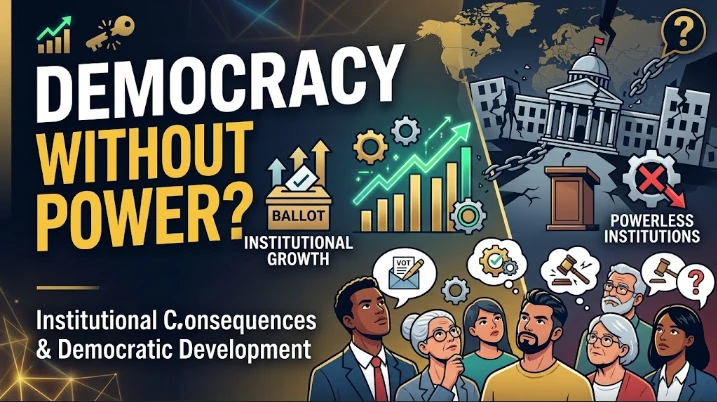
Participation is frequently treated as evidence of democratic development, but attendance at meetings or completion of surveys does not demonstrate that citizens possess meaningful influence. This article distinguishes access—the opportunity to enter a meeting, election, hearing, platform, or consultation—from power, understood as the practical ability to shape agendas, budgets, appointments, implementation, and review. Governments and development organizations often report easily measured indicators such as attendance, workshop numbers, gender balance, and public submissions. These measures show reach but reveal little about whether recommendations changed policy. Repeated symbolic consultation can reduce trust when institutions collect public opinions without explaining their decisions or following citizens’ proposals through the policy cycle. The article recommends tracking which submissions enter official drafts, receive funding, affect implementation, and produce documented responses. It also emphasizes inclusive recruitment, accessible information, participation support, independent evaluation, and transparent feedback. Democratic participation becomes credible when institutions demonstrate how public contributions influenced decisions and explain why particular recommendations were accepted or rejected.
Electoral processes, institutional reforms, CSO development, as well as better public administration are used to assess democratic development. Various forms of participation are included in each of the categories, and while participation can be rather superficial when citizens have no control over the agenda, budget, appointments, implementation or review. It's a point to closely watch in November 2025, as many governments have embraced a participatory model and yet kept a centralist one. Whereas a democracy can establish more arena for voice - and the arenas need not be redistributions of authority to achieve that.
Access vs power is a good point of departure. Access: entry into a meeting, surveys, hearing, platform or election. Power is not so much a theoretical ability to make a difference and to make decision makers answer for the results of their choices, as much as it is a viable and practical ability. Access, however, can lead to a frustrated policy-making reaction if institutions gather opinions but don't follow up with policy. If symbolic consultation is repeated from time to time, it can become detrimental to trust because of participation creating expectations which are not institutionally supported.
Participation which can be counted is often preferred by the development agencies and governments. Attendance and number of workshops and gender balance were criteria of fit for reporting. Those indicators give a measure of reach only and not influence. Poor evaluation not following recommendations through the policy cycle. Which proposals did it get into the official drafts?
Which budgets changed? Who were represented by the communities? What were objections that resulted in redesign? So what commitment was finished? Now those questions move the focus and gaze from the event to institutional consequence.
Timing determines influence. Involving people early in the process and helping to inform the problem and options. Late participation tends to be used to elicit a response from communities to a preferred plan.
Once choices have been made through the consultation process of procurement or site selection or during the drafting of legislation, limited options will be available to change these core decisions. Rules therefore need to be adopted for the effective development of democracies that open up the process of decision making before it becomes too hard to undo commitments. Renewed engagement with a material change should also be the basis for changes and not on outdated consents.
Another source of power that is hidden is agenda setting. The police can call for a lengthy discussion of subjects without asking questions about taxpayers, land, police, debts and distribution. The participants are then given a choice of limited options, predetermined elsewhere. Some institutional capacity must be given to participatory institutions to allow them to put items on the agenda, to request information, to commission independent information, and to demand formal responses. Voice, however, is limited to agenda without the lack of agenda rights.
Invite people to represent but don't make it open invitation. Social inequality is manifested in time, mobility, access to digital tools, language, self-assurance and vulnerability towards retribution. Established organisations and business associations will generally have a much bigger capacity than an informal community. Wider participation can be achieved by having compensation, translation and childcare, disabled access, random selection and targeted recruitment and community facilitation. However, inclusion should take some autonomy and not have community members become unpaid advisors on decisions that have already been made.
There are important learnings from local participatory budget. Even modest investments enhance trust and civic learning when they lay down rules that are transparent and consequences seen. But local exercises also can distract from larger, centrally-planned fiscal decisions. The greater the share of allotment for democracy (both on maintenance and via projects), the greater its value. One playground vote should not replace, however, a public-health, a transport, and a housing budget.
Quality discussion: Citizens' assemblies and deliberative mini-publics can enhance the quality of discussion. Random Selection is used to minimize effects of dominance by organized interests and Grounded Evidence and Facilitating to provide informed judgement. The linking with institutions remains to be final. Recommendations should get parliamentary debate, be open to public feedback, provide implementation reports, and have a binding referring mechanism. When not held to account and managed effectively this can turn another Assembly into another demonstration project, instead of a tool for democratic power.
Despite the changes and challenges, elections are an invaluable tool given that those elected have the power to promulgate general laws and allocate resources. Participatory reform isn't to be compatible with a single layer of non-elected power without any means for the people to hold that power to account. Legislatures can host asemblies, pose questions, post answers and incorporate citizens' suggestions in committee hearings. For policy development, participatory processes can be used which nevertheless include clear responsibilities for making decisions.
The involvement of administration counts also. There are many Rights which are only felt in schools, clinics, licensing bodies, welfare offices, police and digital portals and not in legislatures. Implementations will be affected by complaint systems, user advisory councils institutions, service standards, and co-design. Often there is exclusion within the general policy, and it comes to light through frontline feedback. Good systems ensure the safeguarding of complainants, detailing of patterns, accountability and follow-up of remedies.
The software platforms bring scale, and can camouflage institutional limitations. A petition may be able to bring in a lot of signatories without debate. Thousands of comments can be made with online consultation and the algorithms dictate how visible it is.
Those that are migrants or citizens without documentation are not necessarily included in the identity requirements. Collection of data can have a chilling effect on dissent. To ensure a high level of participation by digital users, measures must be put in place to secure privacy, to provide alternative means of participating, to inform about the process of moderation and to establish clear links between participation and decision making.
Participation also has an impact on the state capacity. Local knowledge can be gained, challenges to implementation and cooperation can be identified. But whether poorly designed, can lead to delay in decisions without adding to legitimacy. Well defined mandates, realistic timescales, suitable evidence and explanation of constraints ensure a lack of fatigue. There are differences between consultation, negotiation, co-production and consent, and it is important to be aware of the different levels of authority that they imply.
Power is most evident when participation indicates that it is able to 'stop' or 'change' a harmful decision. Trigger mechanisms can be based upon a threshold of signatures, evidence of unequal impact, credible rights concerns. Community monitoring will suspend payment if there is breach of contractors' obligation. ICP allows for expression of native land and resource rights. Such are not forever vetoes - are structured levers with consequences focused.
The research on participation should be a combination of quantitative and qualitative method. Recs, budgets and implementation can be tracked via administrative data. Surveys have ability to gather efficacy and trust.
Intimidation, exclusion and informal bargaining are possible themes that can be seen from interviews. A comparative analysis of design characteristics across municipalities or agencies can identify design characteristics that relate to better outcomes. The focus of the central dependent variable cannot be the amount of participation, but the institutional change.
When voice flows through institutions, and comes out as a reason, new policy, co-ownership or redemptive denial. A decentralized government is more likely to be beautiful while being backed by participating populace. Resulting from participation requires corrective empowerment can enrich democracy by altering both the identity of those who can frame problems, control resources and call for corrective. There is no point of getting to a final consensus. The aim: a public process in which dissent is added as a built-in part of the decision-making processes, heavy-handed burdens are given careful consideration and decision makers are held accountable after the public consultation is completed.
There is also a need for continuity in the participation over the political life cycles. Ministerial discretion in the establishment of a forum means it can cease to exist when the government changes. Processes need to be stabilized with statutory mandates, dedicated budgets, public archives or with cross-party sponsorship. Independent review should continue to be provided periodically to ensure each body continues to be representative, valuable and has links to decisions.
There is nothing wrong with conflict, it isn't a reflection of failure. Oil and water are highly contentious issues; this is most likely because they are actually contentious issues of distribution. A well designed project can be conflict-based on evidence, on reasons, negotiation and review; not on skidding out of putting an artificial consensus upon the project. Information contained in a minority report, recorded objection and alternative proposal may be information lost by a majority recommendation.
Facilitator(s) and consultant(s) should be held accountable. Often external engagement firms influence questions, who should participate in the meetings and ‘meeting summaries'. There should be discoverability in contracts which explains the methods, conflicts, raw themes, and limits. There is no democratic legitimacy to be delegated to a private process manager, public agencies must keep up with accuracy.
There must be a public theory of refusal as well for participatory institutions. Sometimes officials do not accept ideas (for reasons of cost, law, evidence or conflicting rights). Even if a proposal is refused, a reasoned refusal can still be respectful as participants make no logic jumps and evidence and trade-offs are disclosed. Such as a vague 'thank you' or a lack of response in the language of appreciation, suggests that engagement was lacking in institutional terms.
Laboratory type pilots and building them can help enhance design prior to national expansion. The municipality or agency can "try" recruitment, voting requirements and the 'call to duty' of response, and independent evaluators make comparisons with similar areas. Scaling should be based upon evidence of influence rather than publicity. There should also be publicity of failed pilots since hushed up failures lead to additional design flaws. Also participant diversity and uptake of the recommendations as well as implementation status should be displayed in public reporting in a single place. Symbols are easier to identify when used on comparable records.
CITE THIS ARTICLE
Amin, M. R. (2025). Participation Without Power? Institutional Consequences of Democracy and Democratic Development in Contemporary Democracies. https://www.ruhulresearchhub.com/article/85480ebd-4830-5adc-a8a6-245ef29eda92
M. R. Amin, “Participation Without Power? Institutional Consequences of Democracy and Democratic Development in Contemporary Democracies,” 2025. [Online]. Available: https://www.ruhulresearchhub.com/article/85480ebd-4830-5adc-a8a6-245ef29eda92
Amin, M. R. (2025) ‘Participation Without Power? Institutional Consequences of Democracy and Democratic Development in Contemporary Democracies’. Available at: https://www.ruhulresearchhub.com/article/85480ebd-4830-5adc-a8a6-245ef29eda92
Amin, Mohd. Ruhul. “Participation Without Power? Institutional Consequences of Democracy and Democratic Development in Contemporary Democracies.” 2025, https://www.ruhulresearchhub.com/article/85480ebd-4830-5adc-a8a6-245ef29eda92.
Mohd. Ruhul Amin. “Participation Without Power? Institutional Consequences of Democracy and Democratic Development in Contemporary Democracies.” (2025). https://www.ruhulresearchhub.com/article/85480ebd-4830-5adc-a8a6-245ef29eda92.
Amin MR. Participation Without Power? Institutional Consequences of Democracy and Democratic Development in Contemporary Democracies. 2025. https://www.ruhulresearchhub.com/article/85480ebd-4830-5adc-a8a6-245ef29eda92
@misc{article_85480ebd48305adca8a6245ef29eda92,
  title = {Participation Without Power? Institutional Consequences of Democracy and Democratic Development in Contemporary Democracies},
  author = {Mohd. Ruhul Amin},
  year = {2025},
  url = {https://www.ruhulresearchhub.com/article/85480ebd-4830-5adc-a8a6-245ef29eda92},
}
TY  - GEN
AU  - Mohd. Ruhul Amin
TI  - Participation Without Power? Institutional Consequences of Democracy and Democratic Development in Contemporary Democracies
PY  - 2025-09-29
UR  - https://www.ruhulresearchhub.com/article/85480ebd-4830-5adc-a8a6-245ef29eda92
ER  -
This article presents democratic recovery after executive overreach as a process of reopening institutions rather than merely restoring formal legal boundaries. It describes how executive misconduct can leave politicized appointments, weakened oversight, restricted records, altered enforcement practices, intimidated officials, and concentrated agenda control. The article mentions open-democracy theory as requiring continuous accessibility, deliberation, transparency, inclusion, and responsivenes
Climate accountability increasingly operates through routine public and corporate decisions rather than exclusively through litigation. This article examines how international environmental law and the law of the sea influence government budgets, permits, procurement, port operations, insurance, energy planning, investment, and corporate governance. The 2024 advisory opinion of the International Tribunal for the Law of the Sea recognized anthropogenic greenhouse-gas emissions as pollution of the
This article examines how biometric border systems can create unequal experiences of citizenship and migration control in the United States. It describes facial recognition, fingerprinting, iris scanning, and interconnected identity databases as technologies that may improve verification and reduce fraud while also expanding surveillance and distributing errors unevenly. The article mentions false matches, failed identification, secondary inspection, questioning, detention, and weak appeal proce