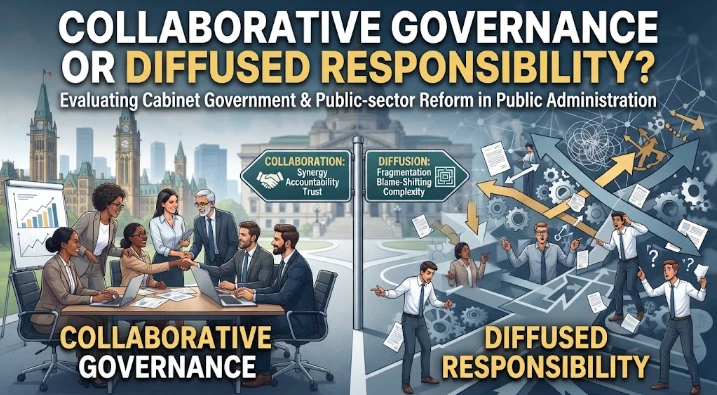
The article evaluates whether collaborative governance in public administration improves coordination or instead diffuses responsibility. Using Cabinet government and cross-agency reform as the setting, it argues that collaboration requires clear mandates, decision rights, budgets, reporting lines, lead ministers, lead executives, and dispute mechanisms. Shared programs need secretariats, data governance, community participation, accountable contracting, parliamentary scrutiny, audit, and preservation of public-service values. The article warns that informal consensus, fragmented appropriations, portfolio-based oversight, and unclear delegations can create an accountability fog in which no actor owns failure. It also highlights transaction costs, exit rules, geographic equity, workforce incentives, risk registers, conflict-of-interest rules, decision records, user journey analysis, and evaluation with baseline data. The central conclusion is that shared action and individual accountability must coexist. Collaboration is legitimate when it reduces fragmentation while citizens can identify where decisions are made, who is responsible, how money is spent, and where complaints and remedies belong.
In the context of cross-agency problems, collaborative governance holds promise of providing solutions. In the areas of housing, climate resilience, public health, digital services, infrastructure, and child well-being, it is rare for these policies and resources to be within a single department. As a result, public-sector reform drives on the formation of partnerships with private organizations, communities and the local government, shared services, interdepartmental boards and joint ventures. The main question that is being evaluated in February 2026 is: Does collaboration help to establish greater coordination or does the collaboration result in a diffusion of responsibility with no single actor held accountable?
In any case, the cabinet government is already based on collective decision making. Collective responsibility is one of the bedrock principles of New Zealand government as outlined in Cabinet Manual. There are agreed decisions made by the Ministers, departments and portfolios are allocated and departments have statutory roles. Another layer employed here is collaboration as several ministers, chief executives and agencies can share an outcome. Shared ownership brings together resources and expertise but also creates confusions in accountability about resources and about failure.
The first strand of safeguarding is having a clear mandate. Collaborative bodies must have clear goals, legal standing, membership, rules for decision-making and towards whom to report. If it's written as partnership together or 'joined up delivery' there is flexibility - for some to do more and others to do less. A mandate should include authorisations about the decisions to be taken, the range of staff and budgets from different agencies and the arrangements to be made for solving disputes.
Responsibility for the budget will often sing out the actual structure. Additional appropriations (controlled by separate departments) is a viable option for a cross-agency program. Both bodies can signal and communicate internally that necessity will require them to cooperate while assuring externally, a potential audience of marketing partners, that they are disconnected in their existence. Funding can be better matched through pooled funding or through such things as “tag” funding or decisions made entirely at the Cabinet level. Financial reporting should be detailed both to allow reporting of expenditure and results.
Leadership is important but persons should not take the place of institutions. A good chair will be able to temporarily put a conflict behind them. The key elements of a good, longer-term collaboration are the presence of a secretariat, shared data, regular review and clear escalation. The changing of staff members should not only break down cooperation. Written procedures maintain lines of continuity and dependence on informal networks of communication.
There's opportunity and there's risk when it comes to data sharing. The integrated information can identify information service gaps and limit the need for multiple applications. Much like privacy, consent, data quality and purpose limitation are key. Promoting 'open access' in a collaborative programme without any accountability should be avoided. Data governance requires designated owners, logging and auditing, processes to correct data, and beyond that, principles for further use.
Enacting a partnership should be about using influence not about ‘consultation theater'. Community groups may have local expertise and local ties but if they work based on government contracts, they may only be able to deliver government services. Collaborative governance is strengthened by partners contributing to the outcomes, access to the resources, and through performance reviews. Funds must be awarded for costs of participation.
The use of private contractors makes for more complicated questions of accountability. Commercial constructions limit information; outsourcing can provide expertise and speed. Performance measures and requirements, audit access, mechanisms of complaint and public records provisions are required for contracts. Public outcomes are the responsibility of the government, even if the delivery is going to be outside of government.
The oversight of Cabinet should be about conflict that did not get resolved. Negotiation with other bodies is an option for technical co-ordination but important compromises are made by elected decision makers. There should not be artificial consensus in Cabinet papers, which should be revealed if it is genuine. Disagreements, distributional effects, and implementation risks need to be included in Cabinet papers if they exist. The notion of collective responsibility only has sense if collective decision was made on the basis of information.
Its parliamentary scrutiny is hampered by, among other factors, the committees being organised by portfolio. However, cross cuttings programs may exist between committees. There is a need for enhanced oversight, including the following: Joint queries; shared reporting; and outcome-based estimates hearings. Ministers need not detract from their accountability by referring to a group. There is still a need for a lead minister or the functions are clearly apportioned.
Audit institutions can have a look at governances constitution and spending. So some questions that are useful are: is it clear what are the objectives? Do they have good information? Do they understand their roles? Do they take corrective action? Lest performance measurement devolve into a list of activities. They should tie-in to a decision and the responsible individuals.
Public-service values are still applicable. There should be collaboration based on political neutrality, free and frank advice, merit, open government and stewardship. The characteristics of joint structures can make it particularly difficult for officials to show that they do not agree for fear this will compromise the unity of the group. There is a need to keep internal records which contain professional advice and provide an explanation of any deviation. Cooperation is designed to harness skills, rather than wipe out them.
To evaluate, you would need a counterfactual. If the outcomes are better following reform, it does not necessarily mean that collaboration effected improvement. Mechanisms can be identified through means such as comparative pilots, phased implementation, process tracing and user experience. It is also important to evaluate transaction costs, as this aspect of meetings, reporting and coordinating can take up a lot of capacity.
Exit rules matter. There are some multi-lateral bodies that should be terminated after a project and other that should carry on permanently. Continued value can be determined by sunset reviews. Closure requires documentation and transfer of responsibility and safeguarding of continuing services. Institutions have a habit of staying on, as there is not much control over their termination.
The shared action and individual accountability are both present, which is the key to collaborative governance. A citizen should be aware of where a decision is made, who a Minister is responsible for a decision, what agency maintains registration of a decision, and where a citizen could send a complaint. The Collaboration can be achieved through collective direction in a form of cabinet government, but there must be accountable responsibilities in public administration. Joined-up government is legitimate when – through working together – fragmentation is reduced but an accountability fog avoided.
Before implementing an approach, an 'outcome' owner should be agreed. Political direction with a lead minister and delivery by a lead chief executive. Responsibility for statutory functions will remain vested in partner agencies. Division should be explained in terms of the public in the public documentation.
Risk registers can be a way of promoting accountability if published at an appropriate level. The critical County requirements, data threats, human resource deficits and outstanding policy issues should continue to be apparent with Cabinet and Parliament. Preserving confidential detail while maintaining the integrity of the whole balance can't be left to total secrecy.
Conflict rules are for collaborative bodies as well. Members may be from agencies, communities and private interests and have various responsibilities. Publication of interests, Declarations diminish suspicion. There must be separation of advice and profit in particular with regard to procurement.
Equity as related to geography should be integrated as an aspect of evaluation. National co-operation can focus resources in larger cities, or cities with good administrative capacities. Caring about Equity, Regional Data Participation, and Distributing benefits. Standard efficiency tools are unable to account for the high cost of delivery which is a reality in rural communities.
Workforce Incentives divert the collaborative efforts. Staff are judged based on Internal targets of agencies – outlooks of cross-agency work seem low priority. Target alignment can be achieved through shared objectives, secondments, and acknowledging others' performance. Home-agency brilliance needs to be enhanced and not undermined by the steps to complimentary career progression.
A map to the public can help to lessen confusion. Individuals need to be aware of who the agency is that is accepting applications and who holds data, complains and pays for delivery. The complexity that is behind the scenes shouldn't be passed on to the service users.
Last, there is a need to correct handwriting in the area of collaboration. Leaders should determine causes for failure to meet the goals of a program and adjust programs. Failure can be hidden in a rebranding or other committee. Evaluation and published management responses are independent, encouraging real learning.
An accountability section should be incorporated within cabinet papers with regards to cross-agency proposals. In the section, one may specify the owners of decisions, who custodians the information, appropriations, and complaint channels. Little procedural thing which can add confusion prior to approval.
Democratic time need to be taken into account in public-sector reform too. To speed delivery, consultations may be compressed, which also omits local knowledge, through collaboration. Timelines need to differentiate between urgency or not and a manager's preference.
Records of decisions and dissent should be made on interagency boards. Minutes can be used to ensure that confidential discussion is maintained, without compromising accountability. When informal consensus takes place without record, it will be not so effective after leadership changes.
A governance review should be based on user outcomes. The recipients of a service do not often care by which company, in fact, the service was delayed. Journey mapping, complaint analysis and case auditing can provide a layer of visibility to reveal fragmentation beyond agency levels of performance.
Every instance of failure should be accompanied by the ministerial responsibility. Rescue of Responsible Minister has not been lifted by Collective Cabinet support so that there is a responsible minister's duty to implement and correct. Having clear public answers (which helps collaboration and not hinder it) is important.
Operational control should be transferred and re-legally authorized, where a change occurs in the authority of the participation. Delegation of power (informal) can raise issues relating to statutory obligations. The risk is lowered by legal advice, published delegations, and by a revised accountancy document.
Evaluation is an essential component of collaborative programs, and should be planned from the beginning. Decisions based on a retrospective evaluation, where no baseline data measurements exist, are almost never based on a strong conclusion.
CITE THIS ARTICLE
Amin, M. R. (2025). Collaborative Governance or Diffused Responsibility? Evaluating Cabinet Government and Public-sector Reform in Public Administration. https://www.ruhulresearchhub.com/article/89eaf87e-f221-5ed8-9758-3e7ba1cdcee6
M. R. Amin, “Collaborative Governance or Diffused Responsibility? Evaluating Cabinet Government and Public-sector Reform in Public Administration,” 2025. [Online]. Available: https://www.ruhulresearchhub.com/article/89eaf87e-f221-5ed8-9758-3e7ba1cdcee6
Amin, M. R. (2025) ‘Collaborative Governance or Diffused Responsibility? Evaluating Cabinet Government and Public-sector Reform in Public Administration’. Available at: https://www.ruhulresearchhub.com/article/89eaf87e-f221-5ed8-9758-3e7ba1cdcee6
Amin, Mohd. Ruhul. “Collaborative Governance or Diffused Responsibility? Evaluating Cabinet Government and Public-sector Reform in Public Administration.” 2025, https://www.ruhulresearchhub.com/article/89eaf87e-f221-5ed8-9758-3e7ba1cdcee6.
Mohd. Ruhul Amin. “Collaborative Governance or Diffused Responsibility? Evaluating Cabinet Government and Public-sector Reform in Public Administration.” (2025). https://www.ruhulresearchhub.com/article/89eaf87e-f221-5ed8-9758-3e7ba1cdcee6.
Amin MR. Collaborative Governance or Diffused Responsibility? Evaluating Cabinet Government and Public-sector Reform in Public Administration. 2025. https://www.ruhulresearchhub.com/article/89eaf87e-f221-5ed8-9758-3e7ba1cdcee6
@misc{article_89eaf87ef2215ed897583e7ba1cdcee6,
  title = {Collaborative Governance or Diffused Responsibility? Evaluating Cabinet Government and Public-sector Reform in Public Administration},
  author = {Mohd. Ruhul Amin},
  year = {2025},
  url = {https://www.ruhulresearchhub.com/article/89eaf87e-f221-5ed8-9758-3e7ba1cdcee6},
}
TY  - GEN
AU  - Mohd. Ruhul Amin
TI  - Collaborative Governance or Diffused Responsibility? Evaluating Cabinet Government and Public-sector Reform in Public Administration
PY  - 2025-12-22
UR  - https://www.ruhulresearchhub.com/article/89eaf87e-f221-5ed8-9758-3e7ba1cdcee6
ER  -
This article presents democratic recovery after executive overreach as a process of reopening institutions rather than merely restoring formal legal boundaries. It describes how executive misconduct can leave politicized appointments, weakened oversight, restricted records, altered enforcement practices, intimidated officials, and concentrated agenda control. The article mentions open-democracy theory as requiring continuous accessibility, deliberation, transparency, inclusion, and responsivenes
Climate accountability increasingly operates through routine public and corporate decisions rather than exclusively through litigation. This article examines how international environmental law and the law of the sea influence government budgets, permits, procurement, port operations, insurance, energy planning, investment, and corporate governance. The 2024 advisory opinion of the International Tribunal for the Law of the Sea recognized anthropogenic greenhouse-gas emissions as pollution of the
This article examines how biometric border systems can create unequal experiences of citizenship and migration control in the United States. It describes facial recognition, fingerprinting, iris scanning, and interconnected identity databases as technologies that may improve verification and reduce fraud while also expanding surveillance and distributing errors unevenly. The article mentions false matches, failed identification, secondary inspection, questioning, detention, and weak appeal proce