The article argues that rights protection under the New Zealand Bill of Rights Act depends on administrative behavior as much as judicial review. Court decisions cannot secure rights if frontline rules, budgets, data systems, operational guidance, and organizational incentives produce unlawful or unfair outcomes. The article links Bill of Rights protections, section 7 vetting, administrative fairness, public-service obligations, parliamentary scrutiny, internal review, ombuds oversight, complaints, inspectors, and compliance audits. It proposes explicit rights-impact assessment, written reasoning for limitations, decision documentation, staff training, structured discretion, technology audits, escalation routes, and remedies proportionate to individual and systemic harm. Evidence should include administrative records, reasons, denied services, searches, complaints, court decisions, and implementation follow-up, with special attention to groups facing unequal access to legal resources. The central message is that constitutional rights become effective when agencies identify, explain, review, and correct rights impacts rather than waiting for litigation to expose recurring administrative failures.
When the institutional limitations of emergency power in New Zealand are debated, it's frequently with a ‘principles first’ approach and the issues of implementation second. Urgent executive action in July 2026 can speed up consultations, implement excessive measures and precedent-setting restrictions that are not necessarily necessary at the time. The fallout is often more a result of a debris of bits and pieces of procedures, incentives and omissions. Thus, institutional design is defined to receive the corresponding consideration that it given legal doctrine.
The governing framework includes: The New Zealand Bill of Rights Act, Legality, Justified limitations, Parliamentary control, Judicial review and International rights. Those sources set standards, standards need institutions that will interpret, implement and review the standards. All the key actors are Cabinet, Parliament, emergency agencies, Police, courts, Councils, public health(s) and affected communities. Independence in that group must be maintained—there should be no confusing of accountability.
The New Zealand Bill of Rights Act 1990 is a statement of civil and political rights and a guide to the policy, law, policing, detention, expression, movement, equality and fair procedure. It is not strange if the rights analysis does not stop when the statutory text. Practical effect is as a result of administrative interpretation, operational guidance and resource allocation. Thus institutional behaviour is a flash point of the constitution, and comes prominently under its protection.
Rights issues taken to Parliament in Section 7 vetting are raised when government bills are put on the table but the operational consequences can of course not be foretold at the time of pre-legislative scrutiny. Agencies have to be constantly evaluated throughout the implementation process. Often, restrictions that may seem marginal while designing the policy will become evident through complaints, judgmental rulings, audit results and in-front reports. Feedback should be used for revision and not be confined to litigation files.
Disciplined evidence is needed when it comes to justified limitations. Not all restrictions are lawful, just because a restriction is claimed to be in pursuit of a legitimate aim. Decision makers should inquire on connection, necessity, lesser and alternative measures, duration and unequal impact. Written analysis enhances the quality of law and the public explanation.
While judicial review is important, litigation is costly, time consuming, has standing obstacles and unequal counsel. Early correction can be provided through internal evaluation, ombudsman oversight and independent complaints, inspectors and parliamentary oversight. There are several avenues which lead to institutional redundancy. Remedies must be delivered – at the individual decision level and also to the broader policy that is repeatedly producing negative outcomes.
The emergency governance processes challenge all the safegards at once. Urgency compactifies information, involves more authority, and it allows public acceptance of a restriction. Having clear legal authority, scope and evidence as well as regular and automatic renewals can maintain constitutional discipline. Retained information, contracts, penalties and other organizational practices all should be part of a post-emergency review.
The key focus of a practical agenda of reforms is clear statutory authority, necessity evidence, proportionality, clauses of time limits, review, clear orders and easy access to challenge. One element deals with failure point #1: Prior to harm, authorsuiation; #2: During harm, documentation; #3: After harm, review; and #4: When harm occurs, remedy. This is because doability is lower due to weaker accountability at later stages if there is no record of, or justification for, it previous stages.
Emergency orders, assessment of rights (whether in the country or in the exporting nation), monitoring of enforcement of orders, exemptions issued, parliamentary scrutiny, judicial rulings and expiry records should all constitute evidence. This type of information enables inter-agency, inter-regional, inter-temporal and inter-target group comparisons. Certain patterns, disparities, delays and repetitive institutional failures can be illuminated without compromising confidentiality through publication.
Essential workers and other highly vulnerable groups—disabled, migrant, detained and low-income households or communities—must be at the heart of equity analysis. Formal neutrality cannot give answers to questions about the extent and predictability of burden concentrations nor to the extent of differential access to review by income, status, geography, disability, ethnicity, age or language. Distributional evidence - design and resource allocation.
All measuring behaviors and methods in themselves pose dangers. Indicators can make for easy outcomes and help foster strategic reporting. Any quantitative data should then be presented alongside the qualitative evidence, independent verification and clear definitions. Disaggregated reporting is important to ensure that strong results at the national level do not mask either the fact that the results are poor for specific groups or the fact that results are poor in specific areas at the national level.
Legitimate effects of public communication. Administrative decisions often involve a great deal of technical jargon, which can distract from the substantive issues at play, and a great deal of rhetoric, which can create an impression of uncertainty. Clear explanation, objectives, evidence, trade-offs, affected rights, and challenge (available). Expressing and being clear about limitations is often a source of greater confidence, than suggesting control.
Implementation requires resources. Review Bodies must have staff, skill, time and access to records, and power to enable them to obtain responses. Funding, the interpretation, accessible venues, and time also are needed for community participation. For unfunded rights and participation duties to become real, it is necessary that they be monitored.
As it comes to institutional change, choose between universal standards and context should not be a false dichotomy. A wide range of core protections like legality, equality, notice, review and remedy exist. How those protections work in practice are impacted by local knowledge. The approach to durable design includes common measures, as well as culturally, geographically and experientially sensitive procedures.
Evaluation of policies should be done post launch and be long term. When key personnel move on or when a crisis arises or budgets become tight, then early compliance may be lost. Continuity is under pressure due to scheduled review, public reporting and independent research. It is important to remain corrective action without having to fail the policy wholesale.
Information about the values of culture depend on leadership signals. Rights analysis should be requested at a high level and (adverse) findings should be reacted upon at a high level in a visible way without compromising candid advice. You can get rewards for detecting and fixing the problems early. Whenever there have been multiple legal issues, silence is golden, which tells employees that compliance is not an issue until it is the courts that intervene.
A measure of the remedies should be proportionate to individual and systemic harm. Reconsideration can be used to modify the individual decision; policy change, data removal, training, remuneration or autonomous oversight may be effective ways of tackling more general causes. The responsibilities for implementation should be specified by courts and oversight bodies. Completed action and unresolved barriers should be published by the agencies.
The range of action of the State is altered by technology. Without an actual frontline decision, rights can be due to the presence of automated functions such as triage, equating identity, prediction and integrated databases. Audits for model purpose, data sources, error, human review and appeal are important for agencies to have. Public audit and correction rights of the procurement contracts.
Lessons must be determined in terms of the support provided to frontline discretion. Laying out all the rules in detail in advance of certain situations cannot be foreseen, but vast discretion leads to inconsistencies and inequities. Judgement can be enhanced through various decision-making aids, supervision, their “own” recorded reasons, and review samples. Staff to be aware when specialist legal advice is required with regard to a rights issue.
They ought to be continued after Act is passed, scrutiny by Parliament. Implementation can be tested through delegated-legislation examination, statutory reviews, and by select committees through agency reporting. The sunset and review requirements should be set for a time before they are automatically renewed. Practical impact of these is expressed by public submissions and these might not be reflected in departmental reporting.
At each stage responsibility should be determined in the governance structure. Nothing could be more frustrating to the Cabinet, the Parliament, the emergency bodies, the Police, the courts, the councils, public-health agencies and even the affected communities than if those responsibilities of authorisation, supply, monitoring and remedy would not be traceable. With overlapping mandates there must be written protocols and escalation. Ambiguity is otherwise used to shield institutional limits and not people that have been impacted.
Don't forget to include in the risk assessment what you don't do. You need to balance over- and under-intervention – over can impact on rights, under can lead to harm going unaddressed or fragmented intervention. Decision records should include an account of the balance taking account of the evidence available and any less than restrictive alternatives that have been considered. The skill to later review and analyse reasoning can then be developed instead of having to work out unstated assumptions.
Independent research can offer a link between official reports, and people's experience. Easy access to your data, ethical control and publication rights enable scientists to verify institutional claims. Confidentiality and any community authority is to be maintained in partnerships. Findings are not to be taken for granted but to be formally responded to.
A narrowly defined limitation, equal exemptions, speedy review, equal application, timeliness of expiration and audits at the end of the crisis should be the criteria by which success is measured. These measures are a mix of outcomes, procedure and institutional capability. Targets: Public, Definitions: Stable, Failures: followed with explanations and corrective plans.
The process of reform should thus shift from the few general commitments to concrete institutional practice, clear statutory authority, necessity evidence, proportionality, validity time limits, orality of international orders and challenge and accessible post-crisis auditing, criteria that could be applied in the evaluation process. By prioritizing the needs of essential workers, people with disabilities, migrants, detainees, low-income families and groups facing not equal enforcement of measures, it is less likely that the “aggregate success” will obscure “concentrated harm.”
CITE THIS ARTICLE
Amin, M. R. (2026). Rights in the Shadow of Emergency: Institutional Constraints on New Zealand Bill of Rights and Constitutional and Administrative Law in New Zealand. https://www.ruhulresearchhub.com/article/95522acd-7ba6-5da3-9f27-8a225c1581fa
M. R. Amin, “Rights in the Shadow of Emergency: Institutional Constraints on New Zealand Bill of Rights and Constitutional and Administrative Law in New Zealand,” 2026. [Online]. Available: https://www.ruhulresearchhub.com/article/95522acd-7ba6-5da3-9f27-8a225c1581fa
Amin, M. R. (2026) ‘Rights in the Shadow of Emergency: Institutional Constraints on New Zealand Bill of Rights and Constitutional and Administrative Law in New Zealand’. Available at: https://www.ruhulresearchhub.com/article/95522acd-7ba6-5da3-9f27-8a225c1581fa
Amin, Mohd. Ruhul. “Rights in the Shadow of Emergency: Institutional Constraints on New Zealand Bill of Rights and Constitutional and Administrative Law in New Zealand.” 2026, https://www.ruhulresearchhub.com/article/95522acd-7ba6-5da3-9f27-8a225c1581fa.
Mohd. Ruhul Amin. “Rights in the Shadow of Emergency: Institutional Constraints on New Zealand Bill of Rights and Constitutional and Administrative Law in New Zealand.” (2026). https://www.ruhulresearchhub.com/article/95522acd-7ba6-5da3-9f27-8a225c1581fa.
Amin MR. Rights in the Shadow of Emergency: Institutional Constraints on New Zealand Bill of Rights and Constitutional and Administrative Law in New Zealand. 2026. https://www.ruhulresearchhub.com/article/95522acd-7ba6-5da3-9f27-8a225c1581fa
@misc{article_95522acd7ba65da39f278a225c1581fa,
  title = {Rights in the Shadow of Emergency: Institutional Constraints on New Zealand Bill of Rights and Constitutional and Administrative Law in New Zealand},
  author = {Mohd. Ruhul Amin},
  year = {2026},
  url = {https://www.ruhulresearchhub.com/article/95522acd-7ba6-5da3-9f27-8a225c1581fa},
}
TY  - GEN
AU  - Mohd. Ruhul Amin
TI  - Rights in the Shadow of Emergency: Institutional Constraints on New Zealand Bill of Rights and Constitutional and Administrative Law in New Zealand
PY  - 2026-05-18
UR  - https://www.ruhulresearchhub.com/article/95522acd-7ba6-5da3-9f27-8a225c1581fa
ER  -
This article presents democratic recovery after executive overreach as a process of reopening institutions rather than merely restoring formal legal boundaries. It describes how executive misconduct can leave politicized appointments, weakened oversight, restricted records, altered enforcement practices, intimidated officials, and concentrated agenda control. The article mentions open-democracy theory as requiring continuous accessibility, deliberation, transparency, inclusion, and responsivenes
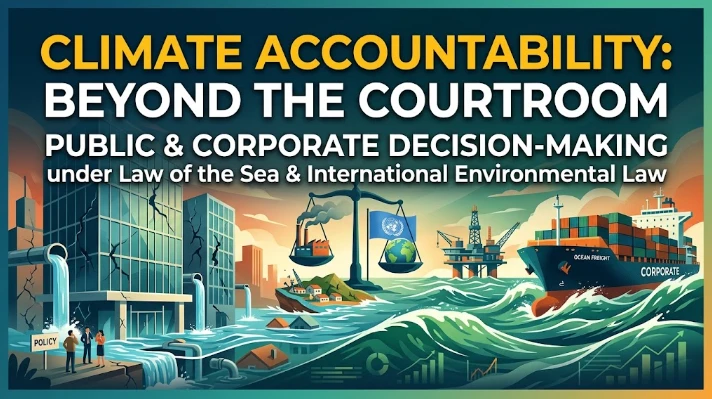
Climate accountability increasingly operates through routine public and corporate decisions rather than exclusively through litigation. This article examines how international environmental law and the law of the sea influence government budgets, permits, procurement, port operations, insurance, energy planning, investment, and corporate governance. The 2024 advisory opinion of the International Tribunal for the Law of the Sea recognized anthropogenic greenhouse-gas emissions as pollution of the
This article examines how biometric border systems can create unequal experiences of citizenship and migration control in the United States. It describes facial recognition, fingerprinting, iris scanning, and interconnected identity databases as technologies that may improve verification and reduce fraud while also expanding surveillance and distributing errors unevenly. The article mentions false matches, failed identification, secondary inspection, questioning, detention, and weak appeal proce