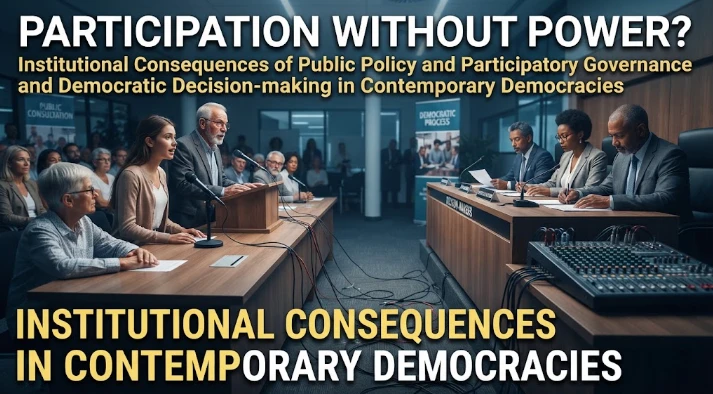
Thus, the participation continuum lies between the three domains of law, administration and public legitimacy. There's extra weight to the issue in July 2026, as the consultations have the potential to collect views while exploring options around also altering an agenda, budget, representation, and final decisions. Goodwill is not the only thing that good institutions can live off of. Safeguards need to be effective in times of pressure, disagreement and political change.
Participation principles in a democratic governance system, administrative fairness, the function of local government, equality norms and access to information regulations are incorporated in the governance arrangement. Those sources set standards, standards need institutions that will interpret, implement and review the standards. Citizens, marginalised community, councillors, ministries, deliberative panels, councillors and public officials are key actors. Independence in that group must be maintained—there should be no confusing of accountability.
Participatory governance is a strategy that often promises to have legitimacy, to provide information and to enhance public ownership. Those benefits are dependent upon the design of the institutions. Open invitations, without more consideration of unequal participation, can lead to unequal participation as the time, confidence, language, transport and digital access remains unbalanced. Openness can be maximized through broadened participation with representative recruitment and practical support.
The link between participation and accountability is through reason-giving. The authorities should provide details about proposals which have changed, as well as those which have not, and the legal and fiscal constraints that have influenced the outcome. Assuming you can just't prove influence through a generic summary. Detailed response allows for public record which aids in learning, challenge, and future participation.
Deliberation is NOT opinion gathering. Participants should have effective counterbalancing, time, indexed debate and discussion, and access to different viewpoints. Deliberative assemblies have the potential to minimise partisan signaling and to facilitate ‘rational' decision-making, but that depends who is involved in the assembly and what the mandate is. Recommendations can be advisory or presumptively accepted by institutions or there might be a formal response threshold.
Other than that, a normal administration is necessary to strengthen democracy. The proper working of election management, public records, procurement process, statistical integrity and professional advice are not issues that typically get a lot of airtime unless they don't work. This guards those systems against possibilities of partisan manipulation. The independent oversight and open appointments can cause erosion before it reaches a critical level of constitutional conflict.
Attendance needs to be monitored in evaluation. There is more evidence in terms of influence, diversity, knowledge gains, trust, policy change, implementation and continued engagement. It can appear to include, but in fact limit representation if repeated participation of the same well connected groups take place. Gaps should be highlighted through the public reporting and corrective action stated.
The rights to be on the agenda, to provide reasons, to participate in budgeting processes, to be elected or be appointed to represent others, to have feedback obligations, and to review rejected proposals should all be key elements in a 'reform agenda' that really works. There is one element for each failure point: authorisation before action, documentation during action, review after action and remedy when harm. This is because doability is lower due to weaker accountability at later stages if there is no record of, or justification for, it previous stages.
The diversity of the participants, the plan's evolution and funding decreases or increases, the formal responses of those involved, the degree to which the plan is being followed, and the extent of long-term citizen involvement should be identified. This type of information enables inter-agency, inter-regional, inter-temporal and inter-target group comparisons. Certain patterns, disparities, delays and repetitive institutional failures can be illuminated without compromising confidentiality through publication.
Equity analysis must focus on the communities that are not well resourced, in terms of time, income or mobility, language access, digital connection or formal representation. Formal neutrality is not able to provide any answer to the question on whether burdens are concentrated predictably, or whether the access to review varies by income, status, geography, disability or ethnicity, age or language. Evidence should be included to help inform design and also resource allocation.
Evaluation of policies should be done post launch and be long term. When key personnel move on or when a crisis arises or budgets become tight, then early compliance may be lost. Continuity is under pressure due to scheduled review, public reporting and independent research. It is important to remain corrective action without having to fail the policy wholesale.
There is a need to link formal rules with incentives in the institutional analysis. The officials behave according to workload, the objective figures, financial means, norms, political signals and anticipated critiques. When those forces drive towards lawful and just behaviour, reform is a success. The safeguard may be printed only in a manual and is not present in case of operating pressure.
All measuring behaviors and methods in themselves pose dangers. Indicators can make for easy outcomes and help foster strategic reporting. One can therefore expect a presence of quantitative data alongside with qualitative evidence, independent verification and transparent definitions. Disaggregated reporting is important to ensure that strong results at the national level do not mask either the fact that the results are poor for specific groups or the fact that results are poor in specific areas at the national level.
The Legal aspect is also impacted by the Public Communication. Administrative decisions often involve a great deal of technical jargon, which can distract from the substantive issues at play, and a great deal of rhetoric, which can create an impression of uncertainty. Clear explanation, objectives, evidence, trade-offs, affected rights, and challenge (available). Expressing and being clear about limitations is often a source of greater confidence, than suggesting control.
Implementation requires resources. Review Bodies must have staff, skill, time and access to records, and power to enable them to obtain responses. Funding, interpretation and having time, as well as venues and community participation are also needed. For unfunded rights and participation duties to become real, it is necessary that they be monitored.
Participation is determined by conditions of media and information. Public notices, consultation papers and evidence portals often have a high level of literacy and are written in a language that government knows, stable Internet, and high level of literacy. There are many ways to extend the opportunity for access, through multiple formats and trusted intermediaries, for example. Transparency needs to comprise usable information and not extensive amounts of technically available information.
Protection from capture is also needed for participatory institutions. Organized interests can take over agendas, talk over each other and the technical points. The risk can be diminished by having conflict-of-interest disclosure, a balanced recruitment, rotating membership, facilitation and public records. There should be no condemnatory connotations to the term 'capture prevention' with respect to expertise and organised civil society.
The local Government contributes an essential lab for try out. The need for walking, living, drinking water, public places, and climate change adaptation have direct implications on life. Participatory methods allow for a link to broad principles of democracy and outcomes which can be seen. Comparing across other Councils can help recognise what designs lead to impact and not single use.
Civic education should focus on the institutions as working systems – viz., the congressional-specificity of the Constitution. Democracy alone, without the knowledge of voting cannot sustain the democratic constraints. The advantages of the understanding to citizens are the oversight, public records, judicial review, citizen consultation and administrative neutrality. With accessible education, it is easier to see institutional erosion, across party lines.
Political parties also contribute to establishing a resilient democracy. The selection of candidates, caucus rules, coalition agreements and internal discipline affect the behavior of the executive. Parties are able to pledge transparent appointments, parliamentary oversight and independence of the administration. There's no way to have inside incentives that encourage attacks against institutions which future governments also require.
At each stage responsibility should be determined in the governance structure. Any cooperation between a citizens' voice, marginalised communities, councils, ministries, deliberative panels, and elected representatives and public officials requires it to be clear how he or she can be authorised, delivered, monitored and remedied. Cross over mandates must be documented in both with a written procedure and escalation path. Ambiguity is otherwise used to shield institutional limits and not people that have been impacted.
Don't forget to include in the risk assessment what you don't do. You need to balance over- and under-intervention – over can impact on rights, under can lead to harm going unaddressed or fragmented intervention. Decision records should include an account of the balance taking account of the evidence available and any less than restrictive alternatives that have been considered. Finally, the reasoning can be reviewed, rather than work out any unstated assumptions.
There is a need for a gap filling between official reporting and community experience which can be provided by independent research. Institutions make claims regarding their services, which can be tested by secure data access, ethical oversight, and publication rights being given to researchers. Confidentiality and any community authority is to be maintained in partnerships. You shouldn't start with passive acceptance of findings, but make a formal statement.
Complaint systems provide effective operation intelligence. Frequent complaints can pinpoint unclear regulations, unfair discretion, and the unavailability of services as well as inadequate and ineffective supervision—before a lawsuit is filed. Themes are codes that should be used to categorize themes in agencies, but keeping the specificity of individual harm. Corrective work and follow-up should be identified through trend analysis and published.
Measurable policy orientation, resources redistributed, representative participation, documented responses, ongoing engagement are ways to measure success. These measures are a combination of outcomes, procedure and institutional capability. Targets: Public, Definitions: Stable, Failures: followed with explanations and corrective plans.
Policies that include agenda rights, reason-giving, participatory budgeting, representative selection, feedback duties, and a consideration of ignored recommendations thus provide a viable way forward for reform, particularly when making evaluation focus on measurable policy impact, redirected revenues, representative involvement, recorded responses and reiteration of recommendations. The inclusion of communities with time and income constraints also brings the important consideration of communities' mobility, language capacity, digital access, formal representation, etc.Segregating them as part of a larger group obscures concentrated harm. Democracy is enriched by the introduction of participation when the same is applied to questions, choices, resources and evaluation of the institutions.