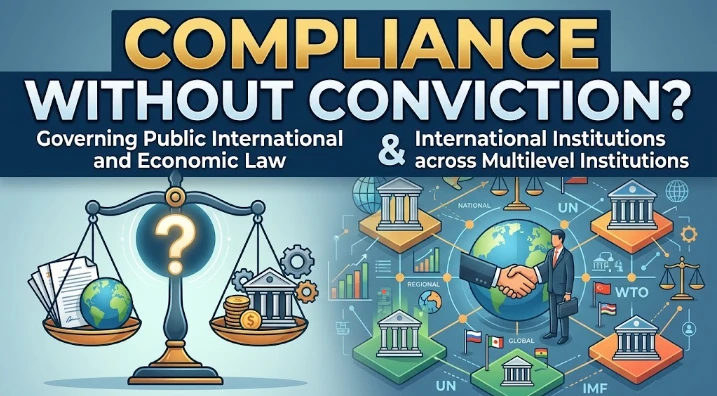
International institutions can generate extensive compliance activity without producing meaningful changes in conduct. Governments submit reports, create committees, adopt model legislation, participate in reviews, and repeat treaty language, while companies publish codes and implementation plans. This article asks whether those activities reflect genuine commitment or strategic efforts to protect reputation, diplomatic influence, and market access. International obligations move through several institutional levels: international organizations define standards, national governments legislate, regulators issue guidance, courts interpret rules, local authorities administer programs, and private actors modify contracts. Implementation can fail at any point. A treaty may be ratified without supporting legislation, a statute may lack enforcement resources, regulators may provide no operational guidance, or court decisions may remain unimplemented. The article recommends evaluating compliance through budgets, enforcement records, institutional incentives, remedies, and measurable outcomes rather than formal adoption alone. Genuine compliance requires political commitment, administrative capacity, transparent monitoring, independent review, and consequences when institutions or regulated actors repeatedly disregard international obligations.
International institutions can create a lot of compliance activity without a change of behaviour. States report, party to reviews, adopt model laws, establish committees, and have official statements that repeat treaty language. Along with codes, firms release and governments announce the plan of implementation. What is up for debate, in December 2025, is whether the action is in keeping with a real sense of institutional commitment or a strategic shift to save face, market share and diplomatic influence. The discrepancy between form vs. substance or conviction is evident in public international law, as well as in international economic law.
There are many different levels of compliance. International institutions try to translate the duties, national government's negotiate, legislate and issue rules, courts interpret and pass verdicts on disputes, local government's implement local programmes, and private parties tweak their contracts. It's a line that can break anywhere and that is failure. Responses of a state to a treaty can be done without laws.
Whether or not a statue is enforced is up to you. There is no need resources for guidance by a regulator. Failure to achieve practical implementation in a case does not prevent a court from deciding the case.
Conviction is not a personal opinion, principled conviction. Rules restrict action when it is not convenient, this is a display of conviction by the institutions. The best test is the pressure of budget constraints, electoral rivalry, economic jolts and powerful private vested interests. Compliance is taken seriously when bigâ, political actors are held to standards, financial support to enforcement is provided, and failure is recognized and declared. Low-cost alignments are less likely to provide good evidence, as they are ceremonial.
The same is true in international economic law where often compliance requires a structured monitoring and consequences, having as its model. WTO's dispute settlement mechanism was implemented to maintain rights and entitlements, interpret the rules and to ensure compliance. By the end of 2024, members had amazed the system with the hundreds of conflicts that were routed to it. While formal decisions may be important, policy change, political negotiations and institutional capacity within the country remain key elements to be considered in regard to implementation.
Public international law may in quite diverse ways. Reporting is a tool which can affect behaviour, as can be peer review, advisory opinion, diplomatic pressure, national action in the courts, or civil society mobilisation. That diversity can make for greater legitimacy and prevent the adoption of one enforcement approach. It may also be a way to minimize responsivity. The governments are able to focus on delay of effective implementation of laws, independence of the judiciary, federalism, or shortages of resources where the commitments have not been met.
It can be found in an implementation map. Each commitment ought to be accompanied by a home based authority, a legal document, a spending plan, a data source, a time frame and a reminder. There are also conflicting ministry issues that are identified through mapping.
Trade commitment can have health, labor, environment, taxation and local regulation impacts. Migration, policing, welfare, and digital systems, are all examples of processes that might be impacted by a human-rights obligation. Coordination is not strictly speaking restricted to inter-ministerial meeting; but there needs to be a follow-up responsibility.
Multilevel institutions allow experiments to be carried out. Local and regional governments have the capacity for setting higher standards, domestic legal interpretation by courts of obligations, and learning from peers agencies by regulators. There is also inequality as a result of variation. There can be significant variations in rights and economic opportunities between regions, where countries' standards are poorly defined. Without minimum guarantees, fiscal support and shared data, there is a lack of flexibility and implementation gaps will be perpetuated.
Private sector actors are carrying out public tasks more and more. International standards get translated into market access by the Certification, Credit Rating, Financial Institutions, Technology Platforms, Auditors or Contractors. However, when methods are proprietary, there is a risk of the accountability becoming weak despite the pressure of such actors which can promote compliance if it is enforced strongly. It requires public checks on conflicts, quality of evidence, and appeal rights and on distributional effects. Consequential decisions should not be beyond the bounds of review as a result of delegation.
There are 4 types of measures needed: commitment, capacity, conduct and outcome. Commitment is indicated by ratification and legislation. Capacity is found in the quality of staffing, budgeting and information system.
Inspections, decisions, sanctions, change in contract identifies conduct. Outcomes for environmental quality, labor conditions, market access, equality and remedy. The 4 in combination will stop a papering and filing system to be confused with effective government.
Information should also be available to data-masking that identifies the taxpayers with whom compliance costs are associated. Concentrated adjustment burdens can be a result of international economic rules. The poorer areas, workers and consumers may have to pay higher than the multinational corporations that have legal and technical ability. It is possible to make more fair with technical assistance, transition periods, simplified processes and social protection. Zero for Partiality Compliance based on unequal capacity can be selectively given.
Clarification of the rules through the dispute settlement can not replace administration. If the case is to be successful, legislative change, guidance, training and monitoring is still needed. Conflict can be solved through mutually agreed solutions, however, in case public interests are touched transparency is needed. Domestic parliaments and auditors should keep in view that implementation is the subject of review and that international quarrels should not be the prerogative of diplomats and the experts in trade law.
International rules are often translated into domestic pressure, through civil society and professional networks. Journalists uncover loopholes, unions call attention to workplace issues, environmentalists fight against permits and business organizations urge for consistency. Whether those actors can operate depends on access to information and the legality of their operations and whether they are protected from retaliation. Domestic actors can help international bodies to become more effective if they are able to apply their rules.
The agreed upon application is fundamental to being legitimate. Powerful states and firms may be better positioned to influence sets of standards to postpone compliance or absorb sanctions. Voluntary cooperation is undermined by a perception that there are double standards. That can be decreased by the use of transparent reasoning, conflict rules, balanced representation and by supporting less-resourced participants. RULES need to be designed in a way that makes people believe that they are being treated equally and consistently.
The reform should be based on feedback. This requires credible data on domestic implementation by international bodies and guidance based on realities in terms of law and administration by domestic agencies. The periodic review shall pinpoint the rules that might probably become obsolete, along with the ones that might be causing unnecessary loads and those that are already successful. Learning isn't dilution - standards don't need to be softened and the ways to implement them can improve.
Sincerity is the fundamental basis for good compliance, otherwise you will get impressive architecture which is built on a shaky basis. True governance is the link between international commitments and domestic powers, resources, practice and response. Although differing instruments are employed in the realm of public international law and in the realm of international economic law, the end goal for both is the same. A rule is important where institutions abide by it in times of political and economic pressures, openly discuss the reasons for exceptions, admit their mistakes, and where affected communities (or market players) can petition for a reconsideration. Consistency is evident for which comes at a great price.
Another test of institutional conviction is related to procurement. Governments who buy goods may enforce a requirement for respect of labor standards, environment, anti-corruption and disclosure. Requires verifications and remedies in clauses of contracts. A supplier code with no audit and consequences, adds another layer of ceremonial alignment.
But mutual recognition arrangements are a good example of a benefit combined with a danger. While Recognition can lead to a reduction in duplicate testing and have a facilitating effect for trade, substandard Equivalence Assessment can lead to a reduction in protection. The regulators should make available criteria, track results, and revoke accreditation if the results do not meet those criteria. A review route is a method for safeguarding troubled companies and consumers.
Capacity-building should be considered to be part of compliance structure. Laboratories, legal know-how, digital systems and inspection personnel are essential for less-resourceful agencies. Weakness of the permanent domestic capability should be addressed by projects and international institutions can provide technical support. Plans for short consultant missions are frequently undertaken in a manner that does not allow for sustainability of the plan in the country by its own institutions.
Handouts are a telling test of leadership. Rules that outlast elections, turnover of executives and disruptive economic events reveal a higher level of institutionalization. The handover processes, records and statutory reporting minimize reliance on individual champions. The first step to compliance is the lack of a personal commitment given that all systems are in place.
Legal obligation and political choice should be differentiated in relation to communication of the public. Proponents of policies sometimes try to hide the fact that they are not agreed upon by portraying them as international obligations. That framing can conceal discretion, and lead to the erosion of trust. Inclusion of mandatory elements, options and distributional decisions with clear explanation allows for democratic debate without denying international obligations.
Independent regulators should be insulated from influence by both politics and industry. Consider credibility-enhancing measures such as appointment rules, safe budgets, publication of meetings, cooling-off periods, and judicial review. Don't be fooled into believing that independence implies isolation, as regulators continue to require legislative directives, public review and assessment of their work.
There is also a need for rights protections for cross-border exchange of data. There is a need for tax, customs, financial and security cooperation in improving enforcement, but harm will be caused by incorrect and over-sharing. Interoperability should come with purpose restrictions, corrections, cyber security and independent monitoring.
CITE THIS ARTICLE
Amin, M. R. (2025). Compliance Without Conviction? Governing Public International and Economic Law and International Institutions Across Multilevel Institutions. https://www.ruhulresearchhub.com/article/b0da7d9d-e94a-5764-b53c-3cda2ed52907
M. R. Amin, “Compliance Without Conviction? Governing Public International and Economic Law and International Institutions Across Multilevel Institutions,” 2025. [Online]. Available: https://www.ruhulresearchhub.com/article/b0da7d9d-e94a-5764-b53c-3cda2ed52907
Amin, M. R. (2025) ‘Compliance Without Conviction? Governing Public International and Economic Law and International Institutions Across Multilevel Institutions’. Available at: https://www.ruhulresearchhub.com/article/b0da7d9d-e94a-5764-b53c-3cda2ed52907
Amin, Mohd. Ruhul. “Compliance Without Conviction? Governing Public International and Economic Law and International Institutions Across Multilevel Institutions.” 2025, https://www.ruhulresearchhub.com/article/b0da7d9d-e94a-5764-b53c-3cda2ed52907.
Mohd. Ruhul Amin. “Compliance Without Conviction? Governing Public International and Economic Law and International Institutions Across Multilevel Institutions.” (2025). https://www.ruhulresearchhub.com/article/b0da7d9d-e94a-5764-b53c-3cda2ed52907.
Amin MR. Compliance Without Conviction? Governing Public International and Economic Law and International Institutions Across Multilevel Institutions. 2025. https://www.ruhulresearchhub.com/article/b0da7d9d-e94a-5764-b53c-3cda2ed52907
@misc{article_b0da7d9de94a5764b53c3cda2ed52907,
  title = {Compliance Without Conviction? Governing Public International and Economic Law and International Institutions Across Multilevel Institutions},
  author = {Mohd. Ruhul Amin},
  year = {2025},
  url = {https://www.ruhulresearchhub.com/article/b0da7d9d-e94a-5764-b53c-3cda2ed52907},
}
TY  - GEN
AU  - Mohd. Ruhul Amin
TI  - Compliance Without Conviction? Governing Public International and Economic Law and International Institutions Across Multilevel Institutions
PY  - 2025-10-20
UR  - https://www.ruhulresearchhub.com/article/b0da7d9d-e94a-5764-b53c-3cda2ed52907
ER  -
This article presents democratic recovery after executive overreach as a process of reopening institutions rather than merely restoring formal legal boundaries. It describes how executive misconduct can leave politicized appointments, weakened oversight, restricted records, altered enforcement practices, intimidated officials, and concentrated agenda control. The article mentions open-democracy theory as requiring continuous accessibility, deliberation, transparency, inclusion, and responsivenes
Climate accountability increasingly operates through routine public and corporate decisions rather than exclusively through litigation. This article examines how international environmental law and the law of the sea influence government budgets, permits, procurement, port operations, insurance, energy planning, investment, and corporate governance. The 2024 advisory opinion of the International Tribunal for the Law of the Sea recognized anthropogenic greenhouse-gas emissions as pollution of the
This article examines how biometric border systems can create unequal experiences of citizenship and migration control in the United States. It describes facial recognition, fingerprinting, iris scanning, and interconnected identity databases as technologies that may improve verification and reduce fraud while also expanding surveillance and distributing errors unevenly. The article mentions false matches, failed identification, secondary inspection, questioning, detention, and weak appeal proce