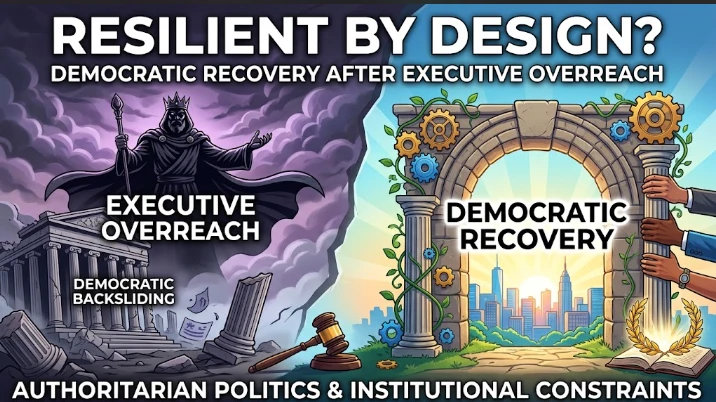
Resilient by Design? Democratic Recovery After Executive Overreach Through the Lens of Authoritarian Politics and Democratic Backsliding and Institutional Constraints
Mohd. Ruhul Amin (Master of Laws (LL.M.) in Human Rights)
Political participation does not necessarily give citizens meaningful influence over government decisions. This article investigates how authoritarian and backsliding regimes may organize elections, consultations, advisory bodies, public meetings, petitions, and digital platforms while retaining control over agendas, budgets, appointments, implementation, and final outcomes. Such arrangements can produce participation without power, allowing institutions to gather information, identify opposition, collect personal data, or claim public legitimacy without surrendering authority. The article distinguishes simple access to participatory spaces from the practical ability to change policies and hold decision-makers accountable. It proposes evaluating participation by examining which recommendations enter official drafts, receive funding, influence implementation, or generate formal government responses. Particular attention is given to marginalized communities whose participation may be limited by income, language, disability, geography, time, or digital access. Genuine participation requires representative recruitment, transparent procedures, documented responses, independent oversight, and enforceable connections between citizens’ contributions and institutional decisions.
Moving from dictatorship to democracy doesn't usually start with a glitzy constitutions. Much more commonly, recovery begins as those institutions that have weathered the executive tide build their confidence, capacity, and public backing to once again impose common bounds. All those are hallmarks of democratic backsliding in October 2025 and all have historically been the path through which such backsliding has proceeded in many countries. A resilient system will therefore be less reliant on heroic rescues and more on instutionalized systems where it is hard to capture and easy to see and to reverse and become expensive to do so.
The relief of executive overreach is that within the ambit of ambiguity or indeterminacy, the executive can do whatever it wants. There are opportunities for a gradual centralisation of powers in the form of broad delegations of authority in statutes, of emergency provisions, of acting for others, of opaque procurement, of politicised disciplinary processes, and weak disclosure rules. Individual moves can seem like complicated or ineffectual. Evidence of these efforts, gathered over many years across various agencies, courts, electoral bodies and public communication systems can change the “reality” of a state's power dynamics without requiring a formal suspension of a constitution. In order to recover, you must first have to realize that there had been a pathway of action that had been building up over time, and not wait for a clear-cut break.
The 2025 V-Dem Democracy Report speaks of an escalating process of autocratization across the globe but also harbours examples of ‘autocratization reversals'. The concept of democratic U-turns in the report has a valuable message: There is no point at which it is impossible for deterioration to be overcome, but at some stage in the process of institutional erosion, recovery will become questionable at best. The end of a long tenure and strong turnarounds aren't often caused by an electoral defeat to an over-ambitious leader. Change at the polls can create an opportunity, but institutional healing must occur in timely fashion, or guardrails will not be put in place and we will continue to repeat the same system of power under different political labels.
First of all has to do with redundancy. Independent courts, legislatures, auditors, election administrators, inspectors general, professional civil services, subnational governments, journalists, and universities, unions, and civic associations do various things. Comprehend that no one can defend democracy singlehandedly. Multiplicity provides multiple avenues for learning and holding authorities accountable for their behavior, lessening the risk of one institution being taken and destroying all lines of accountability. Political pressures might increase and then overlap can turn out to be inefficient in the administration of ordinary times, but it serves as constitutional insurance when political pressures pick up.
The second is an "executive action" that can be reversed. Temporary orders should not be permanent, but rather deadlines for their expiration, unless they are renewed in the open through transparent procedures. There must be definite time limits for acting appointments.
The powers of states of emergency should remain subject to the need, proportionality, oversight of the law-making body and control of the judiciary. One of the key elements to the Venice Commission's rule of law-compliant emergency government is protection against the normalization process. The easier the voluntary restraint from the same office who gets the expanded authority, the easier the recovery will be – when there are automatic exit mechanisms and accessible records of the actions taken, and reviewable reasons.
The third principle relates to the professional administration. What is required for a democratic system, is elected control, and not partisanship. Public servants have reference points to help them tell the difference between legitimate policy-making and unlawful pressure, such as merit-based recruitment, safeguards against whistleblowing, documented instructions and legal procedures to refuse unwarranted pressure. It will take years to again have an administration with these [expertise, institutional memory and trust] because you can't just snap them up and give them the same job and the same responsibility. Recovery plans thus require retention measures, open recruitment, conflict of interest management measures and training involving constitutional responsibilities as an element of operational skills.
The courts also need to be more than just free. The perception of the importance of review depends on case assignment, judicial security, compliance with judicial rulings, access to lawyers, the publishing of reasons, and protection from budget cuts targeted at the courts. A kind of recovery government is in the process of being put in place, a government that tries to fill up the courts to "repair" the system and thus undermines its own legitimacy. Better method emphasizes the clear availability of vacancies, ethical rules, reasonable workload, the implementation of decisions, and significant general changes in the procedures which are not limited to one political battle. The legitimization of the institution increases as a result of rules restricting both of the allies and opponents.
Legislatures come to the fore in the recovery process as there is frequently an overload of oversight by parliament to 'symbolic hearings'. Effective repair can include greater committee powers, access to documents in a timely fashion, a committee research team that is independent of the government, secure minority rights, compulsory attendance of government representatives to testify, and effective publication of government response. It is important to draw attention to the issue of budget scrutiny as it is in this process that the funds are loaned in a concentrated way that it may help to sustain networks created in overreach stages. There are other network disassemblers, like line-item transparency, audit follow-up, disclosure of procurement, and barriers to contracting with politically connected firms, that do not criminalize mere policy disagreement, but can compromise networks.
Restoration of elections should extend beyond the day of elections. Voting system design features like voter registration accuracy, competent district management, transparency of campaign financing, unbiased counting, access to observers, speedy recounts and challenges, and everything in between also make a difference. So does so the data surroundings.
Citizens assess institutional repair through public broadcasters, local journalism, laws for access to information and transparency. Unelected authoritarianism can be found in a government that is elected through mobilisation and by ignoring media coverage. Credible restoration is difficult to accept for good reason and is the norm of office.
The absence of institutions needs to be complemented by civil resistance in a manner that strategies affect legitimacy and the size of coalitions. In the study of nonviolent action it has been demonstrated that mass participation, organizational discipline and splitting away from the bases of support for illegitimate authority are all essential factors to consider in any strategy. Civic movements are confronted with a challenge in the recovery phase, namely how to change from an opposition to an oversight action without morphed into a substitute of the governing parties in the process. Pressure can be left on, and ordinary institutions re-take responsibility, by using independent monitoring, issue based coalitions, local organizing and public score cards.
The assignment of accountability for abuse prior to the design phase is the most challenging design decision. Impunity or at best an absence of consequences for violations can invite repetition and an all-out oratory condemnation, as might indiscriminate retaliation that further polarizes and creates consequential dangers for future leaders. Criminal conduct, administrative error, policy mistake or political mistake should be distinguished by a calibrated approach. Legitimacy is protected through independent investigations, fair trials, access to evidence, participation of the victims and proportionate sanctions. Harms can be addressed by means of truth-telling, archives, reparations, and institutional change, in ways which cannot be addressed only through prosecution.
Sequencing is important with recovery as well. The first priority is to preserve documents, thwart suspicious orders, ensure electoral management, regain access to documents and prevent any retaliatory activities of destroying documents. Medium-term jobs will be statutory reform, building up the civil service, judicial capacity, media protection and enforcing campaign finance. Resilience in the long-term necessitates civic education, a strong local institutional structure, social inclusion and economic policies that counteract periods of vulnerability to alternatives offered by authoritarians. Taking a comprehensive strategy to reform is likely to prove more successful – a one-stop approach to multiple reforms is sometimes liable to lead overwhelming administrative workloads and manifest failure.
Record measures of behavior not words. They are: respect for court orders, reaction time to information requests; turnover of top figures and employment in the professional sphere, competitiveness of suppliers, laws amendment rate, implementation of audits, violence against journalists, electoral dispute resolution, and public confidence (non-partisan). While provided by ADS, aggregate data on democracy is necessary, but not sufficient, for analysis of recovery.Although aggregate data on democracy is necessary for comparison purposes, it is not sufficient for recovery analysis—this requires institutional microdata. In-roads are a sign of further normalization; speeches can be impressive and stir sentiments while egregious or deeply entrenched behavior continues to be pervasive.
However, political incentives are still the key factors. Guardrails can survive if the big parties believe that they will need to come to power one day and need rules that are non partisan. If this kind of reform is aimed solely at curbing a vanquished party, then it will not be believed and will fall apart once the next change of regime goes around. The elections, judges and emergency powers, public documentation and civil-service safeguards are based on cross-party consensus. It is perhaps impossible to ever achieve unity, but the process can still be able to find a compromise(s) or to limit the acceptability of manipulating the process.
So democratic resilience is not just about individuals – it is a characteristic of systems. A more permanent pattern of recovery is achieved when outside actors are able to monitor abuse, citizens have access to verifiable information, public officials are able to resist unlawful demands, courts are able to ensure compliance, and elections take place free of threat. When executives interfered it became evident where design fell short. When repair is successful, that becomes legislation, procedures and capabilities which will be enforceable under subsequent governments. Every successor, even those who are currently trusted by the democratic coalition as leaders, has suffered from the strongest recovery leaving less power for them.
Earlier, institutions must be stress-tested in order to go well beyond the threshold during the next stress. Various scenarios of hotly contested elections, declaration of emergency, mass scale vacancies, cyberattacks, and non compliance of judgments can be explored by simulations. Unclear authority and weak communication links can be made known via a public after-action report. These exercises make resilience out of the constitutional ideal and a practical administration capacity.
CITE THIS ARTICLE
Amin, M. R. (2025). Resilient by Design? Democratic Recovery After Executive Overreach Through the Lens of Authoritarian Politics and Democratic Backsliding and Institutional Constraints. https://www.ruhulresearchhub.com/article/c02e6ea2-4ed9-555a-90ae-8ec76eeefb59
M. R. Amin, “Resilient by Design? Democratic Recovery After Executive Overreach Through the Lens of Authoritarian Politics and Democratic Backsliding and Institutional Constraints,” 2025. [Online]. Available: https://www.ruhulresearchhub.com/article/c02e6ea2-4ed9-555a-90ae-8ec76eeefb59
Amin, M. R. (2025) ‘Resilient by Design? Democratic Recovery After Executive Overreach Through the Lens of Authoritarian Politics and Democratic Backsliding and Institutional Constraints’. Available at: https://www.ruhulresearchhub.com/article/c02e6ea2-4ed9-555a-90ae-8ec76eeefb59
Amin, Mohd. Ruhul. “Resilient by Design? Democratic Recovery After Executive Overreach Through the Lens of Authoritarian Politics and Democratic Backsliding and Institutional Constraints.” 2025, https://www.ruhulresearchhub.com/article/c02e6ea2-4ed9-555a-90ae-8ec76eeefb59.
Mohd. Ruhul Amin. “Resilient by Design? Democratic Recovery After Executive Overreach Through the Lens of Authoritarian Politics and Democratic Backsliding and Institutional Constraints.” (2025). https://www.ruhulresearchhub.com/article/c02e6ea2-4ed9-555a-90ae-8ec76eeefb59.
Amin MR. Resilient by Design? Democratic Recovery After Executive Overreach Through the Lens of Authoritarian Politics and Democratic Backsliding and Institutional Constraints. 2025. https://www.ruhulresearchhub.com/article/c02e6ea2-4ed9-555a-90ae-8ec76eeefb59
@misc{article_c02e6ea24ed9555a90ae8ec76eeefb59,
  title = {Resilient by Design? Democratic Recovery After Executive Overreach Through the Lens of Authoritarian Politics and Democratic Backsliding and Institutional Constraints},
  author = {Mohd. Ruhul Amin},
  year = {2025},
  url = {https://www.ruhulresearchhub.com/article/c02e6ea2-4ed9-555a-90ae-8ec76eeefb59},
}
TY  - GEN
AU  - Mohd. Ruhul Amin
TI  - Resilient by Design? Democratic Recovery After Executive Overreach Through the Lens of Authoritarian Politics and Democratic Backsliding and Institutional Constraints
PY  - 2025-09-08
UR  - https://www.ruhulresearchhub.com/article/c02e6ea2-4ed9-555a-90ae-8ec76eeefb59
ER  -
This article presents democratic recovery after executive overreach as a process of reopening institutions rather than merely restoring formal legal boundaries. It describes how executive misconduct can leave politicized appointments, weakened oversight, restricted records, altered enforcement practices, intimidated officials, and concentrated agenda control. The article mentions open-democracy theory as requiring continuous accessibility, deliberation, transparency, inclusion, and responsivenes
Climate accountability increasingly operates through routine public and corporate decisions rather than exclusively through litigation. This article examines how international environmental law and the law of the sea influence government budgets, permits, procurement, port operations, insurance, energy planning, investment, and corporate governance. The 2024 advisory opinion of the International Tribunal for the Law of the Sea recognized anthropogenic greenhouse-gas emissions as pollution of the
This article examines how biometric border systems can create unequal experiences of citizenship and migration control in the United States. It describes facial recognition, fingerprinting, iris scanning, and interconnected identity databases as technologies that may improve verification and reduce fraud while also expanding surveillance and distributing errors unevenly. The article mentions false matches, failed identification, secondary inspection, questioning, detention, and weak appeal proce