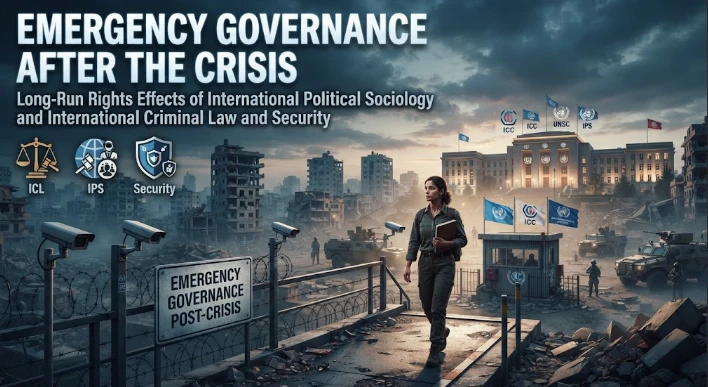
The article analyzes the long-term rights effects of emergency governance after a crisis ends. It warns that temporary powers can persist through databases, surveillance practices, procurement contracts, police routines, mobility controls, and administrative habits even after the formal emergency is over. The proposed institutional response combines criminal-law legality, human-rights limits, emergency doctrine, ordinary judicial review, and oversight by executives, emergency agencies, police, intelligence bodies, courts, auditors, and affected communities. Priority reforms include sunset clauses, post-crisis audits, deletion orders, legislative renewal, public justification, and redress for unlawful harm. The article also stresses documentation, layered review of secrecy, command culture, complaint independence, equity analysis, community participation, long-term evaluation, technology procurement controls, and clear responsibility for joint operations. Success is defined by timely expiry of extraordinary powers, deletion of emergency data, restoration of ordinary procedures, completed audits, and reduced normalized restrictions. A crisis ends constitutionally only when exceptional authority and practices genuinely cease.
Emergency governance's institutional legacy is located at the intersection of law, administration and a legitimation from the public. The entire matter is even more salient in March 2026, in which provisional authorities can thrive by leveraging temporary database controls, procurement contracts, police practices, and administrative practices. Goodwill is not enough for good institutions! The effectiveness of safeguards should be maintained in times of pressure, disagreements, and shift in political control.
International human rights restriction and the Rod of criminal law, the emergency doctrine and the ordinary reviewing body of the Judiciary are all elements of the governing framework. While those sources set the standards, there are others who have to interpret, implement, and review those standards, such as institutions. The productions of: Executives, Emergency agencies, Police, Intelligence bodies, Courts, Auditors and affected communities are the key actors. The coordination within that group needs to maintain the independence, and not confuse responsibility.
In international politics sociolisation focuses on the social production of security. Threats do not come with set definitions, institutions prescribe behaviour, specific groups deemed to be at risk, tools of coercion allocated, and what constitutes acceptable proof. These categorizations result in budgets, legal authorities, professional standing, and telling. A rights-protective approach which looks also at institutional processes that determine what constitutes danger is therefore explored.
A stringent account of blame is added by international criminal law. Severity of misconduct is based on individual responsibility, evidence, context and connections between behaviors and power. Records should be retained, and the institutional design should have a way to retain records, before controversy starts, because otherwise log books, informal orders, etc. might not be kept and wouldn't be helpful at the time of subsequent review. It is important to document to defend affected communities as well as officials who may be subjected to unproven allegations.
One issue that is always a problem is secrecy. While there are some data that are legitimate operational information that needs protection, there is also not a magic bullet that can be used as a response to every question of legality, necessity, or harm. Layered scrutiny of the cleared inspectors, specialist judges, and parliamentary committees and public statistical reporting. These enable the confidential information to be kept safe but also maintain democratic understanding of the extent and impact of coercive power.
The key question is command culture, formal safeguards are either practical restraints or not. Training, promotion, and performance evaluations as well as legal consultation and disciplinary procedures show incentives institutions offer for conduct. A stop, arrest or intelligence data based measure – in isolation to a written policy – has little force or influence on operational success. Restraint, accurate reporting, de-escalation and cooperation in reviews as a positive attitude should be rewarded by balanced incentives.
Remedies—make a difference on behaviors, too. A complaint system that does not allow independent complaints, has no time limits, does not disclose or has no enforceable consequences can lead to increase the distrust. The use of investigation, explanation, correction, discipline, compensation, and reform of institutional practices constitute effective systems. Public summaries should document patterns and changes that have been made and finalized, without revealing business, protected personal data, etc.
Sunset clauses and post-crisis audits, deletion orders, legislative renewal, public justifications and redress for illegal damage should be placed at the top of the list of practical reform measures. Each element corresponds to the failure before, during, after and remedy when harm happens. The order is important in that regard as subsequent accountability is undermined in the absence of prior accountability records and the motivating rationale of activity.
Orders, warrants, mobility controls, surveillance retention and spending files, prosecutions and post-emergency litigation should all be evidence. This material makes it possible to make comparisons between agencies, regional, time, or to the affected groups. There can be clearly identified patterns, disparities and delays, as well as repeated institutional failure, without compromising confidentiality.
Special focus should be placed on workers, minority groups, border communities, those under detention or those who don't have great access to legal services in an equity analysis. Formality alone has no answer as to if and how burdens cluster, or whether and how review access varies by income, status, geography, disability, ethnicity, age or language. Distributional evidence must inform and shape design and to resource allocation.
The legitimacy is also impacted by public communication. Using jargon can be a smokescreen for the true issues at stake in administration decisions, and heightened rhetoric can overstate the level of uncertainty to be faced. Objectives, evidence, trade-offs, affected rights and challenge available should be clearly explained. While there is always a limit, it is important to be honest about that and be confident; otherwise, that may be an empty statement.
Implementation requires resources. There is a need for staff and experts to review bodies, need to keep records at their disposal, need to have secure tenure in the review body and need to mandate response. Funding and interpretation are also needed, as is time and accessible venues when involving the community. The absence of funding for rights and participation obligations can turn them into 'aspirational obligations'.
Institutional reform does not have to be either universal or specific to a context. Powers of protection (legality, equality, notice, review and remedy) are general. The use of those protections is effectively put into practice based upon the local knowledge.
But policies need to be evaluated long-term after launch. Initial implementation may decline due to changes in management, for an event, or changing financial situations. Contingency: scheduled review, public reporting and independent research. Corrective action should be feasible without having to fail policy.
The formal rules in institutional analysis should be related to incentives. Officials react to workloads, goals and targets, budgets, formativeness of profession, politics, and potential scrutiny. The force of reform takes place when those forces direct towards lawful and fair conduct. A safety device that is in a book may be lost to pressure of operation.
A comparative analysis can be used to reinforce the design of institutions, but by not mechanically copying foreign institutions. There are various forms of constitutions where the authority of policing, prosecution, intelligence, and emergency varies. Comparisons are: to look for function (copy label). Helpful questions include: What happens when you're not independent? What does it take for you to be able to share information? What would it take for you to be able to stop illegal activities from happening? What are repercussions if you don't listen to what you are suggesting?
The development of professional education needs to be linked with accountability. Decision under uncertainty, contradiction of orders and lack of information and pressure by the public, can all be tested in a scenario training. Supervisors are to focus on reasoning as well as on the outcome. Reflective practice is a way of making sense for the institutions to know when they've done something wrong and when they were negligent or intentional.
The private acquisition of technology and services that enhance coercive capabilities should be scrutinized, particularly for the proliferation of coercive capability outside of known command structures. Contents of contracts should detail legal boundaries, auditing access to data, who owns it, security standards and what is required to end a contract. Delegated tasks will continue to be the role of public bodies. The commercial confidentiality will not stay on top of the Constitutional accountability.
Legality and remedy have to be legally delegated to an authority or specific person that is responsible for cross-agency operations. Using the term joint task force can create a situation where either no body is aware of the approval action, the information is still pending, or where complaints are simply not made to any one body. Written protocols should be prepared with the assignment of responsibility prior to deployment. Second: When it comes to shared operations, never do it in a way that creates shared evasion.
The diversity of institutions and dissent in protected form are also key to prevention. There are various risks that can be identified by legal, analysts, community liaison and operational staff. Mechanisms to pass on concerns should exist at the internal level which connect them with senior review without risk of a repercussion on the career. [Corrected culture diminishes illegitimate injury and strategic bad fortune.
Achain governance should be defined by having responsibility at each and every stage. Only when the authorisation, delivery, monitoring and remedy are traceable, can these line-up, while bodily harm to people and other effects can be kept to a minimum. Escalations and procedures are required in the event of overlapping mandates. Otherwise, ambiguities safeguard institutional boundaries over impacted people.
It is important that both action and inaction be considered as part of the risk assessment. Rights may be infringed if there is excessive intervention, but some forms of harm may remain unaddressed if there is late or partial (disjointed) intervention. The rationale for the decision should be documented in the decision record by providing supporting evidence and more limiting options. Reasoning can then be reviewed later, and the need to make unstated assumptions to understand the reasoning can be eliminated.
In independent research there can be a connecting link between the official reporting and the experience of the community. From a secure access to data, ethical oversight and publication rights, these serve as a means to begin testing institutional claims. Community authority and confidentiality should be given due respect in the context of partnerships. In order to properly respond to findings, it's not enough to just passively acknowledge them.
Timely expiry, deleted emergency data, restored the ordinary procedure completed audits, and decreased normalized restrictions are to be used as measures of success. The scales that make up these measures are a mix of outcomes, procedure and institutional capability. The objectives must be visible, terms of reference must be clear, and when objectives are not met it is important to have a description about what went wrong and how to rectify the issues.
Legality, capability, participation, transparency and correction provides an indispensable platform (the international human rights limitations, criminal-law legality, emergency doctrine, ordinary judicial review), but it is the actions of executives, emergency agencies, police, intelligence agencies, the courts, auditors, and affected communities – in terms of how authorities are exercised – that are of crucial import in practical protection. Other evidence, including orders, warrants, mobility controls, surveillance retention application and spending files, prosecutions and post-emergency litigation can demonstrate gaps between the formal compliance and actual results. There is an actual end to a crisis constitutionally only when extraordinary authority, records and habits are out of operation and are restored to the ordinary legal process.
CITE THIS ARTICLE
Amin, M. R. (2026). Emergency Governance After the Crisis: Long-Run Rights Effects of International Political Sociology and International Criminal Law and Security. https://www.ruhulresearchhub.com/article/d7f59676-4746-55f1-b7a2-dbecc91ddfda
M. R. Amin, “Emergency Governance After the Crisis: Long-Run Rights Effects of International Political Sociology and International Criminal Law and Security,” 2026. [Online]. Available: https://www.ruhulresearchhub.com/article/d7f59676-4746-55f1-b7a2-dbecc91ddfda
Amin, M. R. (2026) ‘Emergency Governance After the Crisis: Long-Run Rights Effects of International Political Sociology and International Criminal Law and Security’. Available at: https://www.ruhulresearchhub.com/article/d7f59676-4746-55f1-b7a2-dbecc91ddfda
Amin, Mohd. Ruhul. “Emergency Governance After the Crisis: Long-Run Rights Effects of International Political Sociology and International Criminal Law and Security.” 2026, https://www.ruhulresearchhub.com/article/d7f59676-4746-55f1-b7a2-dbecc91ddfda.
Mohd. Ruhul Amin. “Emergency Governance After the Crisis: Long-Run Rights Effects of International Political Sociology and International Criminal Law and Security.” (2026). https://www.ruhulresearchhub.com/article/d7f59676-4746-55f1-b7a2-dbecc91ddfda.
Amin MR. Emergency Governance After the Crisis: Long-Run Rights Effects of International Political Sociology and International Criminal Law and Security. 2026. https://www.ruhulresearchhub.com/article/d7f59676-4746-55f1-b7a2-dbecc91ddfda
@misc{article_d7f59676474655f1b7a2dbecc91ddfda,
  title = {Emergency Governance After the Crisis: Long-Run Rights Effects of International Political Sociology and International Criminal Law and Security},
  author = {Mohd. Ruhul Amin},
  year = {2026},
  url = {https://www.ruhulresearchhub.com/article/d7f59676-4746-55f1-b7a2-dbecc91ddfda},
}
TY  - GEN
AU  - Mohd. Ruhul Amin
TI  - Emergency Governance After the Crisis: Long-Run Rights Effects of International Political Sociology and International Criminal Law and Security
PY  - 2026-01-26
UR  - https://www.ruhulresearchhub.com/article/d7f59676-4746-55f1-b7a2-dbecc91ddfda
ER  -
This article presents democratic recovery after executive overreach as a process of reopening institutions rather than merely restoring formal legal boundaries. It describes how executive misconduct can leave politicized appointments, weakened oversight, restricted records, altered enforcement practices, intimidated officials, and concentrated agenda control. The article mentions open-democracy theory as requiring continuous accessibility, deliberation, transparency, inclusion, and responsivenes
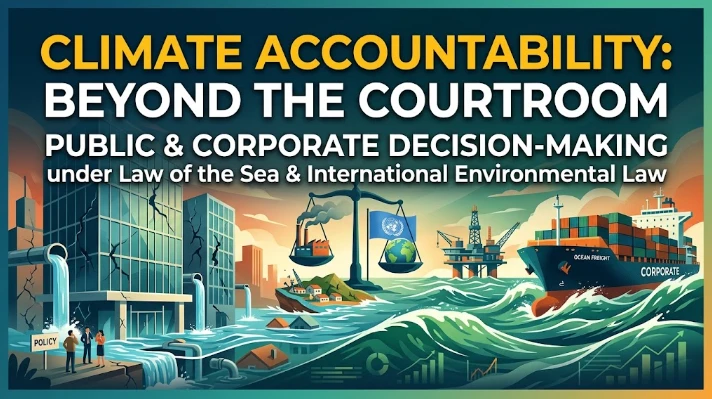
Climate accountability increasingly operates through routine public and corporate decisions rather than exclusively through litigation. This article examines how international environmental law and the law of the sea influence government budgets, permits, procurement, port operations, insurance, energy planning, investment, and corporate governance. The 2024 advisory opinion of the International Tribunal for the Law of the Sea recognized anthropogenic greenhouse-gas emissions as pollution of the
This article examines how biometric border systems can create unequal experiences of citizenship and migration control in the United States. It describes facial recognition, fingerprinting, iris scanning, and interconnected identity databases as technologies that may improve verification and reduce fraud while also expanding surveillance and distributing errors unevenly. The article mentions false matches, failed identification, secondary inspection, questioning, detention, and weak appeal proce