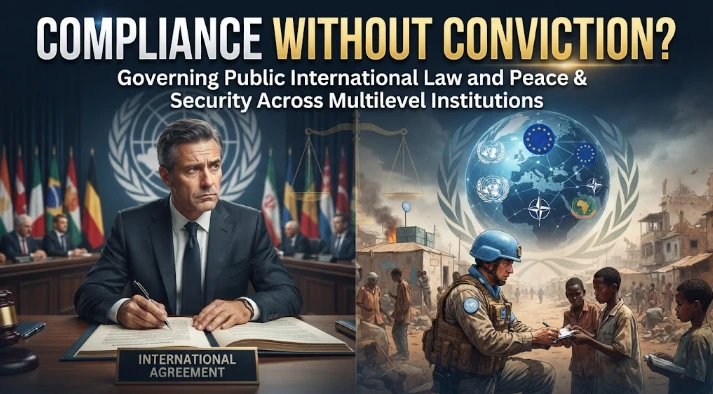
The article distinguishes formal compliance with international peace and security law from genuine institutional conviction. States may ratify treaties, enact laws, create committees, and train personnel while still applying rules selectively, underfunding implementation, or avoiding constraints when strategic interests are involved. The article uses sanctions, military operations, security assistance, private-sector delegation, civil-society space, parliamentary scrutiny, international review, and financial transparency to show how commitment must be tested in practice. It proposes assessing commitment, capacity, conduct, and consequences separately, with attention to independent investigation, civilian-harm tracking, remedies, budget allocations, personnel incentives, technology review, media access, and unresolved recommendations. Multilevel governance requires clear responsibility maps so international bodies, national ministries, local agencies, and companies cannot shift blame. The article concludes that credible compliance depends on consistency, transparency, correction, and willingness to accept legal restraints even when politically inconvenient. Institutional learning and enforceable remedies demonstrate that rules shape behavior rather than merely image.
Formal compliance of peace and security institutions is relatively strong. States sign treaties, pass sanctions laws, enter into reporting procedures, establish committees to see to the implementation of the treaties, educate personnel, and recommit themselves to the UN Charter. Those actions are critical – and not enough – in February 2026. Compliance without conviction happens when rules are followed less than regularly, inadequately funded domestically and when rules are more aptly enforced against those who oppose them or are more inclined to follow them in the first place. True commitment is seen when there are obligations which limit the policy when one's “strategic convenience” arises.
The institutions of public international law are international, national, regional and local level institutions. United Nations draws up rules and makes decisions. National executives are those who give interpretations to foreign-policy commitments. Authority and budget comes from legislatures.
Courts review legality. Measures are taken by the military, police, customs, financial and intelligence agencies. Discrimination in transactions handled by private companies, management of technologies. How a level affects compliance can be either positive or negative.
The first step is to formally adopt. There is a need for domestic effect of treaties, procedures for Security Council obligations and legislation for humanitarian rules. But legal incorporation will lie idle. Capacity is based on budgets, staffing and training, data, and leadership. When investigators don't know their way around, and prosecutors are not independent, many offenses contained in statutes don't have any big bite.
One of the key red flags against selective enforcement. Whatever acts require similar analysis as a matter of law should do so on the basis of equality of political views. Facts could differ giving the supporting for various happens, but criteria should be clear. A coherent rationale helps to prevent international law from taking on the nature of a dictionary of protests. States act on the bases of rules, but double standard rules further reduce cooperation.
The problem is indicated by sanctions. A government may quickly enact wide-ranging asset freezes with poor or no review, or with scant humanitarian relief, or few ways for humanitarian relief or for correcting errors. Proportionality, periodic reassessment, license, designation and appeal are all indicators of a good compliance. Conviction means that attention to rights needs to be paid even if the object of attention is without political sympathy.
However, a heavier challenge exists for military operations. Systems for distinction, proportionality, precautions, detention and investigation should be operated per the rules. There is institutionalization with the presence of legal advisers, target review, civilian-harm tracking, transparent doctrine, and credible investigation. Statistics for training cannot be determinant for the behavior. Independent evidence action is important.
Security assistance can also be indicative of selectivity of commitment. Risk assessment needs to be integrated into arms transfer agreements, intelligence cooperation and training. If the rocks are of great strategic value, there is likely to be pressure for their value to be reduced. Conviction is evidenced by the willingness to change with credible evidence of abuse – even if it has diplomatic consequences for the individual or organization.
Multilevel governance provides possibilities of blame shifting. International bodies can finger-point at the States taking steps to implement, national ministries can finger-point at local agencies taking steps, and private companies can point to contractual compliance. Responsibility map(s) should be developed to indicate who is making each decision. Reporting needs to happen as a result of a case arresting in order of legal mandate, action and remedy.
Security measures are implemented by the banks, technology companies, airlines, ports and contractors, and there is a need for the private sector to be supervised. At scale rights can be impacted by automated screening and automated content moderation. The public rules must be transparent, must be corrected, audited and have data protection. Where companies integrate delegated authority, their commercial confidentiality is not taken away by public accountability.
The indicator of civil-society space is important. Humanitarian organisations, journalists, lawyers, researchers and peace organisations engage in tests to verify the maintenance of the compatibility of rights and the security rules. Seemingly vague counterterrorism legislation abridges lawful activities. Accessible licensing, guidance and clear exemptions include the security and civic action. The critic is not treated as an enemy in institutions which are dedicated to the law.
Parliamentary scrutiny can be the conveyer of the sense of conviction by means of the budget and follow-up. Committees should keep sounding out of agencies on Audit recommendations, investigation of incident and revision of policy etc., Neither the withholding of information nor its lack of accountability is a secure procedure. Opposition access and independent staff decreases the partisan control.
However, the international review mechanisms should also be credible. Reporting processes should look at notices of effects, rather than just notices of law. Independent evidence can be used as a comparison with state reports. Recommendations should include time-bound action, and follow-up. The wider the peer review's findings are hedged by diplomatic politeness, the less effective the peer review will be.
Commitment, capacity, conduct and consequence need to be differentiated when action is measured. Ratification shows commitment. Capacity is seen amongst Staff and Systems.
Actions and enforcement exhibit behavior. Consequence: Civilian protection, Access to remedy, and reduced unlawful harm. A balanced scheme doesn't say that it is successful if a committee is established or a training takes place.
Institutional learning is the process of distinction in between conviction and image management. Agencies need to save evidence, conduct investigations, release results if possible, extend apologies to the victims if an error occurred and alter procedure. Defensive secrecy is a good way to preserve reputation in the short-term, but undermines legitimacy in the long-term. Correction is proof of rules that have an internal force.
“Perfect performance” in complying with the conviction is unnecessary. In a complexly secured environment, there will be uncertainty and error. Consistency, transparency and correction are the key words that distinguish the winning attitude. Public international law is effective and credible in the area of peace and security when institutions are willing to impose restrictions in crisis situations, when institutions are facultative in their application to different spheres of politics and when institutions offer remedy in case of failure. Less than that can make compliance with the law some sort of acting.
Financial transparency can give an indication of priorities. Publicly commitment with little budget allocation reveals a low level of institutionalisation. Investigations, training, advice on legal matters, civilian protection and remedy should be taken the special care at their budget analysis. Classified expenditures must still be subject to a secure independent scrutiny.
It is also important to have personnel policy. Promotion standards do not necessarily ensure that locally successful operation and lawful conduct are rewarded. Any performance system should involve the components of compliance, reporting and protection of civilians. Wherever short-term objectives are not met, leaders who cover it up should be subject of consequences even if achievement has occurred at that level.
Review should be done within international partnerships which should also be done the other way round. Joint operations and intelligence arrangements can give rise to overlaps and gaps which in turn imply the legal assumption of responsibility has fallen to the other. Agreements should have clear standards and documentation, and procedures for investigation. There should be no reduction of accountability below a domestic standard, as a result of the co-operation.
Media access contributes to citizens' trust. There are reasons to have limits that are based on operational security, and there are reasons to have blanket exclusion: official narratives control. Effective means to enhance scrutiny include “embedded access”, briefings, document release, and protection of independent reporting. When a ‘false' statement is issued by a Government Official, corrective measures should be taken promptly.
Remedy should go beyond prosecution of the crime. The different harms are addressed through compensation, rehabilitation, acknowledgement, policy change and record correction. Failure to act admin is not justified on high criminal thresholds. A believable system has a number of pathways, corresponding to the mode of failure.
Driving compliance is the responsibility of civilian leaders. Military lawyers and technical officers are not the only ones who can now be held legally responsible for all these. Ministers and senior executives establish priorities and approve resources, and action in response to findings. Political responsibility is reflected when leadership responds to disturbing evidence, and alters policy.
Comparative learning can provide identification of successful safeguarding measures. States can review systems of oversight, sanctions review, civilian-harm systems and national committees. An imported and not adapted model may not be successful. Design should be influenced by, and reflective of, legal tradition, institutional capacity, and context of conflict.
Independent investigation means that it is removed from tainted chains of command. Investigators must have secure evidence, witness protection, technical capability and must be a legitimate union to publish findings. Time is lost, it can lead to a breakdown in the trust and loss of evidence.
There is a need for more than executive agencies being part of national implementation committees. Members of Parliament or his staff members, independent experts, humanitarian organizations, and professional associations may provide information, in accordance with the following confidentiality guidelines:
Rights & legal review of technology should be done prior to procurement. There can be a range of obligations to accommodate from new surveillance, targeting and biometric tools after deployment that are beyond what the agencies can control. Need Independent testing of vendor claims.
If there is a change in the political climate there should be risk assessment on foreseeable misuse. The creation of a database or a power for a justified danger can then be used against dissent later on. Certain restrictions, such as the ability to access, as well as rules for deletion, and the external review, minimize that risk.
Public reporting to include any undone recommendations. There is often de-emphasis on older research findings and emphasis on completed activities. An institutional Memory is maintained, visible and offers follow-up for legislation.
Participation of regional and local authorities in the national review are required as implementation burdens may not be with central ministries. Their evidence may surface to show ambiguous directions, duties that are not funded, or even conflicting directions.
There should be integrity in public comments as well. ‘Obstruction' can cast a strain on officials and investigators if all law concerns is characterized as such. In order to achieve a credible compliance, it is necessary to respect the independence and give the explanations.
Periodic external assessment provides the opportunity to examine if the national systems are compliant with international commitments and realized outcomes.
CITE THIS ARTICLE
Amin, M. R. (2025). Compliance Without Conviction? Governing Public International Law and Peace and Security Across Multilevel Institutions. https://www.ruhulresearchhub.com/article/e3567879-464b-527d-9151-3b90a2177a03
M. R. Amin, “Compliance Without Conviction? Governing Public International Law and Peace and Security Across Multilevel Institutions,” 2025. [Online]. Available: https://www.ruhulresearchhub.com/article/e3567879-464b-527d-9151-3b90a2177a03
Amin, M. R. (2025) ‘Compliance Without Conviction? Governing Public International Law and Peace and Security Across Multilevel Institutions’. Available at: https://www.ruhulresearchhub.com/article/e3567879-464b-527d-9151-3b90a2177a03
Amin, Mohd. Ruhul. “Compliance Without Conviction? Governing Public International Law and Peace and Security Across Multilevel Institutions.” 2025, https://www.ruhulresearchhub.com/article/e3567879-464b-527d-9151-3b90a2177a03.
Mohd. Ruhul Amin. “Compliance Without Conviction? Governing Public International Law and Peace and Security Across Multilevel Institutions.” (2025). https://www.ruhulresearchhub.com/article/e3567879-464b-527d-9151-3b90a2177a03.
Amin MR. Compliance Without Conviction? Governing Public International Law and Peace and Security Across Multilevel Institutions. 2025. https://www.ruhulresearchhub.com/article/e3567879-464b-527d-9151-3b90a2177a03
@misc{article_e3567879464b527d91513b90a2177a03,
  title = {Compliance Without Conviction? Governing Public International Law and Peace and Security Across Multilevel Institutions},
  author = {Mohd. Ruhul Amin},
  year = {2025},
  url = {https://www.ruhulresearchhub.com/article/e3567879-464b-527d-9151-3b90a2177a03},
}
TY  - GEN
AU  - Mohd. Ruhul Amin
TI  - Compliance Without Conviction? Governing Public International Law and Peace and Security Across Multilevel Institutions
PY  - 2025-12-15
UR  - https://www.ruhulresearchhub.com/article/e3567879-464b-527d-9151-3b90a2177a03
ER  -
This article presents democratic recovery after executive overreach as a process of reopening institutions rather than merely restoring formal legal boundaries. It describes how executive misconduct can leave politicized appointments, weakened oversight, restricted records, altered enforcement practices, intimidated officials, and concentrated agenda control. The article mentions open-democracy theory as requiring continuous accessibility, deliberation, transparency, inclusion, and responsivenes
Climate accountability increasingly operates through routine public and corporate decisions rather than exclusively through litigation. This article examines how international environmental law and the law of the sea influence government budgets, permits, procurement, port operations, insurance, energy planning, investment, and corporate governance. The 2024 advisory opinion of the International Tribunal for the Law of the Sea recognized anthropogenic greenhouse-gas emissions as pollution of the
This article examines how biometric border systems can create unequal experiences of citizenship and migration control in the United States. It describes facial recognition, fingerprinting, iris scanning, and interconnected identity databases as technologies that may improve verification and reduce fraud while also expanding surveillance and distributing errors unevenly. The article mentions false matches, failed identification, secondary inspection, questioning, detention, and weak appeal proce