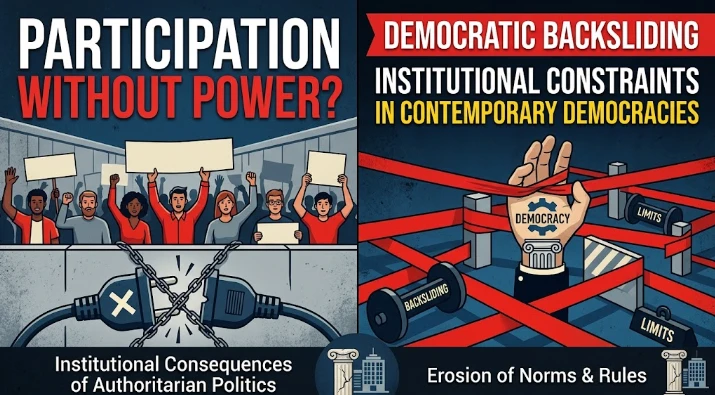
Participation Without Power? Institutional Consequences of Authoritarian Politics and Democratic Backsliding and Institutional Constraints in Contemporary Democracies
Mohd. Ruhul Amin (Master of Laws (LL.M.) in Human Rights)
Political participation does not necessarily give citizens meaningful influence over government decisions. This article investigates how authoritarian and backsliding regimes may organize elections, consultations, advisory bodies, public meetings, petitions, and digital platforms while retaining control over agendas, budgets, appointments, implementation, and final outcomes. Such arrangements can produce participation without power, allowing institutions to gather information, identify opposition, collect personal data, or claim public legitimacy without surrendering authority. The article distinguishes simple access to participatory spaces from the practical ability to change policies and hold decision-makers accountable. It proposes evaluating participation by examining which recommendations enter official drafts, receive funding, influence implementation, or generate formal government responses. Particular attention is given to marginalized communities whose participation may be limited by income, language, disability, geography, time, or digital access. Genuine participation requires representative recruitment, transparent procedures, documented responses, independent oversight, and enforceable connections between citizens’ contributions and institutional decisions.
Participation increase could be accompanied by a decrease of the democratic power. Executives, party leaders, security services, donors or administrative networks not elected to public office can wield significant power to mould the outcomes of elections, consultations can proliferate, online petitions for change accumulate signatures, and calendars are packed with public meetings; but the key decisions are never lost. This contradiction is at the heart of one of today's crucial issues for contemporary democracies as we head towards October of 2025. Consideration of participation should not be limited to attendance, volume of speech and turnout. The more difficult question is whether or not participation leads to shifts in agendas, shares power, serves as a controlling influence on officials, and generates enforceable public reasons.
Participation takes many forms that are often sustained out of consistency with authoritarian politics where they serve to add information, legitimacy and control. Managed Elections uncover opposition strongholds. Consultations map dissent. When using digital platforms, persons have their personal data collected.
Participatory budgeting can help to focus attention on small allocations at the local level during larger allocation processes which remain closed. An advisory council can take the hit, and pass off decision making authority. Arrangements such as this produce involvement without voice because while citizens are called upon to speak, institutions have wide choice to respond to, or not to, actual choices expressed.
That distinction becomes especially important in the case of democratisation processes in the act of backsliding. Popularly, today's erosion takes the form of executive empowerment, polarization, soft tyranny and erosion of checks, and not quite simply by the abolishment of elections. Thus, participation rates may stay the same, while there is falling accountability.
With high turnout does not necessarily equal fair competition. A big sign out means that they are not listening. An orderly public forum does not extend to an equal right of access to the media, law or administration.
Institutional impact - looks on the journey from input to decision. The participatory process should identify the following: Agenda setting; Options on the table; Evaluation of evidence; Decision making authority; Justification (explanation). The participants must be able to consult when procedures are tinkered with. Those are not elements that can be present otherwise participation is political theater. Access is equally important before and after consultation - because if it's meaningfully consulted with, and rejected for no reason, citizens learn that there isn't very much point to consultation.
Timing also is a very important factor in power. Alternative suggestions made after an agreement on the budget or contract or legislative framework has been properly established cannot influence the fundamental decisions. By engaging early, communities can have their say on problems, challenges assumptions and come up with alternatives.
The most common reasons for late participation are on mitigation and on presentation. There would be extensive involvement by authorities which could ensure the original decision is not reviewed. A significant institutional design thus puts participation in front of irreversible commitments and requires a new consultation in the event of changing material facts and changed policy options.
The issue of representation is a problem as well. There are citizenship factors that can affect participation in open forums, such as time and language access; confidence, transport, digital connectivity and organization support. Even if formal access is equal, marginalized communities could be and are under-represented. Including others through random selection, targeted outreach, compensation, translation, disability access, childcare and partnerships throughout the community. However including should not be extraction as groups are repeatedly called for testimony, without any forms of authority or reporting back results.
One answer is provided by deliberative bodies. Citizens' assemblies, juries and mini-publics can provide for some form of structured discussion across social divides; provided participants are well-informed with balanced information and good facilitation. Even these bodies must be given a clear linkage with the elected institutions. Those who should have to go on hiding their opposition to an assembly if that assembly recommends such a thing have reason to fear that the assembly may become symbolic. Deliberation can be linked to institutional consequences like binding authority (without requiring this), mandatory discussion of the issue, formal responses, implementation schedules and mechanisms for review.
Political parties are also in contact with the participatory governance. Parties rally interests, select leaders, coordinate parties' legislative activities and give the elector electoral responsibility. Access can be expanded through bypass, but repeated bypass can lead to a diminished capacity of the institutions that are able to translate preferences into law. Reform must thus be linked to the citizen forum to committees and party processes and not be seen as a rejection of organised politics. Democracy needs not only a direct, but also sustainable agency forms of representation.
Often a plebiscitary participation is provided that forms around the backsliding executives. Demonstrations of rallies, referendums and direct broadcast make a connection for a leader with who they think is a majority of the people and discredit intermediate institutions. Then courts and legislatures, as well as the media, universities, unions and professional organizations are the villains who dare to stand in the way of the people's will. This kind of model seems participative while concentrates pluralism. Democracy demands to keep majority power checkmated through rights, procedures and staying political power of minority.
Domination is avoided through participation that is afforded protection by institutional constraints. Competition is protected by the independent election administration. The right to speech, association and the right to due process and equal treatment is protected by court. Decisions of auditors and information commissioners are traceable.
Additional access points provided by local governments. Refrain from partisan abuse of administrative systems, public-service professionalism. As those limitations fade, it can make participation hazardous as opponents are subjected to surveillance, the loss of their jobs, prosecution and even a denial of services.
New tensions occur when considering issues of digital participation. The Internet cuts down on costs and reimbursement, but systems of authentication, orders, content material moderation and data retention determine who is heard. There are millions of interactions that can be generated on a platform without the generation of accountable decision pathways. The elements for strong design are privacy protection, accessibility, transparency of moderation process, mechanisms of appeal and publication of how the digital input influenced the policy. Technology should assist in moving institutions to be responsive, and not replace efforts to measure democratic participation.
Outcome Measures are necessary for evaluation purposes. An analysis of the difference between the participation and the changes in the agenda, budget, legislation, public resources, representation in the appointed bodies, and compliance with the long-term policy, can be done. Using Process Tracing can explain why two forms of participatory structures can give rise to differing results. Political efficacy and trust should be measured, in the surveys these attitudes should be related with the real decisions made.
Veto power and their distribution is also an issue. Increased engagement when impacted communities can stop negative developments, require more evidence, initiate an independent review or impose conditions. In a plural society an unlimited veto to each group is not possible. Procedures however can identify strain and demand a greater rationale when policies have an impact on land or livelihoods, or on cultural lives or fundamental rights. Radically unequal consequences do not necessarily lead to equality of voice in power.
This is completed by the learning within the institutional setting. Agencies are to state their changes, no change, and reasons why. Later there should be reuse of activities to develop knowledge, not a return to squares one.
Consent and privacy protections should be established for databases for participants, and public records of recommendations maintained. Repeating the gaps between consultation and implementation can be identified by the legislatures and auditors. This feedback – it becomes a part of the governance routine, rather than an event in which people participate.
Being a participant without powers is not innocuous. Symbolic involvement takes time, raises false expectations and can lead to mistrust more than an straight and simple refusal. Not all demands need to be accepted for the participation to be genuine.
It needs to be fair access, exercised for early influences, transparent justifications, accountability of decision makers and visible consequences. A contemporary democracy can avoid the authoritarian drift, and conceptualize participation as a means to distribute governing capacities instead of hearing from people. A key measure is not who is invited into the room, but a change in institutions that follows citizens' involvement in a room.
Coercive power also manifests itself in the form of financing. Without resources, community groups can't keep going to be able to do research, get legal advice and go to court multiple times. Avoid bargaining imbalance by having small-public grants, no-disclosure technical assistance, and data shared or accessed from government. Funding should not be used as a way to incentivize loyalty behaviors, and should be based on neutral criteria and be transparent in its process of awarding.
The media can have an impact on who are legitimate participants. Authorities are much quicker to release statements when it is an organization with good communication than a community with a single man suffering from a number of ailments. Spend some time checking out the minutes, submissions made and any responses from public records. Lobbying disclosure and calendar transparency offer needed transparency about open participation vs. allowing special influence to occur behind the scenes in a nonpublic manner.
The last safeguard relates to institutional memory. Recommendations should be upheld and searchable, as well as official responses and records of implementation measures, across political cycles. With no archives there can be a misconception that abstractions made during previous consultations did not take place on every consultation. When records are kept for a considerable length of time, communities, auditors, and legislatures can make comparisons between the promises and the way the delivery is made, and pinpoint which news is more responsive, and which less.
CITE THIS ARTICLE
Amin, M. R. (2025). Participation Without Power? Institutional Consequences of Authoritarian Politics and Democratic Backsliding and Institutional Constraints in Contemporary Democracies. https://www.ruhulresearchhub.com/article/f0edca4b-86a8-5e57-8c05-69c423fb89e7
M. R. Amin, “Participation Without Power? Institutional Consequences of Authoritarian Politics and Democratic Backsliding and Institutional Constraints in Contemporary Democracies,” 2025. [Online]. Available: https://www.ruhulresearchhub.com/article/f0edca4b-86a8-5e57-8c05-69c423fb89e7
Amin, M. R. (2025) ‘Participation Without Power? Institutional Consequences of Authoritarian Politics and Democratic Backsliding and Institutional Constraints in Contemporary Democracies’. Available at: https://www.ruhulresearchhub.com/article/f0edca4b-86a8-5e57-8c05-69c423fb89e7
Amin, Mohd. Ruhul. “Participation Without Power? Institutional Consequences of Authoritarian Politics and Democratic Backsliding and Institutional Constraints in Contemporary Democracies.” 2025, https://www.ruhulresearchhub.com/article/f0edca4b-86a8-5e57-8c05-69c423fb89e7.
Mohd. Ruhul Amin. “Participation Without Power? Institutional Consequences of Authoritarian Politics and Democratic Backsliding and Institutional Constraints in Contemporary Democracies.” (2025). https://www.ruhulresearchhub.com/article/f0edca4b-86a8-5e57-8c05-69c423fb89e7.
Amin MR. Participation Without Power? Institutional Consequences of Authoritarian Politics and Democratic Backsliding and Institutional Constraints in Contemporary Democracies. 2025. https://www.ruhulresearchhub.com/article/f0edca4b-86a8-5e57-8c05-69c423fb89e7
@misc{article_f0edca4b86a85e578c0569c423fb89e7,
  title = {Participation Without Power? Institutional Consequences of Authoritarian Politics and Democratic Backsliding and Institutional Constraints in Contemporary Democracies},
  author = {Mohd. Ruhul Amin},
  year = {2025},
  url = {https://www.ruhulresearchhub.com/article/f0edca4b-86a8-5e57-8c05-69c423fb89e7},
}
TY  - GEN
AU  - Mohd. Ruhul Amin
TI  - Participation Without Power? Institutional Consequences of Authoritarian Politics and Democratic Backsliding and Institutional Constraints in Contemporary Democracies
PY  - 2025-09-15
UR  - https://www.ruhulresearchhub.com/article/f0edca4b-86a8-5e57-8c05-69c423fb89e7
ER  -
This article presents democratic recovery after executive overreach as a process of reopening institutions rather than merely restoring formal legal boundaries. It describes how executive misconduct can leave politicized appointments, weakened oversight, restricted records, altered enforcement practices, intimidated officials, and concentrated agenda control. The article mentions open-democracy theory as requiring continuous accessibility, deliberation, transparency, inclusion, and responsivenes
Climate accountability increasingly operates through routine public and corporate decisions rather than exclusively through litigation. This article examines how international environmental law and the law of the sea influence government budgets, permits, procurement, port operations, insurance, energy planning, investment, and corporate governance. The 2024 advisory opinion of the International Tribunal for the Law of the Sea recognized anthropogenic greenhouse-gas emissions as pollution of the
This article examines how biometric border systems can create unequal experiences of citizenship and migration control in the United States. It describes facial recognition, fingerprinting, iris scanning, and interconnected identity databases as technologies that may improve verification and reduce fraud while also expanding surveillance and distributing errors unevenly. The article mentions false matches, failed identification, secondary inspection, questioning, detention, and weak appeal proce