The article examines how public international law on peace and security becomes effective only when international commitments are integrated into accountable domestic institutions. It focuses on constitutional authorization, parliamentary scrutiny, judicial review, sanctions administration, humanitarian-law implementation, security assistance, counterterrorism, federal coordination, private-sector delegation, and civil-society protections. The article argues that security secrecy must remain limited, reviewable, and time-bound, while sanctions and other coercive measures require notice, reasons, humanitarian exemptions, reassessment, and accessible remedies. It also highlights weapons governance, cyber operations, migration security, budgeting, serious-crime jurisdiction, civil defense, gender and disability analysis, archives, public-health security, and post-operation learning. Strong legal integration is measured by behavior and institutional capacity rather than treaty ratification alone. The central claim is that international law supports peace when parliaments, courts, agencies, local bodies, private actors, and civil society implement obligations through transparent authority, adequate resources, review, correction, and consistent standards.
The concepts of public international law and peace and security are linked to a complex and dense system of rules, institutions and domestic practices. The principles of sovereign equality, good-faith performance of obligations, peaceful settlement of disputes and restriction of force are set forth in the United Nations Charter. Weapons, humanitarian behavior, terrorism, sanctions and cooperation are subject to regulation in the form of treaties. The crucially important governance question in January 2026 is how will those texts of international commitments come into domestic systems without diminishing constitutional accountability or turning into "symbolic promises.
The first step towards constitutional integration is to look at the structure of the constitution. Certain requirements are direct and other requirements are through legislation, regulations or executive action. Peace and security powers frequently include numerous sensitive powers for military operations, intelligence, sanctions, detentions and emergencies. The resolution of domestic authorization issues is important, because general, discretionary authority by the executive could lead to the legitimate setting of foreign obligations slipping to the back burner, thus creating an excuse for opacity or concentration of authority.
There is a need for Parliaments to be meaningfully involved. Examine treaties, where they are deployed, how they are reviewed in terms of the imposition of sanctions, budget, and access to classified oversight of their implementation, and thus tie international action to democratic responsibility. It is impossible to have full transparency in all things related to security however it must be limited, subject to review and time-bound. Particular committees require expertise and guaranteed access, as well as power to question the government.
Courts also carry out integration mediation. The constitutionality of security measures can be tested by way of judicial review, to see if they comply with statutory authority, international obligations and constitutional rights. There are institutional constraints for courts in classification of evidence, foreign relations cases. Procedures which are independent counsel, security cleared, and with meaningful public summaries can serve to afford fairness. Legislative deference inevitably involves the fallibility of selective executive interpretation and thus leaves international law at risk.
What the consequences of governance are demonstrated by sanctions. In order to implement international or coordinated sanctions, they must be designated domestically, licensing must be put in place, and the said sanctions must be enforced. Both businesses and charities, families and humanitarian efforts can be impacted by errors. Notice, if at all possible, is required, as well as reasons, a review, and frequent reevaluate, together with humanitarian exemptions, for due process. The legitimacy of a sanctions regime decreases if it is making mistakes that it cannot fix.
The application of international humanity law calls for a lot of preparation within the country before conflicts. Treaty obligations can be implemented through criminal laws, military manuals, training, weapon review, the detention process, and national implementation committees. The International Committee of the Red Cross (ICRC) has been promoting national institutions for this goal for a long time. Being permanent, not on-demand due to crisis, is one way of making integration stronger.
Peace operations, security assistance generate extra obligations. Even training foreign forces, transferring weapons, sharing of intelligence and funding the security partners can be abused if there is a lack of risk assessment. Domestic agencies require realistic 'due-diligence' regimes, monitoring for end use and suspension requirements, as well as reporting to the public. As relates to strategic partnership, it will not replace legal responsibility.
War on terror legislation is rife with tensions. Anything broad could criminalise political activity, justice or humanitarian work, peaceful association and International co-operation could take care of transnational threats. The legality, necessity, proportionality and review should be retained during integration. Sunset clauses and independent evaluation act as a barrier against the making of emergency measures permanent.
A problem with coordination issues arises in federal systems. Multiple layers of government can monitor and enforce Border Control, policing, emergency response and prosecution. There is a need to establish clear responsibilities for national commitments, as well as compatible data systems. Need protection of rights through minimum standards and resources and training at the local levels. Shifting of blame or moving the reporting level reduces compliance.
Private actors play a role in the implementation of security law, too. Banks filter transactions, technology companies give answers to queries of data, transportation companies have travel restrictions, or contractors can proffer logistics or detention. Delegation can help speed up an organization but also lower transparency. The accountability and responsibility of resources should be maintained through licensing, audit access, complaint process and rules of liability.
Civil society is impacted by Integration. Security can be regulated against groups such as human rights and humanitarian organizations and peace activists, researchers and journalists and also member societies of the diaspora. Needs for exemptions & guidance to be made practically clear. Barriers can be identified with the consultation of the affected organisations, as a result of this leaving no unintentional barriers. Security law that hinders legal humanitarian action can lead to curtailment of international law's values.
Domestic feedback is also needed in International institutions. Global level rules can have unanticipated effects when they are put into practice. Non-observance reporting is good, but it should be used as a tool to report operational issues and not as a form of reputation management. Learning can be supplemented by civil-society input, and independent assessments. Adaptation should not compromise the integrity of or commitment to protections or weaken whatever they are effective at.
Legal adoption should be measures from behaviour. Some markers are useful and these include levels of training of quality, prosecutions of grave breaches, review of sanctions, civilian-harm tracking, weapons assessments, parliamentary scrutiny, in relation to remedy for unlawful action. Evidence based on the numbers of ratifications is only partial. When the decisions taken by front-line are in line with the law, it is a success.
The most stringent test is that of political consistency. Governments can read the international law out at their opponents, and reduce their responsibilities at their allies or local agencies. The application of selective to the detriment of legitimacy. Double standards can be minimised by transparency of criteria and an independent review. The public should not believe all policy decisions to be inevitable, it should understand that there may be uncertainty and conflict.
Politics of legal integration refers to who is doing what reading of obligations, who takes burden of implementing, security burdens, who can contest errors. However, public international law can assist in promoting peace if there is domestic construction of the state's commitment via lawful delegation of authority, skills and review. Weak integration brings about executive discretion, disjointed administration and symbolic compliance. There is strong integration of international rules and regulations with parliaments, courts, agencies, local bodies, private actors and civil society; at the same time accountability of each of these levels is maintained.
An integrated review is required as seen with weapons governance. Various agencies are involved with acquisition, transfer, use, storage and disposal. Risk should be evaluated prior to contracting with the legal advisors, technical specialists and human-rights experts. End use monitoring and terms of suspension prevent end-user diversion and abuse.
There is also a need to plan for the local legal context in peace agreements. Security measures or amnesties, elections, decentralisation, and transitional justice can be in opposition to the existing legislation. Implementation commissions have to be given authority, resources and participation in the affected communities. International guarantees can't be substitutes for domestic institutions that can fulfil commitments.
To that are added the complexities related to cyber operations. There are open questions with regard to attribution, sovereignty, due diligence, countermeasures and civilian protection. Incidents should be reported and be governed by framework of authorization, legal review, oversight and domestic frameworks. Don't confuse Norfolk Island wind and with a secret capability.
International cooperation can serve as a way of securitizing migration and refugee policies. Screening and information-sharing should not violate non-refoulement, privacy and due process. There is a need for independent evaluation of automated risk tools. Having a vulnerable population turn into something you can't fix because they're integrated into security should not happen.
Human and financial resources involved in implementing should be reflected in budget. Often times, the funds for training, courts, inspection or technology are not provided with a treaty commitment. Kredibilitet för obligations genom fiscal notes och multi year plans. Unfunded compliance leads to inconsistent practice and decreases trust and confidence of international partners.
After action review to facilitate learning. Where possible, the military exercises, the sanctions cases, emergencies, and the cross border exercises should result in protected internal analysis and public findings. Owners and due dates are required for recommendations. If we repeatedly carry out our lessons without implementation, it means it is a weak school.
Domestic laws have to have jurisdiction over, and provide fair-trial guarantees for, serious violations of the law. Impunity gaps diminish treaty commitments whilst issues of jurisdiction, either universal or extraterritorial, are complex and indicate evidentiary and diplomatic issues. Capability can be enhanced through specialised investigators and international co-operation.
There is also an overlap between civil defense and emergency planning and international commitments. In order to protect civilians, medical services, cultural property and critical infrastructure this should be done in advance of conflict. Guidance, resources and exercises are needed for local authorities & service providers.
Gender and disability analysis, should be included in peace and security policy. Different groups are impacted by conflict and the provisions of security at different levels, and absence or inaccessibility of a warning or aid system can further compound the harm. Enhanced planning through participation of affected organizations.
Preserving archives is a part of future accountabilities. Retention and rules for the secure access of operational records, diplomatic files, investigation material. Other knowledge that can be lost in a political changeover can render truth, prosecution and institutional learning unattainable.
There is, for instance, public-health security! Disease surveillance, border measures are international needs, as is privacy and proportionality, and equal access to care. Scientific independence needs to be protected and emergency restrictions should be subject to review.
They also must have easy access to remedy following the operations by veterans, civilians and affected families. Breading the criminal processes where they cannot take place or are not suitable, administrative compensation and health support can provide.
CITE THIS ARTICLE
Amin, M. R. (2025). The Politics of Legal Integration: Governance Consequences of Public International Law and Peace and Security. https://www.ruhulresearchhub.com/article/f51a1f18-42f3-5066-8e91-6f58968ed855
M. R. Amin, “The Politics of Legal Integration: Governance Consequences of Public International Law and Peace and Security,” 2025. [Online]. Available: https://www.ruhulresearchhub.com/article/f51a1f18-42f3-5066-8e91-6f58968ed855
Amin, M. R. (2025) ‘The Politics of Legal Integration: Governance Consequences of Public International Law and Peace and Security’. Available at: https://www.ruhulresearchhub.com/article/f51a1f18-42f3-5066-8e91-6f58968ed855
Amin, Mohd. Ruhul. “The Politics of Legal Integration: Governance Consequences of Public International Law and Peace and Security.” 2025, https://www.ruhulresearchhub.com/article/f51a1f18-42f3-5066-8e91-6f58968ed855.
Mohd. Ruhul Amin. “The Politics of Legal Integration: Governance Consequences of Public International Law and Peace and Security.” (2025). https://www.ruhulresearchhub.com/article/f51a1f18-42f3-5066-8e91-6f58968ed855.
Amin MR. The Politics of Legal Integration: Governance Consequences of Public International Law and Peace and Security. 2025. https://www.ruhulresearchhub.com/article/f51a1f18-42f3-5066-8e91-6f58968ed855
@misc{article_f51a1f1842f350668e916f58968ed855,
  title = {The Politics of Legal Integration: Governance Consequences of Public International Law and Peace and Security},
  author = {Mohd. Ruhul Amin},
  year = {2025},
  url = {https://www.ruhulresearchhub.com/article/f51a1f18-42f3-5066-8e91-6f58968ed855},
}
TY  - GEN
AU  - Mohd. Ruhul Amin
TI  - The Politics of Legal Integration: Governance Consequences of Public International Law and Peace and Security
PY  - 2025-12-01
UR  - https://www.ruhulresearchhub.com/article/f51a1f18-42f3-5066-8e91-6f58968ed855
ER  -
This article presents democratic recovery after executive overreach as a process of reopening institutions rather than merely restoring formal legal boundaries. It describes how executive misconduct can leave politicized appointments, weakened oversight, restricted records, altered enforcement practices, intimidated officials, and concentrated agenda control. The article mentions open-democracy theory as requiring continuous accessibility, deliberation, transparency, inclusion, and responsivenes
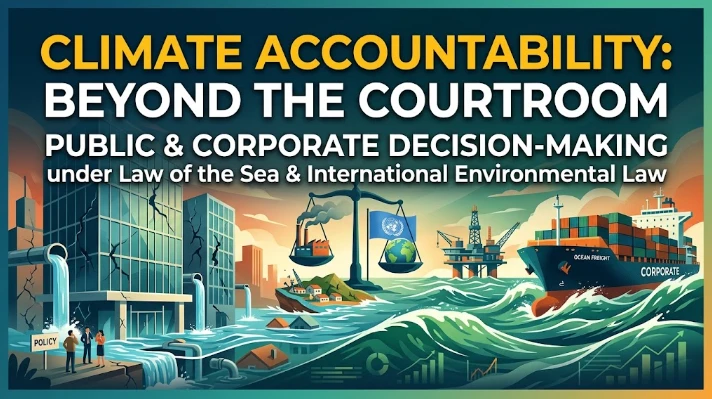
Climate accountability increasingly operates through routine public and corporate decisions rather than exclusively through litigation. This article examines how international environmental law and the law of the sea influence government budgets, permits, procurement, port operations, insurance, energy planning, investment, and corporate governance. The 2024 advisory opinion of the International Tribunal for the Law of the Sea recognized anthropogenic greenhouse-gas emissions as pollution of the
This article examines how biometric border systems can create unequal experiences of citizenship and migration control in the United States. It describes facial recognition, fingerprinting, iris scanning, and interconnected identity databases as technologies that may improve verification and reduce fraud while also expanding surveillance and distributing errors unevenly. The article mentions false matches, failed identification, secondary inspection, questioning, detention, and weak appeal proce