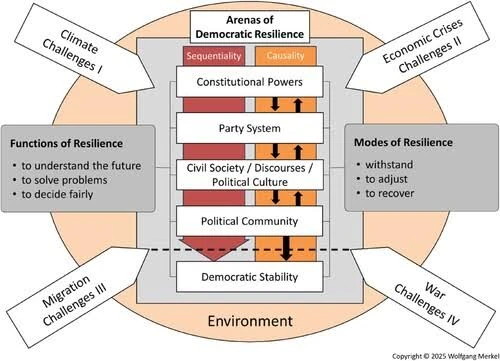
Trying to quantify the recovery of democracy after the overreach of the executive is inadequate. Statement of the right to be measured must come after and follow the restoration of capacities of institutional independence, professional management, protection of rights, and electoral justice and public confidence. A change in leadership can boost national scores, however poorly functioning, damaged routines associated with that change typically do not get touched on. There's also a sense in which reform turns into "partisan revenge," which impedes recovery. Democracy measurement thus requires a temporal and institutional design that is able to distinguish between symbolic changes, operational changes, and changes that can provide durable safeguards against the recurrence of democracy.
Recovering the democracy involves more than changing the occupant of an office, overturning an impugned order. Limited institutional design and watchdog oversight, politicized appointments, changed enforcement regimes, intimidated civil servants, and perhaps a sense among the public that every election is a good time to tinker with the institutions will all be a product of executive overreach. What is needed is restoration, investigation and prevention to achieve recovery. A need for secure tenure and offices; administrative records need to be preserved; unlawful directives need review, affected groups need remedy independent offices need secure tenure and resources, administrative records need to be preserved, unlawful directives need review, affected groups need remedy.
There is also a need for restraint in the reform that would take place, for fear that a sometimes over-zealous "overcorrection" might simply reinforce this winner-take-all dynamic. The durability of recovery enhances neutral capacity and makes it more difficult to abuse in the future, in Party.
When creating a democracy measurement these complex institutions must be reduced to comparable indicators, and each index involves with decisions regarding the concept and the indication of evidence, aggregation and uncertainty. Electoral competition, civil liberties, judicial independence, media freedom, participation, equality and deliberation reflect various aspects. V-Dem aims to respond to this complexity with several indices as well as expert-coded indicators and other projects have their own frameworks. Scores allow comparison amongst scores but can mask local variation or fast turnover of administration. So, the responsible use looks at how indicator-level movement, confidence intervals, coding notes and corroborating evidence, not just a single indicator, are used to provide a diagnosis.
The process of how institutional constraints operate is through independence, capacity, transparency and coordination. Independent but only a weak protection if a court does not have timely access nor remedies that are enforceable. An insecure employment status of civil servants makes them liable to loyalty tests. Election administrators must have resources, as well as physical safety and legal clarity and the public's trust.
These cannot be achieved if there is a lack of access to information and of safeguarding against retaliatory investigation. Demonstrable constraints are those that are supported by multiple institutions that are able to detect, expose, delay and repair abuse. By having redundant parts, the risk of one getting killed rendering the whole accountability system disabled is reduced.
Early-warning should monitor behaviors not at the constitutional level of rupture. Signals are partisan replacement of professional election officials, selective investigation, threats against election personnel, interference with peaceful assembly, the use of extraordinary powers in unusual instances, attacks against the normal media and attempts to delegitimize routine certification. There can be a reason for every event that is innocent! These are all aggravated by the shift of several indicators in the same direction, and opened, exclusionary justifications and remediations become increasingly ineffective. Clustering occurs when a number of administrative records, court documents, legislative processes, staffing data, event datasets and surveys indicate a looming institutional disaster.
Courts act as constitutional guardrails at the right time, under the right conditions and available when there are remedies and compliance. After an emergency has passed, a ruling can help shed light on a doctrine, but can't help people who were impacted. The most important decisions may not be subject to review due to standing, the necessity for confidentiality, classification, procedural delay, or cost. Judicial control, in other words, must be while ensuring the speediness of proceedings, access to evidence, adequate remedies and no reprisals.
Administrative documents providing reasons, choices and alternatives, also, are relied on by courts. If there is no record of executive action to examine then judicial scrutiny can be mere speculation, and language in the Constitution can verge on political rhetoric.
Legislative oversight provides a democratic validation and ongoing review; however, the formal approval may cover up shortcomings in control. Good committees must be staffed, have views heard, have access to documents, have opposition and have the ability to limit and stop delegated powers. In renewing votes, take into account new evidence not the same old crisis text. Budget review also is important because good programs can continue after legal issues have died down, if they are appropriated.
Public reporting has a potential role to contribute to accountability, but sensitive information has to be designed carefully to allow access to report not all information. The nature of institutional stress has an impact on whether legislatures clash or are the outgrowths of party leadership at the executive.
Just taking part isn't enough! Some strategies that can enhance voices without altering agenda setting, information control, and ultimate decisions are consultations, hearings, citizen panels, and advisory boards. Evaluation should enquire as to who comes in, and whose voice gets heard, who is heard when the evidence is presented, which of the recommendations leads to changes in the policy, and who gets to participate in an appeal procedure if they are excluded. Participation can become symbolic, when officials choose participants which suit them, or for example with asking for comments after the key decisions have been made. Good design provides participants with timely information, independent facilitation, clear requirements for participation in deliberation and the connection between deliberation and final decision-making is clear.
Measurement = commitment, capacity, behavior, outcome – done separately. Commitment is spelling out on Treaty Ratification and capacity is spelling out on Budgets and Staffing. Administrative decisions and enforcement practices show performance and safety, access and equality, as well as remedy. By adding all four types, the false optimism is not introduced.
A country can have better documentation despite the on-going abuse, or better documentation can be effected by some other economic change. Mechanisms are identified via Longitudinal evidence, matched comparisons, case tracing and affected communities interview approaches. Data quality also has an impact, as official reports of violations may be inaccurate if they are under-reported, civil-society documents may tend to focus on the most visible or blatant violations while legal documents may not report violations under informal settlement or in the face of intimidation.
There are some elements of democratic change that can be seen in subnational analysis that do not appear in the national trend. The administration of local elections, the practices of public record laws, prosecutors, protest police, judges and civil-service protection vary widely across the jurisdictions in the United States. Similar indicators can highlight areas of resilience and of deterioration and help with natural experiments of policy change. The use of local evidence also helps to limit the use of a national rhetoric to "explain" every outcome.
A democracy is lived with the County offices, school boards, courts, police departments and state offices. There is thus a need for measurement which links the national constitutional structure to where rights are put into practice, that is, in the administrative locations.
Trust is required in the information environment for this voter accountability to take place. Much of the time institutional violations have to do with procedure and are more important than with policy or personality. There should be clear reporting to include but not be limited to the rule that became relevant, action taken, evidence available, responsible authority as well as the impact on future competition. Words of partisan hyperbole and false equivalence can deceive and whittle down credibility.
Independent election officials, courts, researchers and journalists play different functions and can help to enhance the facture clarity of the election. Citizen recognition of a violation is more likely the fewer resistances that exist to its recognition and the more immediate cause of the violation the citizens have.
An index of recovery, including direction and extent of recovery, should be considered. Being appointed an inspector, be able to restore a rule, or release withheld records is a step forward toward repair, but without secure tenure, budget and procedural protections, it is not complete. A reform should also be looked at in terms of measuring whether or not it is addressing future governments or merely rectifying one government. Neutral design helps to chance recovering becoming a partisan exception.
The Meaning of "public trust" cannot be taken lightly. Trust can increase when institutions are made fairer but it can increase amongst one constituency when they have been taken over. Disaggregated surveys, complaint patterns, and service outcomes and perceptions of procedural justice provide a much clearer picture. When the conflict is lost by democratic group, its members still anticipate a set of uniform rules to govern them, so as to prevent abuse of their power.
Democracy measurement can be important when it relates to numbers and provides insights into mechanisms, and not as a substitute for judgement. There should be a check that score, survey and event data, administrative records and case evidence show that there are power wins and there are protection losses and it should show if there is still a possibility of correction. When there is partisan tolerance, voters will not remove themselves from the institutional system since the costs of executive overreach are reduced. Two things are therefore required for recovery: a structural fix and the public accounting.
The question is whether a resilient democracy will allow the contest, fair and non-partisan executive, rights, and meaningful participation—even in the face of obvious, current political pressures for exception. At times, switching movements in the indicator-level scores can be more indicative than the score on a composite national score. Democratic values become a reality if public sanctions apply to partisan. Every effort must be made to protect the future opponents in recovery, as much as present opponents, if applicable.