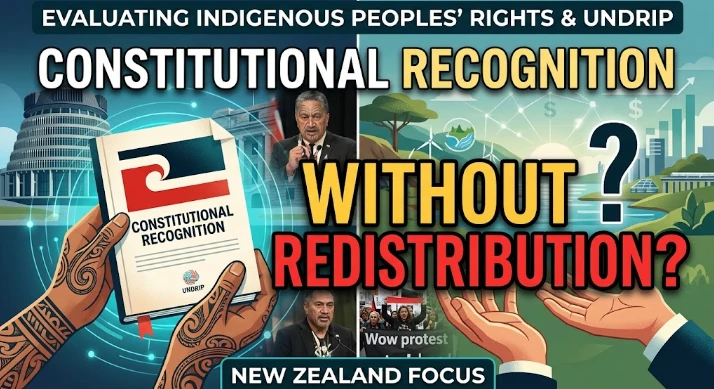
Formal recognition of Indigenous rights does not necessarily redistribute political authority, resources, or institutional influence. This article evaluates how Māori rights and the United Nations Declaration on the Rights of Indigenous Peoples can be translated into meaningful governance in New Zealand. Constitutional language, policy commitments, and consultation processes may acknowledge Indigenous status while leaving budgets, land decisions, service systems, and regulatory power under exclusive state control. The article therefore distinguishes symbolic recognition from substantive redistribution. It proposes assessing whether Māori institutions can define problems, influence agendas, allocate resources, govern data, oversee implementation, and obtain remedies when commitments are violated. Te Tiriti o Waitangi, UNDRIP, and domestic legal protections provide normative foundations, but their effectiveness depends on operational arrangements. Shared decision-making, transparent funding, institutional representation, community-controlled evaluation, and enforceable accountability can close the gap between recognition and practice. Indigenous rights become substantive when Māori communities possess durable authority over decisions that affect their territories, identities, resources, wellbeing, and collective futures.
While material power has changed little and changed even less in a swift manner, the character of its amendments has undergone extensive changes, mediated by constitutional recognition. Words like partnership, culture and dignity, and Indigenous rights, can be included in legislated, policy language, or rituals without a transfer in land control, decision-making or fiscal authority, or a change in service design. There are symbolic and redistribution rights, and therefore, in January 2026, it is necessary to distinguish between these rights and evaluate Indigenous peoples' rights in New Zealand. Possibly, the UNDRIP offers a general outline, as the institutions, capacity and authority for domesic impact depend on the specific country.
UNDRIP recognizes minimum standards in the areas of survival, dignity, well-being, self-determination, culture, land, participation and free, prior and informed consent. The Declaration is a statement of intent and does not specify any particular type of constitution. It sets forth guidelines which will be interpreted by States in history and existing legal ties. In New Zealand, that translation is in a context where Te Tiriri o Waitangi, tikanga, legislation, court decisions, the Waitangi Tribunal and changing negotiation regimes between the Crown and Māori authorities shape it.
Recognition matters. The public use of language may have an impact on the interpretation, administrative culture, education and legitimacy. Legal recognition can result in claims, inform courts, and inform institutional change. But acclaim outside of means invariably can grow to be a replacement for change. A policy which has had positive effects on Māori identity may be accompanied by inaccessible services, land decisions are still centralised and funding does not reflect the responsibilities given to Māori providers.
The concept of 'redistribution' should be taken in its broad sense. Financial transfers are important factors, but they are not the only ones; jurisdiction, data control, land access, appointment power, procurement, authority to design services, and so on, are also important. A co-governance system where each group maintains the same number of members, but has no budget and no binding mandate is not very powerful. The consultation process with no agenda rights or review can keep Crown discretion intact. Evaluation should thus cover the question as to what is feasible in terms of decisions and enforcement.
Whenua, wai and taonga continue to be important as it is the land and its resources that have cultural and political power. Settlement has found a resolution to many historic claims, but settlement will not resolve all current rights issues. Maori interests are still being impacted by environmental regulation, infrastructure, conservation, housing and climate adaptation continues. An early engagement with and joint ownership of the choice of what is offered is more effective than consultation after the basics have been chosen.
Another test will be service delivery. Māori organisations are likely to provide health and social services, education and housing and justice with a wealth of knowledge of the community. Contracting can be a vehicle for self-determined models and short funding cycles and restricted performance measures can result in re-dependency. Sustainable systems must be financed, well planned, have their own data and have the power to make decisions about results. No redistribution with transfer of responsibility without the transfer of resources.
Careful assessment of political representation is required, as well. Important channels include Māori electorates, local representation and advisory bodies and appointments. Having a representation doesn't necessarily mean you have decision making power. Influence is defined by committee structure, committee voting, access to the committee agenda, rights to commit information and committee budgets. Institutions should release the nature of Māori influence on decision making not just 'attendance'.
Two misunderstandings of the concept of free, prior, and informed consent are that it is either a universal veto or ordinary consultation. Effective implementation emphasizes the need for good faith negotiation, information, lack of coercion, and respect for Indigenous authority, where rights are particularly impacted. They will set up a process to go through depending on the situation and severity. When projects pose a potential threat to the survival of a culture and control over traditional lands, the standard of review must be higher than what is being considered in routine administrative matters.
Information is one of the major elements of the constitution. The narratives created by government data inform funding, risk scores, eligibility for services and research. Māori data sovereignty issues revolve around governance issues such as data collection, access, interpretation and re-usage. A lack of control can also enable institutions to get recognition without giving up decision making. Agreements must have a clear purpose, security, benefit to the community and accountability.
The degree of reform can be uncovered by fiscal analysis. The best way to see if commitments are here to stay or not is to check whether they are part of the budget or not. Examples of useful indicators are multi-year funding, percentage of funding managed by Māori institutions, percentage of funding going to Māori organizations as procurement, percentage of funding for capability and costs passed through underfunding of mandated outcomes. Transparent reporting of resources needs to be identified as new resource and not merely re项labeling old expenditure.
The Waitangi Tribunal provides a significant avenue for accountability, but recommendations and reports need to be put into action. Government responses should provide timeframes, accountability of government bodies, budgets and rationale for those recommendations that do not appear in Government responses. Follow-through can be carried out by Parliamentary committees and independent audit. Partial recognition is indicated by a report which clarifies public opinion on the matter but leaves the administration unchanged.
Another way in which courts influence constitutional recognition is through the way in which they interpret and review statutes. Litigation can help to clarify duties but the cost of access and limited remedies are restrictive. Design of administration to be less reliant on repeat court action. Having a clear statutory duty, collaborative decision-making processes, and rights that are part of the procedure enforced can introduce a sense of obligation in ordinary governance.
Community based outcomes are required to be included in an evaluation. State indicators often focus on the efficiency of services, and ignore cultural continuity, collective authority, language, land‐based ties and well‐being of future generations. Measures are more likely to be co-designed if Māori institutions retain control of interpretation. Independent research can carry out a check on the ground of plans and reality in regions and sectors.
This creates potentially political contestation in redistribution as there is limited authority and resources. Explanation is key (transparent explanation). Identical treatment is not required by the duty of constitutional fairness where "historical obligations" and unequal burdens and collective rights are involved. Public institutions need to make clear how differentiated arrangements contribute to democratic legitimacy and good governance and, in particular, not depict reform as a sort of private deal.
The recognition takes on meaning when there is an institutional shift in terms of decision-making, control of resources, knowledge standards and the ability to call for remedy. One way to view UNDRIP is as a framework and Te Tiriti relationships offer New Zealand a particular constitutional context. It's not a question of respectful language in the official documents. What matters is whether Māori communities have lasting decision-making power, suitable resources and control measures that can be enforced on issues that impact the collective life. If there is no such change, constitutional recognition is at risk of turning into the ornamental description of power that is left unworded.
A scorecard by sector can help put things in perspective on the recognition changing power. There are distinct institutions involved in the fields of health, education, justice, environment, local government and data policy per se. Indicators should recognises Māori decision rights, controlled funding, authority of Māori workforce, and Māori access to remedy. Relations may be less strong in areas than reflected by the national averages.
The other redistributive mechanism is procurement. Government buying can be a tool to supporting Māori enterprises and Māori community capability as long as what is being sought is proportionate and the criteria are still transparent. The focus of the procurement policy should not be solely taken on the price. Apprenticeship, sourcing from the local area and Cultural commitments can be part of contract design.
Language is also impacted when it comes to Constitutional recognition. Practical access, cultural continuity supported by te reo Māori in courts, services, school and information to the public. Requirements for language rights are trained staff, resources and quality. To be symbolic bilingual, not providing a service, doesn't really have that much worth.
A good trial of shared authority exists in the governance of the environment. There is a need for staff, science, monitoring, enforcement and finances in joint management bodies. If state agencies have all of the coercive powers, the co-governance is of the advisory type. An agreement should outline what to do in case of disputes and how the information of communities goes into the decisions.
The importance is around intergenerational accountability – redistribution takes place over long-term time horizons. Future autonomy is formed by land, data, and language and institutional capability. Often it is the case that shorter political cycles mean that recognition may be preferred to advancing the process of building capacity. Long-term goals are safeguarded by multi-year commitments for action and independent monitoring.
There is need for public debate to differentiate collective right from an individual preference. Indigenous People are not just demographic groups, they are Peoples with rights. It is therefore possible to depart from the general consultation arrangements in institutional arrangements. Clear explanation helps to foster democratic understanding and helps to diminish misleading 'equalities claim' with regard to every differentiated measure.
The evaluation of capability should not result in a posture of ‘capability is a precondition for authority' - it should be done in terms of institutional capability. Phased transfer can be a blended approach of immediate decision rights and agreed investment, staffing and support. Milestones are needs to be built upon to show progress towards which should be negotiated. Delay simply needs to be publicly reported on and independently audited, not exercised at the discretion of the administrator.
Māori researcher(s) and institutions need to be involved from design to interpretation in checks against their individual criteria. Partnering in research allows for state defined measures to not be the only measure of progress.
CITE THIS ARTICLE
Amin, M. R. (2025). Constitutional Recognition Without Redistribution? Evaluating Indigenous Peoples’ Rights and UNDRIP in New Zealand. https://www.ruhulresearchhub.com/article/196f4d60-a81f-5b3b-bba8-260049ae7c11
M. R. Amin, “Constitutional Recognition Without Redistribution? Evaluating Indigenous Peoples’ Rights and UNDRIP in New Zealand,” 2025. [Online]. Available: https://www.ruhulresearchhub.com/article/196f4d60-a81f-5b3b-bba8-260049ae7c11
Amin, M. R. (2025) ‘Constitutional Recognition Without Redistribution? Evaluating Indigenous Peoples’ Rights and UNDRIP in New Zealand’. Available at: https://www.ruhulresearchhub.com/article/196f4d60-a81f-5b3b-bba8-260049ae7c11
Amin, Mohd. Ruhul. “Constitutional Recognition Without Redistribution? Evaluating Indigenous Peoples’ Rights and UNDRIP in New Zealand.” 2025, https://www.ruhulresearchhub.com/article/196f4d60-a81f-5b3b-bba8-260049ae7c11.
Mohd. Ruhul Amin. “Constitutional Recognition Without Redistribution? Evaluating Indigenous Peoples’ Rights and UNDRIP in New Zealand.” (2025). https://www.ruhulresearchhub.com/article/196f4d60-a81f-5b3b-bba8-260049ae7c11.
Amin MR. Constitutional Recognition Without Redistribution? Evaluating Indigenous Peoples’ Rights and UNDRIP in New Zealand. 2025. https://www.ruhulresearchhub.com/article/196f4d60-a81f-5b3b-bba8-260049ae7c11
@misc{article_196f4d60a81f5b3bbba8260049ae7c11,
  title = {Constitutional Recognition Without Redistribution? Evaluating Indigenous Peoples’ Rights and UNDRIP in New Zealand},
  author = {Mohd. Ruhul Amin},
  year = {2025},
  url = {https://www.ruhulresearchhub.com/article/196f4d60-a81f-5b3b-bba8-260049ae7c11},
}
TY  - GEN
AU  - Mohd. Ruhul Amin
TI  - Constitutional Recognition Without Redistribution? Evaluating Indigenous Peoples’ Rights and UNDRIP in New Zealand
PY  - 2025-11-10
UR  - https://www.ruhulresearchhub.com/article/196f4d60-a81f-5b3b-bba8-260049ae7c11
ER  -
This article presents democratic recovery after executive overreach as a process of reopening institutions rather than merely restoring formal legal boundaries. It describes how executive misconduct can leave politicized appointments, weakened oversight, restricted records, altered enforcement practices, intimidated officials, and concentrated agenda control. The article mentions open-democracy theory as requiring continuous accessibility, deliberation, transparency, inclusion, and responsivenes
Climate accountability increasingly operates through routine public and corporate decisions rather than exclusively through litigation. This article examines how international environmental law and the law of the sea influence government budgets, permits, procurement, port operations, insurance, energy planning, investment, and corporate governance. The 2024 advisory opinion of the International Tribunal for the Law of the Sea recognized anthropogenic greenhouse-gas emissions as pollution of the
This article examines how biometric border systems can create unequal experiences of citizenship and migration control in the United States. It describes facial recognition, fingerprinting, iris scanning, and interconnected identity databases as technologies that may improve verification and reduce fraud while also expanding surveillance and distributing errors unevenly. The article mentions false matches, failed identification, secondary inspection, questioning, detention, and weak appeal proce