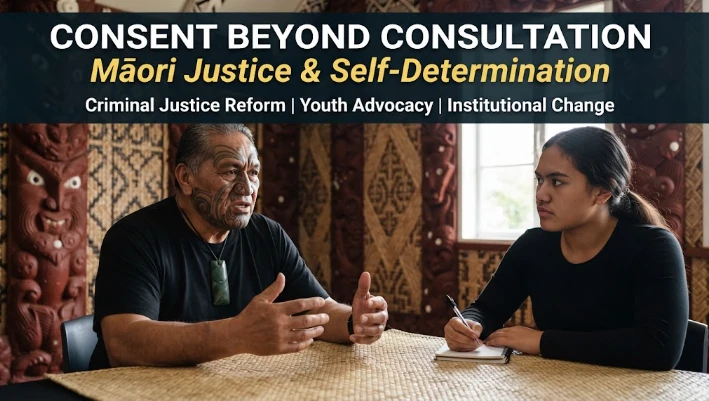
Consent Beyond Consultation: Māori Legal Issues and Criminal Justice and Youth Justice and the Institutional Conditions for Indigenous Self-Determination
Mohd. Ruhul Amin (Master of Laws (LL.M.) in Human Rights)
The article distinguishes meaningful Indigenous consent from consultation processes controlled by state institutions. It argues that consultation becomes procedural when government determines timing, available options, information, resources, and the final decision. Drawing on UNDRIP, Te Tiriti obligations, administrative fairness, tikanga Māori, and youth-justice principles, it proposes agenda-setting power, independent advice, sufficient time, transparent alternatives, negotiated authority, and enforceable agreements. The article also emphasizes whānau continuity, rangatahi participation, stable Māori-led services, data sovereignty, tikanga-informed dispute resolution, multi-year funding, workforce development, and attention to cumulative effects in land and resource decisions. Consultation records, governance seats, funding transfers, service design, dispute outcomes, and documented influence should be used to assess whether participation changes decisions. The central test is whether refusal, revision, and shared control remain genuine institutional options. Consent has democratic substance only when Māori authorities can shape problems, resources, data, implementation, and remedies rather than merely respond to predetermined proposals.
Consent is at the nexus of law, administration and public legitimacy, as a determinant of Indigenous self-determination. The importance of the issue is particularly acute during the fifth month of 2026, because consultation may turn into a blanket of mere proforma when the institutions get to decide the timing, the total number of options, what information to include and the final decision. There can be no such thing as goodwill for strong institutions. Security shouldn't waver during pressure, disagreements and changes of political monitoring.
UNDRIP standards, The Tiriti obligations, administrative fairness, tikanga Māori and principles of youth-justice are included in the governing framework. Those are the sources that set up standards, but there need to be institutions to interpret, implement, and review to assign meaning to standards. Rangatahi and contracted service providers, whānau, ministries, courts and councils are the key actors. But that group needs to work in coordination keeping independence, not sharing the responsibility.
With Māori cases, issues of law and power are inextricably linked. tikanga, whakapapa, whenua and collective responsibility transform justice and policy conversations. A narrow model of service delivery views Māori institutions are as market providers. A model of self-determination has been suggested that includes authority to problem define, resource allocate, self-govern data and evaluate outcome.
Te Tiriti relationships are things we should do on an ongoing basis; not just things that we touch on from time to time. Getting started early is important since potential options get reduced once the budgets, legislation, or project design is fixed. Must have information accessible, realistic timeframe and must have Māori institutions properly resourced to be able to participate. Where there is a difference of opinion, there needs to be clear explanation of the reciprocal duties, too.
Rangatahi Māori can see the effects of the disjointed administration which exists from side to side between school, care and protection, health, police, court and marae. The use of shared rule can minimize duplications of assessments and of conflicting planning. Continuity and belonging to whānau should be key outcomes, as should be cultural connections, and support that is locally based. Stable funding provides Māori providers with continuity of: Capability and Relationships.
Data sovereignty is of the record of accountability. Administrative data can reveal disparity, and state control and limited performance measures can regulate control. Collect, access, interpret, link, retain and publish should be covered by governance arrangements. Māori designed indicators identify belonging, mana and whānau strength, cultural continuity and community safety as well as justice measures.
Ordinary contract management isn't enough for dealing with dispute resolution. Shared governance requires a set of mutually agreed upon deadlock, breach, funding dispute, and jurisdiction over-lapping procedures. Independent mediation, tikanga based processes, review rights and public reporting are processes that safeguard relationships. Until those mechanisms are in place, the formal partnership may end up falling apart from the first serious disagreement, which is a problem.
Greater empowerment to agenda set, independent advice, time, transparency of alternatives, negotiated empowerment, enforceable agreement are important aspects of a practical reform agenda. Each element refers to a failure point – before, during, after and remedy if caused. The order is important because identifying “root cause” – and holding someone accountable for it - is harder if there is no record upstream, and no justification.
Evidence should involve consultation logs, decisions made as a result of consultations, transfers of consultation funds, governors seats, design of consultation services and resolution of disagreements. This type of content can be compared between agencies, regions, over time and to affected groups. Sometimes patterns, disparities, delays and repetitions of institutional failure may be revealed without compromising confidentiality by publication.
People and places who have not historically been part of land, justice, welfare, youth-policy processes – and so forth – should be at the heart of equity analysis. Formal neutrality cannot provide answers to questions of knowledge of burdens or differences of access to review by income, status, location, disability, ethnicity, age or language. The connection between distributional evidence and design and resource allocation should be made.
Public communication also has an impact on the legitimacy. The language of technocracy can cloud the sizable effects of the decisions made by administrators, and the bravado of rhetoric can magnify any doubt. Objectives, evidence, trade-offs, rights affected and challenge available should be explained and made clear. When educators admit that they don't know how to do something, it can help to build more confidence than saying, “I have it all under control.”
Implementation requires resources. Review bodies should have staff, expertize, job security, access to documentation and authority to make conclusions. Funding, interpretation, accessible venues and time also are important components of community involvement. Unfunded rights may turn into symbolic statements, as well as participation duties.
A false dichotomy of universalism and context should be avoided in the process of institutional reform. General rights of respect for the law, equality, right to be heard, to have the case reconsidered and to be corrected are in force. How protections work in reality are mediated by local knowledge. DURABLE DESIGN provides an integrated set of common protections and culturally, geographically and experientially responsive procedures.
Evaluation of policies post launch should continue for the long term. If this change in leadership, crisis or budget occurs, early compliance can decrease. Continuity as a result of scheduled review, public reporting and independent research. It should be possible to take corrective action without a complete failure of the policy.
The relationship between formal rules and incentives should be included in the analysis at the institutional level. Work load, targets, budgets, professional norms, political signals and expected scrutiny are all factors to which the officials react. When those forces direct towards lawful and fair conduct, then reform works well. A safeguard, which is only in a manual, can be lost under operation pressure.
Funding design reflects the degree to which there is institutional commitment. Short-term contracts and limited products can cause Māori organisations to have to accommodate their community-based agendas to match their agency classification or function. The support of capability is derived from multi-year funding, flexible outcomes and transparent costs recognition. Accountability will be robust and locally determined processes will be allowed.
The processes should be Tikanga-informed, affecting substance, as well as ceremony. Relationship, Collective responsibility, Restoration, Mana can transform Referral, Hearing, Remedy and Evaluation. Trainers need to build capacity particularly among institutional staff, not a single bout of culture trainings. Where management is by Māori tikanga is part of the guiding framework, it should be interpreted with their leadership.
Shared authority is supported with workforce development. There's a need for stable access to legal, policy, data, clinical and a youth-justice pathway and expertise for Māori-led institutions. It's also important that state agencies have employees who can work using relational processes. Joint capability plans can minimise reliance on a few people going round and round the same consultation needs.
Cumulative effects need to be taken into account in land and resources decisions. A single project assessment can focus on one-time loss, limited access and cultural degradation and environmental degradation across generations. A ‘catchment' and whakapapa-based framework can expand the frame. Decision journal entries must show how cumulative Māori interests played a part in making the decisions.
They should be given more weight at the institutional level when they participate in youth. Barriers not identified by adult governance can be added up on Rangatahi panels, peer research and through youth-led evaluation. Safeguards need to enable participation with privacy, safety and informed participation. Official responses should report if there was any modification of services, financial resources or policy and practice in justice.
Responsibility needs to be identified throughout the governance buildings. Authorisation, delivery, monitoring and remedy has to be traceable to allow iwi, hapū, rangatahi, whānau, ministries, courts, councils and contract delivery service providers to work in an effective way as partners together. Where there is an overlap of responsivities, there are written procedures and escalation mechanisms. Ambiguity is otherwise the safeguarding of institutional boundaries and not affected people.
Risk assessment to be considered including action and inaction. There is evidence that both over-intervention and under or late and disjointed intervention threaten the rights of individuals and children. Decision record should include a discussion on the balance based on evidence and less-restrictive alternative(s). It will then be possible to evaluate reasoning at a later time, instead of having to reconstruct unstated assumptions.
Indépendent research can be a link between official reporting and community experience. Data access and publication rights afford researchers the opportunity to test institutional claims, while secure data access and ethical oversight protects the integrity of that data. Confidentiality and authority of the community must be upheld through partnerships. Any findings should be answered in a formal manner, and not merely acknowledged.
Signs of success should be determined by their influence that is recorded, consent that is negotiated, reduced unilateral override, more Māori-led services, and ongoing institutional relationship. These measures are both result- and process-oriented and include institutional capacity. Targets need to be clear, definitions need to be consistent, there needs to be an explanation of failures and there needs to be plans in place to correct.
The best institutional approach involves a blend of the four elements – legality, capability, participation, transparency and correction. While providing a necessary foundation, UNDRIP and Te Tiriti obligations, administrative fairness, tikanga Māori and youth-justice principles are also important factors in whether or not rights are actually protected in practice. A set of evidence from consultation recorded, decisions made, funding transferred, seats on the governance group, services designed, and outcomes of disputes can highlight the gap between compliance and outcomes. Democracy has a sense in consent if refusal, revision and shared control are still alive options of institutions.
CITE THIS ARTICLE
Amin, M. R. (2026). Consent Beyond Consultation: Māori Legal Issues and Criminal Justice and Youth Justice and the Institutional Conditions for Indigenous Self-Determination. https://www.ruhulresearchhub.com/article/d4420c9f-de31-5187-803a-72297f5e2f62
M. R. Amin, “Consent Beyond Consultation: Māori Legal Issues and Criminal Justice and Youth Justice and the Institutional Conditions for Indigenous Self-Determination,” 2026. [Online]. Available: https://www.ruhulresearchhub.com/article/d4420c9f-de31-5187-803a-72297f5e2f62
Amin, M. R. (2026) ‘Consent Beyond Consultation: Māori Legal Issues and Criminal Justice and Youth Justice and the Institutional Conditions for Indigenous Self-Determination’. Available at: https://www.ruhulresearchhub.com/article/d4420c9f-de31-5187-803a-72297f5e2f62
Amin, Mohd. Ruhul. “Consent Beyond Consultation: Māori Legal Issues and Criminal Justice and Youth Justice and the Institutional Conditions for Indigenous Self-Determination.” 2026, https://www.ruhulresearchhub.com/article/d4420c9f-de31-5187-803a-72297f5e2f62.
Mohd. Ruhul Amin. “Consent Beyond Consultation: Māori Legal Issues and Criminal Justice and Youth Justice and the Institutional Conditions for Indigenous Self-Determination.” (2026). https://www.ruhulresearchhub.com/article/d4420c9f-de31-5187-803a-72297f5e2f62.
Amin MR. Consent Beyond Consultation: Māori Legal Issues and Criminal Justice and Youth Justice and the Institutional Conditions for Indigenous Self-Determination. 2026. https://www.ruhulresearchhub.com/article/d4420c9f-de31-5187-803a-72297f5e2f62
@misc{article_d4420c9fde315187803a72297f5e2f62,
  title = {Consent Beyond Consultation: Māori Legal Issues and Criminal Justice and Youth Justice and the Institutional Conditions for Indigenous Self-Determination},
  author = {Mohd. Ruhul Amin},
  year = {2026},
  url = {https://www.ruhulresearchhub.com/article/d4420c9f-de31-5187-803a-72297f5e2f62},
}
TY  - GEN
AU  - Mohd. Ruhul Amin
TI  - Consent Beyond Consultation: Māori Legal Issues and Criminal Justice and Youth Justice and the Institutional Conditions for Indigenous Self-Determination
PY  - 2026-03-02
UR  - https://www.ruhulresearchhub.com/article/d4420c9f-de31-5187-803a-72297f5e2f62
ER  -
This article presents democratic recovery after executive overreach as a process of reopening institutions rather than merely restoring formal legal boundaries. It describes how executive misconduct can leave politicized appointments, weakened oversight, restricted records, altered enforcement practices, intimidated officials, and concentrated agenda control. The article mentions open-democracy theory as requiring continuous accessibility, deliberation, transparency, inclusion, and responsivenes
Climate accountability increasingly operates through routine public and corporate decisions rather than exclusively through litigation. This article examines how international environmental law and the law of the sea influence government budgets, permits, procurement, port operations, insurance, energy planning, investment, and corporate governance. The 2024 advisory opinion of the International Tribunal for the Law of the Sea recognized anthropogenic greenhouse-gas emissions as pollution of the
This article examines how biometric border systems can create unequal experiences of citizenship and migration control in the United States. It describes facial recognition, fingerprinting, iris scanning, and interconnected identity databases as technologies that may improve verification and reduce fraud while also expanding surveillance and distributing errors unevenly. The article mentions false matches, failed identification, secondary inspection, questioning, detention, and weak appeal proce