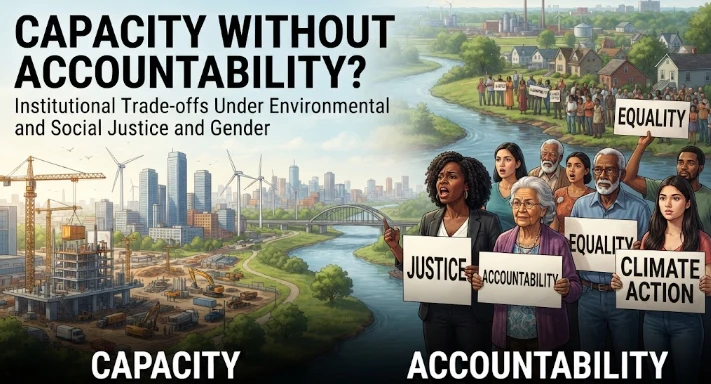
The article analyzes how reforms intended to increase administrative capacity can weaken accountability in environmental and social policy. Centralization, outsourcing, emergency delivery, automation, and contracting may increase speed and expertise while obscuring responsibility, local knowledge, equity effects, and public review. The proposed governance framework combines public-service principles, procurement rules, privacy, anti-discrimination law, and environmental responsibility. Practical safeguards include auditable delegation, transparent contracts, public-interest tests, human oversight, citizen participation, enforceable performance duties, disaggregated evidence, independent audits, and accessible complaint mechanisms. The article emphasizes gendered impacts, unpaid care, digital exclusion, precarious work, unequal environmental exposure, and place-based differences that national averages can hide. It also calls for long-term evaluation, distribution-sensitive budgeting, co-production, strong enforcement, and procurement standards tied to environmental and social outcomes. Capacity is legitimate only when delivery improvements remain answerable, reviewable, transparent, equitable, and connected to local knowledge rather than allowing speed or technical complexity to shield concentrated harm.
Much of the discussion on the balance of capacity and accountability begins with concepts and concludes with problems of practice. By June 2026, scratching and middle class voice can be undermined by centralisation, outsourcing, emergency delivery and automation which can enhance speed. One pivotal decision will not cause the harm, it will typically be the result of an accumulation of procedures, incentives and omissions. The design of institutions ought thus to receive the same care as the "legal doctrine".
The governing framework comprises public-service principles, public procurement regulations, protection of privacy, anti-discrimination legislation and environmental responsibility. Standards are set by those sources but do need the institutions to interpret, implement and review them. The main players are central government bodies, local government bodies, companies, digital companies, auditors, providers of community services, as well as residents. That group needs to maintain independence in coordination and not to encase responsibility.
There are things beyond efficiency to public value. Administrative performance includes environmental quality, equal treatment, democratic voice, cultural integrity, trust and future. Using a "narrow" cost measure can act as an incentive for the shifting of costs to households, communities, or future generations. Those transfers will be apparent on a broader evaluation.
The Public Service Act 2020 incorporates principles like those of political neutrality, free and frank advice, appointments based on merit, open government and stewardship into the administration of New Zealand. Those principles help to promote legitimacy amidst increased policy conflict. Indeed, in the context of environmental decision making in particular, stewardship is of critical importance since the impacts go beyond elections and the lifetime of organisations.
Exposure, income, unpaid care, transport, safety, housing, employment and participation to be considered in the gender analysis. Household data may provide a masking effect of inequalities in power over resources and time. Disaggregated evidence that is more robust to form a basis for policy design. Intersectional analysis also refrains from considering gender to be an homogenous category.
The questions of environmental justice are Who is harmed, Who is benefiting, Whose opinion is being heard, and What options are there to resolve the harm. Climate risk and conservation policy, pollution and infrastructure have highly local impacts. The economic assessment should then be done in a distributional manner as well. Community knowledge can identify challenges or issues that surveys during the project may not uncover.
There's need for institutional memory for the accountability mechanisms. Lessons can be lost and long term commitment can be undermined through reorganisations, change of management, short-term contracts, and other factors. Records are maintained, public dashboards keep everyone informed and continuity is maintained by sustaining indicators and independent review. These also enable other governments to tell the difference between real failure and implementation challenge and complexity.
Practical reform measures should include delegation that is subject to audit, transparency of the contracts, public interest tests, human oversight, citizens' participation, and binding performance obligations. These elements cover the different failure points: authorisation – in advance of action, documentation – as action takes place, review – after action and remedy – when harm is detected. The order is important because amongst other things, checkpoints of accountability will be reduced if previous records and previous reasons are missing.
This could involve details of contracts, failure of services, algorithmic results, spending information, environmental impact, complaints and audit results. Such information makes it possible to compare between agencies, regions, over time and with regard to impact on various groups. Publication is a way of concealing identities and revealing trends, inequities, delay and systemic failure.
Equity Analysis should focus on groups with unequal exposure to the environment, unpaid care responsibilities, isolation and exclusion from digital technologies and precarious employment situations. The formal neutrality cannot be used to answer the questions on the leveling off of burdens or inconsistencies in access to review, by income, by status, by geography or any other of the various factors relating to disability, ethnicity, age, language etc. Distributional evidence to make diet of design and allocation of resources.
All measurements come with their own dangers. Indicators can provide a simpler way of reporting and can facilitate strategic reporting. In view of these considerations, then, quantitative data should be placed next to qualitative data and to various kinds of independent verification and clearly defined terms. Disaggregated reporting is important as a national average may be hiding significant failures at the local and group level.
Public communication has an impact on legitimacy. Administrative decisions have significant consequences and are often rendered in a way so opaque by jargon that they are difficult to comprehend, but they are often also intentionally distorted and confused with rhetoric that suggests greater doubts than are in fact warranted. Clear explanation should identify objective, evidence, levels of compromise and rights impacted, and opportunities for challenge. Acknowledging limits is more effective and is often a more honest approach to bolstering confidence than pretending to have a bit of control.
Implementation requires resources. Staffing, expertise, secure tenure, record access, and a requirement for responses are all key to review bodies. One also needs to think about the feasibility of community participation with the point of funding, interpreting and the venues offering space to do it and the time. Unfunded rights and participation duties can be turn 'symbolic commitments'.
It is important to avoid taking a approach to institutional reform in the face of universal standards and context. Broad protections include the rights of core treatments (legality, equality, notice, review and remedy). Protections are effective in practice based upon local knowledge. Durable design leverages roughly normal protection mechanisms and culturally, geographically, and experientially-indexed procedures.
After policy launch, following the policy should be taken for long term evaluation. When compliance is done early on, it can go astray as leadership changes, crises arise or budgets are cut. Continuity is maintained by scheduled review, public reporting of their findings and independent research. This corrective process can be carried out without being dependent upon complete policy failure.
There should be historical trends of distribution when doing a budget analysis. Upfront savings can mean: health cost consequences, disaster losses, service losses or uncompensated care burdens. Fiscal appraisal must address uncertainty and carry out sensitivity analysis. Breakthroughs should be counted toward intergenerational effects even if those effects are down the line - and discounted in standard accounting.
Co-production can mean enhancements in legitimacy and effectiveness. community groups possess intricate information about obstacles and what things ought to be. Co-production is not consultation where design, delivery and evaluation are decisions that are made after key decisions. Roles and fair compensation defuse participation to prevent it serving as unpaid administration.
Outcomes are determined by the capabilities of regulation and enforcement. Under-resourced inspection, monitoring and follow-up leads to an inability to drive up standards through the strength of the statutory framework. There is a need to not give up on communities that suffer from chronic low-visibility harm with risk-based enforcement. Priorities can be conveyed through public reporting – keeping flexibility for new emerging threats!
Environmental and social objectives can be promoted with the design of the procurement. Evaluation factors may include emission, working conditions, accessibility, the gains to the community and gender impacts. Contract management should not trust supplier assurances, but should make sure that the work is performed. There must be a progression from using correction plans to penalties or termination.
By highlighting the connections that may be overlooked through national averages, place-based governance claims that it can also assess systemic challenges and opportunities. Australia's experiences of environmental susceptibility, service access, employment, transport and housing varies from state to state. As for central funding, it should take into account local information and the knowledge of the community. National standards are important, but so too is that delivery that takes into consideration geographic conditions.
There needs to be a point of responsibility for every step of the governance system. Without traceability of the authorization, delivery, monitoring, and remedy, all other parties (e.g., community providers, affected residents, auditors, contractors, and digital vendors) will not be able to work together effectively with central agencies and councils. If multiple mandates are in place, there needs to be written protocols and escalation routes in place. If there is any ambiguity, then, it is in favour of protecting the institutional boundaries and not the affected people.
Both ‘do' and ‘muster' need to be considered for risk assessment. Too much, or inappropriate, intervention may infringe rights of the child or young person while not intervening or intervening too late or not intervening together can mean that significant harm is not dealt with. Records of decisions should provide an account of how available evidence and less restrictive alternatives were considered in reaching a decision about the balance. It's then possible, in later review, to assess reasoning instead of making assumptions not expressed in the text.
Official reporting may not capture the community's practical knowledge, which can be obtained through independent research. Access to such data, ethical management and rights for publication enable researchers to verify institutional claims. Confidentiality and community authority need to be included in partnerships. Findings do not need to be "acknowledged," nor should they be overlooked.
Complaint systems provide useful “operational intelligence.” Ongoing grievances can reveal unclear rules, subjective practices, keeping services out of reach, or poor oversight prior to significant litigation. Agencies must remember to code for themes and must not minimize the individual harm in codes. Use the Trend Analysis to lead to Corrective Work assigned and Follow Up published.
Deliverable, commitment of spending, narrowing of the gap, ease of review, compliance of contractor as well as local knowledge should be used as indices to assess success. The measures include both outcomes and procedure as well as institutional capability. Targets to be made public, failure definitions to be fixed, and failures with explanations and corrective plans.
Therefore, reform should begin to shift from an intent to another set of tangible institutional mechanisms such as auditable delegation, transparent contracts, public-interest tests, human review, local participation and enforceable performance duties, all focused on the quality of the delivery, accountable spending, narrowing of the disparity, easy-to-access review processes, compliance of contractors and retention of local knowledge. Focusing on groups that have different experiences of environmental exposure, unpaid care obligations, marginalisation in the digital world and job insecurity, avoids the possibility of a positive aggregate outcome blueprinting harm that is concentrated in certain groups. Answerability and equal protection must always be linked to capacity's speed and expertise.
CITE THIS ARTICLE
Amin, M. R. (2026). Capacity Without Accountability? Institutional Trade-offs Under Environmental and Social Justice and Gender. https://www.ruhulresearchhub.com/article/9b57fd65-6b3c-58d6-8c5b-22dbb001e9e8
M. R. Amin, “Capacity Without Accountability? Institutional Trade-offs Under Environmental and Social Justice and Gender,” 2026. [Online]. Available: https://www.ruhulresearchhub.com/article/9b57fd65-6b3c-58d6-8c5b-22dbb001e9e8
Amin, M. R. (2026) ‘Capacity Without Accountability? Institutional Trade-offs Under Environmental and Social Justice and Gender’. Available at: https://www.ruhulresearchhub.com/article/9b57fd65-6b3c-58d6-8c5b-22dbb001e9e8
Amin, Mohd. Ruhul. “Capacity Without Accountability? Institutional Trade-offs Under Environmental and Social Justice and Gender.” 2026, https://www.ruhulresearchhub.com/article/9b57fd65-6b3c-58d6-8c5b-22dbb001e9e8.
Mohd. Ruhul Amin. “Capacity Without Accountability? Institutional Trade-offs Under Environmental and Social Justice and Gender.” (2026). https://www.ruhulresearchhub.com/article/9b57fd65-6b3c-58d6-8c5b-22dbb001e9e8.
Amin MR. Capacity Without Accountability? Institutional Trade-offs Under Environmental and Social Justice and Gender. 2026. https://www.ruhulresearchhub.com/article/9b57fd65-6b3c-58d6-8c5b-22dbb001e9e8
@misc{article_9b57fd656b3c58d68c5b22dbb001e9e8,
  title = {Capacity Without Accountability? Institutional Trade-offs Under Environmental and Social Justice and Gender},
  author = {Mohd. Ruhul Amin},
  year = {2026},
  url = {https://www.ruhulresearchhub.com/article/9b57fd65-6b3c-58d6-8c5b-22dbb001e9e8},
}
TY  - GEN
AU  - Mohd. Ruhul Amin
TI  - Capacity Without Accountability? Institutional Trade-offs Under Environmental and Social Justice and Gender
PY  - 2026-04-06
UR  - https://www.ruhulresearchhub.com/article/9b57fd65-6b3c-58d6-8c5b-22dbb001e9e8
ER  -
This article presents democratic recovery after executive overreach as a process of reopening institutions rather than merely restoring formal legal boundaries. It describes how executive misconduct can leave politicized appointments, weakened oversight, restricted records, altered enforcement practices, intimidated officials, and concentrated agenda control. The article mentions open-democracy theory as requiring continuous accessibility, deliberation, transparency, inclusion, and responsivenes
Climate accountability increasingly operates through routine public and corporate decisions rather than exclusively through litigation. This article examines how international environmental law and the law of the sea influence government budgets, permits, procurement, port operations, insurance, energy planning, investment, and corporate governance. The 2024 advisory opinion of the International Tribunal for the Law of the Sea recognized anthropogenic greenhouse-gas emissions as pollution of the
This article examines how biometric border systems can create unequal experiences of citizenship and migration control in the United States. It describes facial recognition, fingerprinting, iris scanning, and interconnected identity databases as technologies that may improve verification and reduce fraud while also expanding surveillance and distributing errors unevenly. The article mentions false matches, failed identification, secondary inspection, questioning, detention, and weak appeal proce