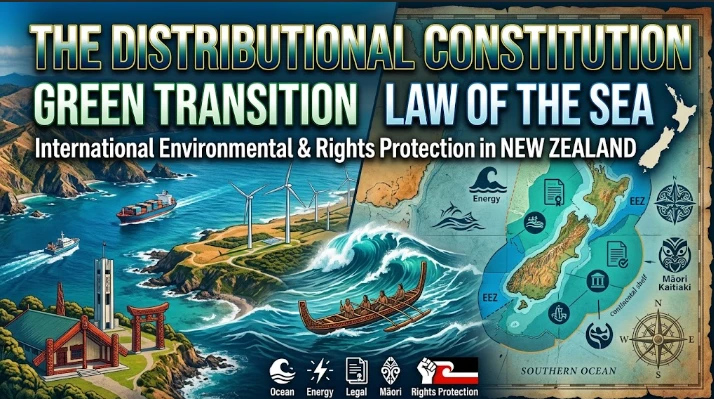
The green transition is not merely a technical shift from high-emission energy to cleaner alternatives. It redistributes land, employment, infrastructure, capital, environmental risk, and political authority, making it constitutional in a broader institutional sense. This article considers those distributional consequences in New Zealand, where climate policy intersects with coastal vulnerability, marine governance, regional inequality, Māori authority, natural-resource dependence, and Te Tiriti o Waitangi. Renewable energy facilities, transmission networks, ports, coastal defences, forestry projects, and mineral extraction produce national benefits but impose concentrated local burdens. International environmental law and the law of the sea also require decision-makers to consider climate-related damage to oceans and marine resources. The article argues that a just transition must assess who receives economic opportunities, who carries environmental costs, and who controls affected resources. Meaningful Māori participation, transparent impact assessment, fair compensation, community benefit-sharing, accessible remedies, and long-term monitoring are necessary to prevent climate policy from reproducing existing social and territorial inequalities.
The green transition is often depicted as being a technical transition between high-emitting energy and less polluting energy systems. Transitions in practice involve the reorganization of the distribution of land, capital, risk, employment, infrastructure and political power. Hence, this transition is constitutional in a wide sense, because the interests that are subject to protection – the burden of the adjustments, and the rights which stand in the way of environmental urgency – have, ultimately, to be determined in public decisions. New Zealand's decentralised governance presents a unique way to express a wide range of perspectives, making December 2025 an especially significant opportunity given the points below for climate policy discussions in New Zealand: 1) Putting climate policy on the agenda intersects with New Zealand's coastal vulnerabilities, a place that is central to daily life, culture, identity, and economic prosperity for many; 2) It is also an opportunity to bring climate policy to the table alongside discussions on marine governance, Indigenous authority, regional inequity, and reliance on natural resources, alongside the central role that Te Tiriti o Waitangi plays in the discussion.
Marine protection is the center of the responsibility for law of the sea towards climate change. It is in this context that in 2024, the International Tribunal for the Law of the Sea finds anthropogenic greenhouse-gas emissions as pollution of the marine environment under the United Nations Convention on the Law of the Sea. For New Zealand as an island nation with a number of sea-pastoral activities of high importance the above is associated with energy, transport, fisheries, ports and coastal planning. Actions that cause harm to the ocean and marine resources cannot be remote impacts of our own development decisions.
The first step to distribution is determining where to sell. Renewable generation and renewables transmission, ports, road, mineral extraction, forestry and coastal defenses are sited in specific locations. There may be very site-specific burdens while getting national emissions benefits.
Loss of land, noise, ecological and cultural disruption, increased cost of housing or decreased access to customary resources can be a challenge for communities. Facing a need for fairness goes beyond just collective carbon accountancy. Distributive impacts and benefits should be considered in relation to the project approval process: How are the impacts on who and what paid for by the project, and what are the alternatives that would across different distributions?
Needs to be central to this are Māori rights, Māori authority. There are standards that go beyond late-stage consultation in Te Tiriti relationships, tikanga, customary interests and the United Nations Declaration on the Rights of Indigenous Peoples. Avoidance, or early negotiations with affected, should be afforded to transition projects that involve whenua, wai, coastal and taonga. Acknowledging authority through the use of shared governance, consent processes, benefit agreements and long-term monitoring activities can denigrate Māori involvement as one of the many perspectives of a stakeholder group.
Another constitutional issue would be how affordable energy is. There are initial costs for households of carbon pricing, investments in networks, transition of vehicles and retrofitting of buildings. Low-income families tend to reside in sub-optimal houses, and also have limited access to capital. When the fight against climate change has a systemic impact on the well-being of the poorest, this can be prevented by adopting rebates, specific and targeted grants, social tariffs, public transport and tenant protections. Politically popular, universal subsidies can often just channel big subsidies to households that are already in a position to invest.
There is a need for institutional support to employment transition as well. In sensitive areas, there is a need for clear routes for employment, rather than promises. Skills plans across the region, income protection, recognising existing skills, involvement of unions and investment in the area can minimise disruption. Training programmes need to be linked to jobs and infrastructure projects' schedules. Failing to get the job done is a case in which a worker finishes a course after replacement industries are only speculative.
Procurement, grants, guarantees and ownership are examples of how the public finances affect distribution. Government can put in place local employment, apprenticeship clauses as well as environmental protection clauses and open benefit sharing clauses in publicly funded projects. Carefully designed conditions are required to maintain competition and value in such type. Open contracting and beneficial-ownership disclosure decreases the chance of private windfalls being left behind when it comes to transition spending without public accountability.
Some of the most difficult decisions will be the result of adapting to coastal changes. Manages Retreat, Protection Works, Insurance Withdrawal, Zoning changes and relocation of infrastructure impact the property rights, local tax base, cultural sites, and the continuity of communities. A purely market approach does not consider how poorer households will be left trapping when the riskiness of the urban area increases. An exclusive property-based approach is likely to forget about renters, businesses, marae and public places. National plans should establish funding, as well as principles of compensation, participation, and the respective responsibilities, between central and local levels of government.
There is rights protection in regard to decision procedure. Communities require the information to be easily accessible, expert advice, and time to make decisions that is not too short and justification for decisions. Judicial review is significant, but it has a time-consuming and expensive process. Administrative complaints, mediation, ombuds review and project level grievance procedures are alternative methods to address conflict earlier. Process good; but agreement does not ensue.
Integrity for environment is must in distribution. A green project may have a detrimental effect on biodiversity, freshwater and marine ecosystems. The necessity for trade-offs must be clearly reviewed, and not automatically accepted with the basis of emissions benefits. Where it can be determined there are multiple projects within one area, a cumulative impact analysis must be conducted. NbS can offer adaptive and ecological benefits but a focus on controlling land is also needed and access to the community.
A disaggregation of outcomes needs to be required at measurement. Safeguarding energy poverty or regional unemployment may be achieved by national emissions reductions. Indicators of household cost, transport, level of participation of Māori in governance, level of local ownership, biodiversity and public subsidy distribution should be monitored. Published data should contribute to the privacy protection at accessible geographical and demographic levels that are useful for the respective data provider. Independent audit is effective in checking if promised benefits have been achieved to benefiting communities.
The scrutiny of corporate transition plans is warranted as the companies have an impact on job creation, investment and the development of a local area. There needs to be disclosure of the impact on the supply chain, workforce, engagement with Indigenous authorities and capital expenditure associated with the plan. Green claims should be based on the evidence across the entire cradle-to-cradle lifespan. There's a need for regulators to have the authority to deal with misleading disclosure, and for lenders and investors to look past carbon metrics and at the issue of distributional risk.
Fairness - a basis for long-term political durability. Putting costs on groups that have little influence and whose impact is easy to see can lead to backlash and delay in implementing climate policy. Fairness[3] isn't only a moral one, it is the precondition for ongoing implementation. Broad coalitions coalesce around the prospect of tangible support for when the household feels they see a credible pathway, the region feels they see investment and Māori authority is seen to be given meaning. Technocratic planning in isolation is a source of disintegration of that coalition.
Distributional constitutions are not necessarily contained in a single document. It is made up of rules focusing on participation, rights, financial support, compensation and oversight throughout the transition process. This includes legislation, local plans, procurement standards, Cabinet guidance and Treaty processes and court decisions. Coherence is important since communities ought not to be treated drastically distinct if they just alter the kind of agency that is in control of a project.
New Zealand's green transition will be able to achieve all three of the safeguarding of climate stability, marine ecosystems, livelihoods, and rights – but it will not happen by itself. Obligations are under the law of the sea and under international environmental law – distribution depends on domestic institutions. A good transition puts those choices in the open, up for debate, and under scrutiny. It's not just about the rate of emissions reductions. The key question is: Does taking climate action required foster a just constitutional relationship between the state, communities, Māori organisations, future generations and the natural environment?
Distribution and political durability can be enhanced by local ownership. In affected regions community energy, iwi investment, partnership with the local government and cooperative models receive higher share of value. Even if the property is owned, it still will come under the environmental spotlight but will alter the bargaining positions and revenue streams. Public financial assistance can help support such models—both in terms of patient capital and technical assistance.
Consider the impact on decisions, and account for intergenerational analysis. There are 'above the electoral cycle' costs and benefits associated with long-lasting infrastructure. The discounts rates, maintenance responsibilities, and decommissioning costs may save putting costs on following taxpayers. Independent review of fiscal and environmental problems can be a way to uncover those transfers. An institution of guardianship or long-term planning requirements are needed for the representation of future generations, through statutes.
National targets can be linked with local priorities through regional transition agreements. These can include establishment of infrastructure, developing skills, housing, ecosystem restoration and business development. Shared governance and clear milestones help to eliminate the risks from fragmented grants. It is important to make public whether investments do reach those communities people with the biggest adjustment load.
There is a need for special distributional consideration in transport policy. EV subsidies could be geared towards wealthier families and PT & AT towards overall access. Rural communities are different to a big city and have different types of constraints. Transition packages should be a reflection of distance, freight required, disability and limited charging infrastructure - not necessarily even through a single national pathway.
Deliberated processes can bring to light implicit trade-offs that lie behind the policies. There is need for models that illustrate consequences for households, regions, the ecology, and the finances, and that are easily accessible for citizens.
CITE THIS ARTICLE
Amin, M. R. (2025). The Distributional Constitution of the Green Transition: Law of the Sea and International Environmental and Rights Protection in New Zealand. https://www.ruhulresearchhub.com/article/ed2ed5c2-bc1d-5ade-a76a-ec32c45841ed
M. R. Amin, “The Distributional Constitution of the Green Transition: Law of the Sea and International Environmental and Rights Protection in New Zealand,” 2025. [Online]. Available: https://www.ruhulresearchhub.com/article/ed2ed5c2-bc1d-5ade-a76a-ec32c45841ed
Amin, M. R. (2025) ‘The Distributional Constitution of the Green Transition: Law of the Sea and International Environmental and Rights Protection in New Zealand’. Available at: https://www.ruhulresearchhub.com/article/ed2ed5c2-bc1d-5ade-a76a-ec32c45841ed
Amin, Mohd. Ruhul. “The Distributional Constitution of the Green Transition: Law of the Sea and International Environmental and Rights Protection in New Zealand.” 2025, https://www.ruhulresearchhub.com/article/ed2ed5c2-bc1d-5ade-a76a-ec32c45841ed.
Mohd. Ruhul Amin. “The Distributional Constitution of the Green Transition: Law of the Sea and International Environmental and Rights Protection in New Zealand.” (2025). https://www.ruhulresearchhub.com/article/ed2ed5c2-bc1d-5ade-a76a-ec32c45841ed.
Amin MR. The Distributional Constitution of the Green Transition: Law of the Sea and International Environmental and Rights Protection in New Zealand. 2025. https://www.ruhulresearchhub.com/article/ed2ed5c2-bc1d-5ade-a76a-ec32c45841ed
@misc{article_ed2ed5c2bc1d5adea76aec32c45841ed,
  title = {The Distributional Constitution of the Green Transition: Law of the Sea and International Environmental and Rights Protection in New Zealand},
  author = {Mohd. Ruhul Amin},
  year = {2025},
  url = {https://www.ruhulresearchhub.com/article/ed2ed5c2-bc1d-5ade-a76a-ec32c45841ed},
}
TY  - GEN
AU  - Mohd. Ruhul Amin
TI  - The Distributional Constitution of the Green Transition: Law of the Sea and International Environmental and Rights Protection in New Zealand
PY  - 2025-10-13
UR  - https://www.ruhulresearchhub.com/article/ed2ed5c2-bc1d-5ade-a76a-ec32c45841ed
ER  -
This article presents democratic recovery after executive overreach as a process of reopening institutions rather than merely restoring formal legal boundaries. It describes how executive misconduct can leave politicized appointments, weakened oversight, restricted records, altered enforcement practices, intimidated officials, and concentrated agenda control. The article mentions open-democracy theory as requiring continuous accessibility, deliberation, transparency, inclusion, and responsivenes
Climate accountability increasingly operates through routine public and corporate decisions rather than exclusively through litigation. This article examines how international environmental law and the law of the sea influence government budgets, permits, procurement, port operations, insurance, energy planning, investment, and corporate governance. The 2024 advisory opinion of the International Tribunal for the Law of the Sea recognized anthropogenic greenhouse-gas emissions as pollution of the
This article examines how biometric border systems can create unequal experiences of citizenship and migration control in the United States. It describes facial recognition, fingerprinting, iris scanning, and interconnected identity databases as technologies that may improve verification and reduce fraud while also expanding surveillance and distributing errors unevenly. The article mentions false matches, failed identification, secondary inspection, questioning, detention, and weak appeal proce