This article presents an analysis of the long-term human-rights consequences that may remain after a formal crisis or emergency has ended. It describes how temporary databases, delegated powers, procurement exceptions, surveillance practices, institutional relationships, and administrative procedures can become permanent features of governance. The article mentions necessity, proportionality, temporariness, parliamentary control, and judicial review as essential standards for assessing emergency authority. It also explains that an expired sunset clause does not automatically eliminate contracts, data systems, staffing arrangements, or enforcement practices created during exceptional circumstances. A meaningful post-crisis review should therefore identify retained powers, unequal burdens, pending remedies, and institutional practices requiring repeal, modification, or lawful reauthorization. The article emphasizes documentation, victim participation, independent investigation, reparations, and guarantees of non-repetition. It concludes that human-rights accountability is credible only when formal termination of an emergency is followed by institutional audits, transparent reporting, enforceable remedies, and demonstrable changes in administrative behaviour.
A crisis can come to an end in the calendar but exceptional governance is taking place in the institutions. Emergency databases are still in operation, delegated powers still have an impact on future decision-making processes, procurement exceptions become new relationships, and temporary restrictions become benchmarks for future action. Long run rights analysis should shift from emergency declarations formally coming to an end in January 2025. With regard to residue, unequal burdens, access to remedy and guarantees against recurrence, international human-rights accountability provides a lens through which to consider these aspects.
There is special risk with emergency governance as temporary measures tend to become institutionalized administrative routine. New databases are still in use, procurement ‘shortcuts' are becoming a habit, delegated authority is increasing, and agencies still have in place procedures created during a period of exceptional circumstances. According to the Venice Commission's guidance on the rule of law there are five elements: necessity, proportionality, temporariness, parliamentary control and meaningful judicial review. These principles don't simply focus on dramatic abuses, but should also focus on residue left over after a crisis.
Another type of sunset clause can expire, despite existing contracts, data systems, staffing plans and interagency relationships. A proper check of rights thus focuses on what does not go away after the formal declarations cease to be, which communities bore the brunt of the burden, and which emergency measures became "normal".
The transition towards democratic backsliding is not normally announced in the form of elections being cancelled, or a constitutional regime being suspended. Much more typically, reductions occur in small increments of administration that are technically legal, but erode both the principles of fair competition and public accountability and institutional control. A prosecutor faces selective pressure, an inspector general is cut off, election oversight gets more partisan or the public agencies begin to consider criticism as disloyalty. In isolation, each decision may be pretty trivial – but together they may reduce the practical effectiveness of big abuses. The constitutional moment thus becomes a late braking, coming as it does after informal protections have been reduced, and after politics has deduced that what it can get away with testing the boundaries has little repercussion.
The United States has a ‘dense but fractured’ accountability system. Various federal and state-level actors as well as civil-rights offices, legislative committees, professional boards, local prosecutors, the press, and civil society groups share this responsibility. Fragmentation provides several access points but also gives the possibility of responsibility to shift between institutions. Federalism helps to preserve experimentation and local autonomy, while also having the potential of uneven remedies to similar violations.
Robust accountability relies upon the sharing of evidence, jurisdiction, protected independence and follow up after the spotlight has faded. One incident can be dealt with through either a report with no enforcement; a settlement with no monitoring or a prosecution with no institutional reform.
Documentation is a starting point, not an end-point for accountability. Reliable work helps to set up a date, a location, a chain of command, a legal classification, witness credibility and the preservation procedures. Digital material can bring opportunities and dangers: metadata can be used for verification, manipulation, duplication or insufficient security storage and uncontrollable dissemination can put at risk victims and compromise admissibility. Independent fact-finding as guidance by the OHCHR is viewed as a tool for providing a factual record, raising awareness with decision makers and determining potential accountability.
This necessitates the need to take action from investigators, prosecutors, courts, reparations bodies, policymakers, and impacted communities to turn information into action in order to move towards accountability. Archives created this way can be impressive, but are helpless if a breakage occurs in any link.
Full accountability framework isn't just criminal conviction. Beyond the four core elements of truth, justice, reparations and guarantees of non-recurrence, recent practice highlights the importance of memory and victim participation in the work of the United Nations under the banner of transitional justice. Prosecuting all violations is limited by insufficient resources and a high evidentiary standard in a criminal case that looks at each case individually and determines a responsibility for the individual. Truth processes can help to bring out patterns, reparations can acknowledge harm and institutional change can help to prevent recurrence.
They are never to be used as a replacement for each other. Truth commissions that do not include consequences may be played-out, and prosecution without victims on board can feel detached. Complementarity is important because violations of rights stimulate consequences in terms of legal status, livelihood, health, family life, and political voice and public trust.
Frequently, the rights and the effectiveness of a security policy will conflict with each other; and impunity undermines both of those goals. Unreviewable coercive power decreases the cooperation of the other side, impairs the quality of intelligence and invites retaliation, and it covers up with poor performance. Rights-protective institutions provide for mandates, documented authorization and independent review, accessible complaint mechanisms, and consequences for command responsibility. There needs to be oversight at the policy level and on individual behaviors, as well as potentially damaging consequences can arise from legitimate-looking policies operating on a large scale.
High level of protection for officials against unreasonable political requests. Since security agencies are independent and autonomous, with all records being open for review, the agencies can refuse to follow instructions which are of a partisan nature, (which are in the service of an illegitimate public interest).
A wide-spread comparison, together with a close institutional analysis, is a strong evidence strategy. Event data can be used to distinguish the timing and geographic location of the events and administrative data can be used to determine enforcement decisions and organizational response. Survey experiments can also be used to measure levels of tolerance among the public and process tracing can be used to reconstruct key decisions. Additional indicators are provided through court opinions, internal guidance, indications of procurement, personnel changes, disciplinary action, and budget changes.
There are no single indicators of democratic erosion or of accountability. It is important to use triangulation, since public rhetoric is often set in a dangerous tone, official statistics may not be accurate (due to underreporting), and supporters of the legal change may not have put in place the means to enforce it. The more there is certainty about the mechanism at all levels of governance, the higher the level of confidence that is built.
There should be post crisis audits to list any maintained databases, delegations, emergency laws and pending claims that require remedy. International standards turn to reality when every exceptional measure has a person responsible for it, a time frame for its validity, a due process test, and a deletion or closure procedure. This is because different emergency burdens may be in effect in various parts of the country and aggregated national assessments of proportionality fail to capture this.
Consultation which tailor’s priorities, protective measures, the form of the information available to victims and evidentiary practice creates legitimacy. Several opportunities to abuse are not the consequence of a single executive decision at the tactical level and that is why command responsibility and organizational accountability are important. In practice, investigation and witness protection, monitoring and reparations are some of the areas where a commitment to action becomes most apparent than in speeches, for they demand ongoing resources.
Gaps left to be addressed in public reporting should be explained, and not application of procedure taken for substantive remedy. Some of the methods institutional memory can be maintained in reform over changes in leadership are binding policy, archival access, requirements for training, and external review. A credible process also ensures due process, as a sense of accountability is undermined by an apparent inevitability of punishment, or by political whimsy in it.
It is essential that the independence of the investigation be fortified in terms of appointment, tenure, funds, access to evidence and publication of results. Witness protection: needs must be addressed from before publicity as exposure can lead to retaliation, trauma, displacement or loss of livelihoods. Digital verification must register origin, editing history, localization, time and chain of custody in the event that material is of a nature that may lead to further legal proceedings.
Reparations involve restitution, compensation, rehabilitation, as well as public recognition and memorialization and institutional assurance of non-repetition. But community-defined harm can offer insights into harms that are not included in criminal files – such as the loss of learning, family disintegration, stigma and political ostracism. Monitoring processes should be built with benchmarks and exit criteria and open a settlement only when real change can be seen within an organization's behavior.
Professional licensing bodies can help enhance professional responsibility, if the violation is also a breach of ethical obligations in addition to criminal or civil law. The role of the media investigations can create avenues for accountability while the role of legal institutions is not to do it in the name of publicity but independently. A disjointed system must have clearly-defined referral procedures because grievances may be bounced around between agencies, bouncing out of the system before a deadline may pass or evidence may be lost.
When the documentation goes hand in hand with legal responsibility, which in turn is supported by the recognition of the victim, the change of the institutions and an explanation to the public, then accountability becomes credible. One prosecution can make a difference and no prosecution can fix all the rules and relationships. One report CAN create the truth, but nothing in and of itself can reform not archive! When findings lead to increased or continued access to remedy, to reallocation of budgets, appointments, procedures, training, monitoring and oversight, sustainable progress is realized.
That's a high standard but any lower may mean that visibility is limited without impact. Ultimately, human rights protection will be best served by institutions which have the ability to learn from abuse, while also not getting used to exceptional powers, and not diffuse responsibility at points where the authorities have become splintered.
CITE THIS ARTICLE
Amin, M. R. (2025). Emergency Governance After the Crisis: Long-Run Rights Effects of International Human Rights and Accountability. https://www.ruhulresearchhub.com/article/e3faf420-47fb-501a-b516-00a3764a8643
M. R. Amin, “Emergency Governance After the Crisis: Long-Run Rights Effects of International Human Rights and Accountability,” 2025. [Online]. Available: https://www.ruhulresearchhub.com/article/e3faf420-47fb-501a-b516-00a3764a8643
Amin, M. R. (2025) ‘Emergency Governance After the Crisis: Long-Run Rights Effects of International Human Rights and Accountability’. Available at: https://www.ruhulresearchhub.com/article/e3faf420-47fb-501a-b516-00a3764a8643
Amin, Mohd. Ruhul. “Emergency Governance After the Crisis: Long-Run Rights Effects of International Human Rights and Accountability.” 2025, https://www.ruhulresearchhub.com/article/e3faf420-47fb-501a-b516-00a3764a8643.
Mohd. Ruhul Amin. “Emergency Governance After the Crisis: Long-Run Rights Effects of International Human Rights and Accountability.” (2025). https://www.ruhulresearchhub.com/article/e3faf420-47fb-501a-b516-00a3764a8643.
Amin MR. Emergency Governance After the Crisis: Long-Run Rights Effects of International Human Rights and Accountability. 2025. https://www.ruhulresearchhub.com/article/e3faf420-47fb-501a-b516-00a3764a8643
@misc{article_e3faf42047fb501ab51600a3764a8643,
  title = {Emergency Governance After the Crisis: Long-Run Rights Effects of International Human Rights and Accountability},
  author = {Mohd. Ruhul Amin},
  year = {2025},
  url = {https://www.ruhulresearchhub.com/article/e3faf420-47fb-501a-b516-00a3764a8643},
}
TY  - GEN
AU  - Mohd. Ruhul Amin
TI  - Emergency Governance After the Crisis: Long-Run Rights Effects of International Human Rights and Accountability
PY  - 2025-01-26
UR  - https://www.ruhulresearchhub.com/article/e3faf420-47fb-501a-b516-00a3764a8643
ER  -
This article presents democratic recovery after executive overreach as a process of reopening institutions rather than merely restoring formal legal boundaries. It describes how executive misconduct can leave politicized appointments, weakened oversight, restricted records, altered enforcement practices, intimidated officials, and concentrated agenda control. The article mentions open-democracy theory as requiring continuous accessibility, deliberation, transparency, inclusion, and responsivenes
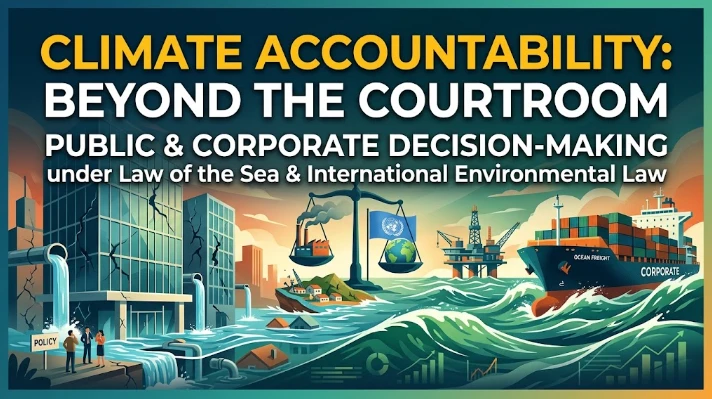
Climate accountability increasingly operates through routine public and corporate decisions rather than exclusively through litigation. This article examines how international environmental law and the law of the sea influence government budgets, permits, procurement, port operations, insurance, energy planning, investment, and corporate governance. The 2024 advisory opinion of the International Tribunal for the Law of the Sea recognized anthropogenic greenhouse-gas emissions as pollution of the
This article examines how biometric border systems can create unequal experiences of citizenship and migration control in the United States. It describes facial recognition, fingerprinting, iris scanning, and interconnected identity databases as technologies that may improve verification and reduce fraud while also expanding surveillance and distributing errors unevenly. The article mentions false matches, failed identification, secondary inspection, questioning, detention, and weak appeal proce