This article examines how emergency governance can continue to restrict human-rights organizations after formal crisis measures have ended. It describes the long-term effects of surveillance systems, protest restrictions, registration rules, foreign-funding controls, data-sharing practices, emergency contracts, and administrative risk classifications. The article mentions that repealing a prominent emergency measure is insufficient when institutional residue remains embedded in ordinary procedures and technology. Post-crisis review should identify retained powers, contracts, databases, personnel units, restrictions, and pending remedies. The analysis also discusses the vulnerability of advocacy organizations to selective regulation, donor dependence, digital attacks, and administrative pressure that may disable their work without an explicit prohibition. Strong organizations require diversified funding, secure data practices, source protection, transparent methodology, and independent correction procedures. The article concludes that recovery requires lawful data retention and deletion rules, institutional audits, access to remedies, viewpoint-neutral regulation, and safeguards ensuring that civil society can document, organize, litigate, and criticize without political retaliation.
A declared state of emergency may go on to terminate without the legal, financial and operational ramifications being looked after by advocacy groups. Emergency residue in July 2025 should be analyzed under the regulations of long-run rights, the surveillance system, funding, protest restrictions and data-sharing practices. Exceptional governance tends to human-rights groups to be the first to be targeted for such criticism. But some more than repeal of a ‘headline measure' is required for recovery. Institutional safeguards have to respond and wash down the remainder of the powers and give access back, safeguard the records, and offer remedy to remainer burden when the interest of the public subsides.
In time of crisis, the government test constitution for they can and must act fast and they have to be concentrated for it to be legitimate. The main issue starts when unparalleled authority is no more clearly outlined. Legality, necessity, proportionality, temporariness, parliamentary control and judicial review are all points touched on by the Venice Commission, in its guidance. Those principles transform open-ended emergency powers into a boxed one, under supervision.
Many rules are required after the constitutional system, such as, rules for renewal, publication, rules for data's retention, rules for procurement, rules for delegate and post-emergency audit. With a lack of safeguards, a temporary measure may remain in force even after the formal declaration through regular rules, institutional routine or technological system.
In the long run, rights come into play when people no longer seem to be talking about the sexuality issue. Databases go on, emergency contracts turn into regular contracts, special enforcement units are given new mandates and large definitions enter into regular policies. The precedent can also live on: the later adoption of exceptions is based in turn on the earlier adoption as evidence that similarly later action is in accordance with the norm. There's more to a good sunset provision than an expiration date.
Records should be cancelled or lawfully re-authorized, delegated authority should be audited, and impacted communities should be given access to remedy and legislatures should be provided access to data on the unequal burdens. Therefore, and for the post crises governance, it has to be assumed that there is also a structured residue audit and not to assume normality.
Human-rights groups exist on the tight rope between recording, advocating, providing services, litigating and communicating. Communities can provide detailed evidence through access, but grants, partnerships and official access may make them vulnerable. Security design has to seek to ensure the protection of lawful advocacy, while avoiding the creation of an intelligence source or regulated extension of the government that can lead to a suppression of civil society. Requirements for the registration of rules, the financial reporting to the regulating body, foreign-funding controls, restrictions on protest and digital surveillance all must be applied in a viewpoint neutral fashion. There also need to be inbuilt protections with independent organizations, for evidence verification, informed consent, data protection, staff safety and correcting public errors.
An advocacy campaign is most effective institutionally when there is a link between the evidence of harm documented and a specific decision point. Attention can be directed via general condemnation while sustained reform will typically be achieved if there is a demand put forward for an actor that is clear. There are different ways available through litigation, legislative testimony, inspector-general referrals, shareholder pressure, rules for professional discipline, and rules involving public procurement. Having coordination is important as responsibility can be lost if there are disjointed campaigns.
However, credibility is related to clear methods, uncertainty phrasing, and better, prompt, corrections of errors. Good advocacy makes evidence not just a brief media cycle an accountability chain.
Security and rights are often portrayed as conflicting values but impunity can crush effectiveness in the security operations. Unchecked authorization undermines civil partnership and influences intelligence, embarks upon the assassination of the political competence and leads to escalation. Rights-protective institutions create certain rules, a written authorization, a review system that is independent of the institution, a complaint mechanism accessible to users, and consequences that go all the way, to command decisions and the frontline misconduct. These also prevent personnel from being given ambiguous or biased orders. When promotions, budgets, training, procurement, and disciplinary procedures based on lawful accuracy rather than on force or arrest statistics and politically popular targeting of individuals or groups will improve the credibility of “professional standards”.
Feedback relationship between repression and resistance. Fighters gather clues to which strategies are the most successful at stifling mobilization, judges discover which legal concepts withstand challenges and groups figure out which coalitions are most popular, and donors tighten risk assessments. Learning can improve the rights if it results in better policy, training, documentation and oversight in response to misbehavior. But the same can intensify the coercion if there is a more concerted effort to monitor you or if the limits are increasingly legitimated by law.
Sequence analysis shows to be a better alternative, except for looking at the number of isolated events. Documented results of the confrontations, in terms of staff changes, funding sources, legal actions, protest strategies, disciplinary actions, and policy changes, can indicate if each encounter was an improvement toward restraint or a more effective control.
The process of how institutional constraints operate is through independence, capacity, transparency and coordination. A court, which is nominally independent, and is not given timely access or speedy remedies, provides a weak protection. There would be no civil service that is professional with insecure tenure that could not be subject to loyalty tests. Election administrators must have resources, as well as physical safety and legal clarity and the public's trust.
These cannot be achieved if there is a lack of access to information and of safeguarding against retaliatory investigation. Demonstrable constraints are those that are supported by multiple institutions that are able to detect, expose, delay and repair abuse. Redundancy also helps minimize risk of disablement with the capture of one body destroying accountability.
Fundamental rights, which are safeguarded when there is protection amidst uncertainty, fear and political asymmetry, are resilient. The most difficult ones are with unpopular groups, with some speech that people disagree with, with migrants, prisoners and protesters and communities that are called ‘security risks. If protection is equal in the lull, it offers a modest number of clues as to the robustness of the constitution. Resilience is evident when there is good due process, good assessment that is individualized, good legal counsel, good review and good reasons when under pressure.
It is important to continue to do distributional analysis as a formally neutral rule can still exert concentrated burdens based on geography, disability, language, income, immigration status or based on access to digital systems. A form of rights protection is needed, but not only by way of doctrinal examination, but also by an empirical focus on its implementation.
Financial independence goes hand in hand with the ability to consistently challenge powerful institutions by human-rights organizations. Donors focusing their attention in one direction can cause sudden vulnerability; donors dictating the process or the rules can come across as restrictive, and these things can be done with a smokescreen of transparency or a return to domestic politics in name of 'national security'. Resilient organizations diversify revenue, have reserves and overcome donor pressure and no matter their program decisions are, they acknowledge conflicts. Public regulation should look at fraud and have clear, proportionate and viewpoint neutral requirements.
Transparency of funding helps build trust - fund transparency should not compromise vulnerable staff, partners or beneficiaries. When institutional autonomy is protected on both the financial accountability and freedom of expression sides, then it is strongest.
Sunset design ought to give a duty for termination instead of rely on any institution unwinding exceptional practice on its own. An audit may identify emergency authorities, contracts, databases, personnel units, guidance papers and pending cases and categorize each of these for repeal, ordinary law review, renewal and compensation. Publication enhances transparency and accountability, through privileged legislative or judicial access to the sensitive information. A structured exit process also gives a better chance to be prepared in the future: Institutional learning is generated from evidence and not from political memory. Temporary power is only temporary when there is an owner, a time for termination and when there is a record to be reviewed.
Often emergency restrictions on the rights to civil society come in the guise of neutral terms. Narrow or wide sweeping security checks, assembly restrictions or foreign funding restrictions can impose disproportionate restrictions in the absence of a political target. Residue comes into existence when the temporary forms and risk classifications without any doubt become standards. The treatment of an individual should be compared between organizations on a Post emergency review only and any requirements which have no further need should be removed.
In preserving records, there is another tension created. Data that reveals abuse should be protected and data that is gathered in emergency situations should be protected, as it may endanger advocates and participants. A lawful transition must have distinct rules for retention, deletion and for accountability, to retain information that is necessary for accountability, but to also delete information where the collector no longer has a purpose to hold on to it, and accountability rules must be supervised independently from any deletion rules. The right to life is at great risk with blanket retention as well as blanket destruction.
Rights-protective security and credible advocacy are based on the same institutional strengths; accountability, sound evidence, independent monitoring and accountability. Selective human rights control of human rights organizations should be prevented, including in the areas of documentation, organization, litigation and criticism. That freedom is enhanced by internal rigor and certainly not constrained. Democratic security is realized when there are institutional means of state and society to respond to actual threats to security without tolerating or eroding activities of lawful dissent, or when civil society is able to criticize and contest coercive action without loss of truth, consent or the safeguard of vulnerable communities.
Good security, source protection and corrections policy facilitate trustworthy advocacy on the part of personnel. Administrative pressure can take form of selective pressure, without leaving discernible traces of a ban.
CITE THIS ARTICLE
Amin, M. R. (2025). Emergency Governance After the Crisis: Long-Run Rights Effects of Human Rights Organizations and Advocacy. https://www.ruhulresearchhub.com/article/34d3b8bf-05c1-565d-8fa0-ad8a039416d2
M. R. Amin, “Emergency Governance After the Crisis: Long-Run Rights Effects of Human Rights Organizations and Advocacy,” 2025. [Online]. Available: https://www.ruhulresearchhub.com/article/34d3b8bf-05c1-565d-8fa0-ad8a039416d2
Amin, M. R. (2025) ‘Emergency Governance After the Crisis: Long-Run Rights Effects of Human Rights Organizations and Advocacy’. Available at: https://www.ruhulresearchhub.com/article/34d3b8bf-05c1-565d-8fa0-ad8a039416d2
Amin, Mohd. Ruhul. “Emergency Governance After the Crisis: Long-Run Rights Effects of Human Rights Organizations and Advocacy.” 2025, https://www.ruhulresearchhub.com/article/34d3b8bf-05c1-565d-8fa0-ad8a039416d2.
Mohd. Ruhul Amin. “Emergency Governance After the Crisis: Long-Run Rights Effects of Human Rights Organizations and Advocacy.” (2025). https://www.ruhulresearchhub.com/article/34d3b8bf-05c1-565d-8fa0-ad8a039416d2.
Amin MR. Emergency Governance After the Crisis: Long-Run Rights Effects of Human Rights Organizations and Advocacy. 2025. https://www.ruhulresearchhub.com/article/34d3b8bf-05c1-565d-8fa0-ad8a039416d2
@misc{article_34d3b8bf05c1565d8fa0ad8a039416d2,
  title = {Emergency Governance After the Crisis: Long-Run Rights Effects of Human Rights Organizations and Advocacy},
  author = {Mohd. Ruhul Amin},
  year = {2025},
  url = {https://www.ruhulresearchhub.com/article/34d3b8bf-05c1-565d-8fa0-ad8a039416d2},
}
TY  - GEN
AU  - Mohd. Ruhul Amin
TI  - Emergency Governance After the Crisis: Long-Run Rights Effects of Human Rights Organizations and Advocacy
PY  - 2025-07-02
UR  - https://www.ruhulresearchhub.com/article/34d3b8bf-05c1-565d-8fa0-ad8a039416d2
ER  -
This article presents democratic recovery after executive overreach as a process of reopening institutions rather than merely restoring formal legal boundaries. It describes how executive misconduct can leave politicized appointments, weakened oversight, restricted records, altered enforcement practices, intimidated officials, and concentrated agenda control. The article mentions open-democracy theory as requiring continuous accessibility, deliberation, transparency, inclusion, and responsivenes
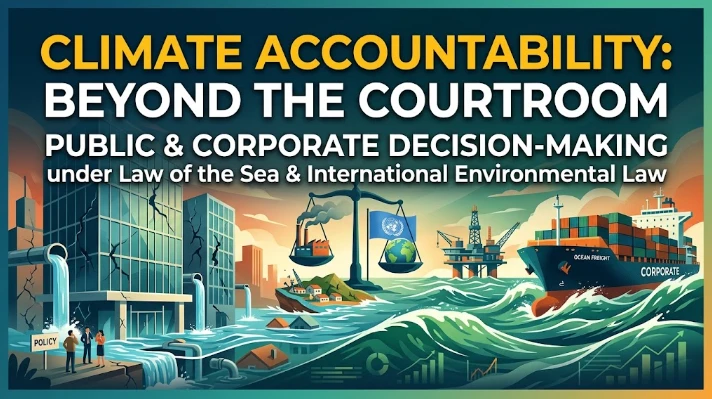
Climate accountability increasingly operates through routine public and corporate decisions rather than exclusively through litigation. This article examines how international environmental law and the law of the sea influence government budgets, permits, procurement, port operations, insurance, energy planning, investment, and corporate governance. The 2024 advisory opinion of the International Tribunal for the Law of the Sea recognized anthropogenic greenhouse-gas emissions as pollution of the
This article examines how biometric border systems can create unequal experiences of citizenship and migration control in the United States. It describes facial recognition, fingerprinting, iris scanning, and interconnected identity databases as technologies that may improve verification and reduce fraud while also expanding surveillance and distributing errors unevenly. The article mentions false matches, failed identification, secondary inspection, questioning, detention, and weak appeal proce