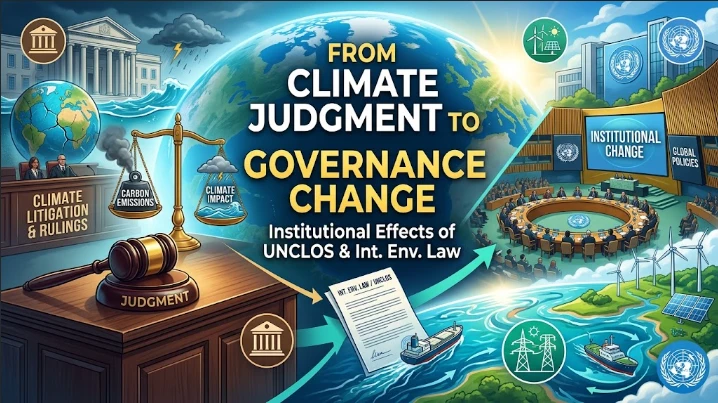
International climate judgments can clarify legal duties quickly, but converting those principles into governance reform may take years. This article examines how climate rulings influence domestic legislation, administrative regulations, budgets, planning, permitting, monitoring, enforcement, and corporate investment. The 2024 International Tribunal for the Law of the Sea advisory opinion connected anthropogenic greenhouse-gas emissions with marine pollution under UNCLOS and emphasized duties to prevent, reduce, and control environmental harm. The International Court of Justice’s 2025 climate advisory opinion further developed the legal understanding of state responsibility and climate damage. However, advisory opinions cannot transform governance unless legislatures, ministries, regulators, courts, public institutions, and businesses incorporate their reasoning into operational practices. The article proposes implementation plans with assigned responsibilities, measurable objectives, transparent reporting, scientific review, and accessible accountability mechanisms. It also recommends reviewing public finance, infrastructure approvals, energy policies, and corporate risk systems. Climate governance changes when international obligations become routine considerations throughout the entire domestic decision-making cycle.
A climate judgment can start the process to clear up law in a single day but governance change is a process which take years. Legal principles need to be incorporated into ministries' regulations, ministries' procedures need to be updated, legislatures need to provide funding, courts need to manage implementation, and firms need to make changes to their investments. As the number of international climate laws continues to increase, international climate obligations will need to be legally recognised and implemented in the domestic sphere, which created an important challenge in terms of implementation in November 2025.
An advisory opinion of 2024 for the International Tribunal for the Law of the Sea was a significant step. The Tribunal under the United Nations Convention on the Law of the Sea revealed that pollution of the marine environment is related to anthropogenic greenhouse gas emissions. Obligations to prevent (neither reduce nor control) marine pollution were associated with change from obligation to prevention, from obligation to reduction, and from obligation to protection.Marine pollution duties to prevent, reduce, and control were associated with change from obligation to prevention, change from obligation to reduction and change from obligation to protection. Legal significance is high, institutional significance is conditional on the state's modifications of the planning, permitting, monitoring and enforcement.
The climate advisory opinion given by the International Court of Justice in July 2025 added to the general overall climate change legal landscape of state responsibility and climate damage. Advisory opinions keep the interpretation going and don't actually solve all of the issues that arise at home. But, these directions may impact the legislation, reasoning of judges, diplomatic negotiations and administration risks. This means that measures to support governance change should start with your institutions' open and transparent accountabilities being considered as operational entitlements and commitments, rather than legal documents or matters for legal teams.
An obligation map should be the first step to implementation. Corresponding institutions, decision points, data, review processes and remedies are required for each legal principle. A duty to protect the marine environment can impact on energy approvals, shipping regulation, fisheries management, coastal planning and public finance and industrial policy. However, if mapping isn't available, agencies can presume that the climate resides elsewhere. Thus, fragmentation results in a system of everyone being aware of the problem, but none changing behaviour.
One way to do the translation is called regulatory impact assessment. New laws and large scale policies should incorporate aspects of anticipated emissions, ocean impacts, distributional impacts and climate commitments. There is a need to make alternatives to the present situation a serious option, and reduce demand as well as lower emissions. Assessment should be done prior to politicking solidifying. If a preferred option is selected, then there will likely not be changes to governance at that time of developing a technical annex.
There also are needs for revision of permitting systems. At the project level, there is a tendency to consider facilities in isolation with no consideration for the cumulative effects and downstream uses. Long-term lock-in and supply chains including connected infrastructure need to be considered in climate governance. Regulators must have discretion to demand transition planning, monitoring conditions, to review permits when additional information comes in, and punishment for failure to comply with conditions. Good execution of clear decision rules limits arbitrariness of decision making and minimises investor uncertainty.
Using public finance could help accelerate the implementation. Markets are influenced by export credit, development lending, state-owned enterprises, and subsidies and procurement practices. Climate screening, clear-cutting and conditions on legal change – dependent on measurable performance. If public finances are routinely dedicated to projects that are not consistent with pathways, then a government's claim to be compliant, can cannot be taken seriously. Parliamentary committees, supreme audit institutions can carry out testing of that alignment.
Climate policy still presents a coordination challenge for institutions as policy does not follow an institutional structure. Committees with authority can make decisions, but with no authority, they make reports – this helps inter-ministerial committees to improve coherence. A good organisation coordination system requires there to be a lead institution, demarcated roles, escalation process, shared data and influence over the budget. An approved cabinet level review can address conflict, and independent oversight can remove the potential for closed coordination and control at the executive level.
The local government has a pivotal role to play. Emergency planning, waste management, transport, building rules, coastal zoning and infrastructure have all an impact on climate resilience. National legislation to support and guarantee resources and minimum standards, allowing local knowledge. Unfunded mandates are non-reimbursable mandates that result in paper compliance. To effectively put in place municipalities' legal obligations, providing support in the form of grants, technical support, regional coordination and access to climate data was helpful for PWS municipalities.
Governance change can be achieved in the courts with results, which honour institutional roles. Declaratory judgments can be used to deliver clarifications on obligations and a structural order can require a plan, timelines, reporting, reconsideration, etc. Too much intrusion of the Court in the management process has the risk of generating legitimacy issues, and obfuscated statements can result in ineffective and damaging routines. Effective remedies that hold governments to account include addressing shortcomings in the law, ensuring remaining administrative discretion within lawful choices, and necessitating clear implementation procedures.
The other levels of implementation are the corporate regulations. There needs to be a linkage between disclosure rules and audited data, governance systems, capital spending, and scenario analysis. There is a definite need for responsibility of Directors and senior managers for transition plans. A remedy for consumer and securities regulators is to contest misleading statements. Licensing and procurement may necessitate proof of companies' actions consistent with public commitment.
Participation is needed to allow for Governance Change. Communities impacted by coastal and fisheries loss and communities that assume a role of energy transition and community relocation contain knowledge that is not addressed by centralized knowledge models. Special mention should be made as regards to Indigenous authority and the involvement of marine territories, customary practices or the survival of Indigenous cultures. Consultation should happen in the early design stages, be made aware of and understand trade-offs, and have influence over final design. Mutual participation with no feedback of its implementation can lead to increased distrust.
Monitoring should be done on the institutional behaviour and environmental outcomes. While emissions and ecosystem indicators will always be important, governance dimensions provide insight into whether or not change is happening. Examples of effective measures include changes to regulations, climate conditions in permits, public-financing screening, audit recommendations put into practice, data publishing, enforcement measures and complaint resolution. For those indicators to be useful they could detect the failure to come sooner than the time when long-term environmental effects would be apparent.
Many times the limiting factor is capacity. Agencies require climate scientists, economists, legal experts, data specialists, inspections staff, as well as staff to communicate with communities. Simely addressing understaffing and disconnected systems through training isn't enough. Guides to obligations becoming standard include budgets, recruitment, retention, and common technical services. Capacity, including in small and climate-vulnerable states, is facilitated through international cooperation, but support should be provided through strengthening local capacity, and not through developing parallel reporting systems.
The crux between judgement to governance is institutionalisation. Implementation of legal principles into templates, manuals, budgets, databases, contracts and performance systems. That work can be easy peasy and lemon squeezy as opposed to a landmark opinion, and each mundane can make the difference in law changing emissions and resilience. The credibility of climate governance is enhanced if any significant public decision, whether or not a mandate was issued, demonstrates how duty was understood, proof was evaluated, concerned communities had their say, and consequences will be tracked. A judgment opens the door, administrative transformation looks for climate law.
Implementing should be a shared responsibility between legal and other stakeholder groups. Shared responsibility of policy, finance, operational, scientific, and procurement and community-engagement teams is required. Performance milestones are allowed to be included in the senior performance agreements. Internal audit can conduct testing to verify if climate obligations are making it to actual decisions vs. language in the policy.
There will have to be an escalation of enforcement as well for institutional change to happen. Repeated or serious reporting failures may result in a permit suspension, withdrawal of funding and prosecution, whereas minor reporting failures may result in correction plans. Having a clear escalation helps to create predictability. Discretion, though, should be kept on record so that regulators can't be found to be "discreet" in their application of it in similar situations.
Tackling this requires cross-border co-operation – ocean systems and emissions cross borders. States have access to monitoring data, common shipping and port standards, common marine research, vulnerable neighbors and more! Expectations with no backing of capacity should be dropped in favor of cooperating through finance and providing access to technology.
A fixed frequency of policy review, as well as after significant scientific advances, should be implemented. Things like climate assumptions and technology change, and physical impacts become more apparent. Static rules can be a constraint which locks the institutions into outdated courses. Review of clauses, public consultation and transparent revision help to maintain governance that is responsive and long term sources of direction.
All implementation plans must also identify any aspect of the plan that is going to bring legal conflict. Correlation of climate duties with investment treaties, real estate law, trade obligations and sectoral laws is possible. Proactively identifying and examining the legal and liability issues early on in the process can help avoid a “litigation stalemate.” Legislatures can help to prioritise where existing legislation hinders effective and coherent climate governance.
Completed action should be differentiated in the public reporting. Many dashboards blend the two, to give the impression of all-important progress. Implementation is visual with independent verification and date stamped milestones to provide the explanation of delay before targets are missed.
The results of the audit just need to be directly linked to the budget and leadership decisions, and if the issues continue to be found, there should be a consequence for the institution.
CITE THIS ARTICLE
Amin, M. R. (2025). From Climate Judgment to Governance Change: Institutional Effects of Law of the Sea and International Environmental. https://www.ruhulresearchhub.com/article/e6d28093-b397-585b-8989-0f79207271dd
M. R. Amin, “From Climate Judgment to Governance Change: Institutional Effects of Law of the Sea and International Environmental,” 2025. [Online]. Available: https://www.ruhulresearchhub.com/article/e6d28093-b397-585b-8989-0f79207271dd
Amin, M. R. (2025) ‘From Climate Judgment to Governance Change: Institutional Effects of Law of the Sea and International Environmental’. Available at: https://www.ruhulresearchhub.com/article/e6d28093-b397-585b-8989-0f79207271dd
Amin, Mohd. Ruhul. “From Climate Judgment to Governance Change: Institutional Effects of Law of the Sea and International Environmental.” 2025, https://www.ruhulresearchhub.com/article/e6d28093-b397-585b-8989-0f79207271dd.
Mohd. Ruhul Amin. “From Climate Judgment to Governance Change: Institutional Effects of Law of the Sea and International Environmental.” (2025). https://www.ruhulresearchhub.com/article/e6d28093-b397-585b-8989-0f79207271dd.
Amin MR. From Climate Judgment to Governance Change: Institutional Effects of Law of the Sea and International Environmental. 2025. https://www.ruhulresearchhub.com/article/e6d28093-b397-585b-8989-0f79207271dd
@misc{article_e6d28093b397585b89890f79207271dd,
  title = {From Climate Judgment to Governance Change: Institutional Effects of Law of the Sea and International Environmental},
  author = {Mohd. Ruhul Amin},
  year = {2025},
  url = {https://www.ruhulresearchhub.com/article/e6d28093-b397-585b-8989-0f79207271dd},
}
TY  - GEN
AU  - Mohd. Ruhul Amin
TI  - From Climate Judgment to Governance Change: Institutional Effects of Law of the Sea and International Environmental
PY  - 2025-10-06
UR  - https://www.ruhulresearchhub.com/article/e6d28093-b397-585b-8989-0f79207271dd
ER  -
This article presents democratic recovery after executive overreach as a process of reopening institutions rather than merely restoring formal legal boundaries. It describes how executive misconduct can leave politicized appointments, weakened oversight, restricted records, altered enforcement practices, intimidated officials, and concentrated agenda control. The article mentions open-democracy theory as requiring continuous accessibility, deliberation, transparency, inclusion, and responsivenes
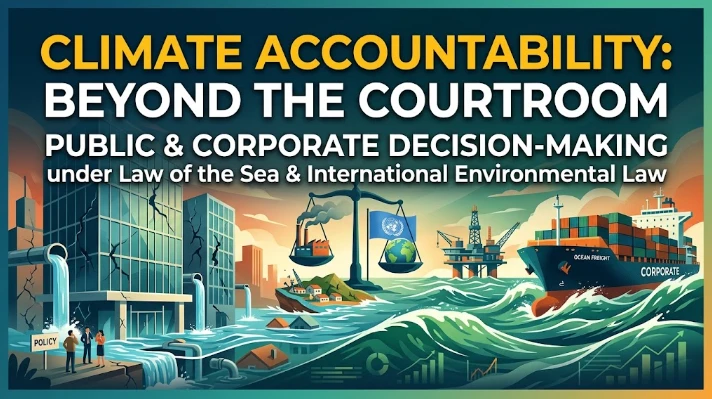
Climate accountability increasingly operates through routine public and corporate decisions rather than exclusively through litigation. This article examines how international environmental law and the law of the sea influence government budgets, permits, procurement, port operations, insurance, energy planning, investment, and corporate governance. The 2024 advisory opinion of the International Tribunal for the Law of the Sea recognized anthropogenic greenhouse-gas emissions as pollution of the
This article examines how biometric border systems can create unequal experiences of citizenship and migration control in the United States. It describes facial recognition, fingerprinting, iris scanning, and interconnected identity databases as technologies that may improve verification and reduce fraud while also expanding surveillance and distributing errors unevenly. The article mentions false matches, failed identification, secondary inspection, questioning, detention, and weak appeal proce