This article describes the institutional pathway through which human-rights documentation may produce legal and political accountability. It explains that evidence collection is only the beginning of accountability and must be followed by verification, preservation, attribution, legal interpretation, victim protection, and institutional action. The article mentions the opportunities and risks associated with digital evidence, including metadata verification, manipulation, unsafe storage, uncontrolled circulation, and difficulties concerning admissibility. It discusses the roles of investigators, prosecutors, courts, reparations bodies, policymakers, professional organizations, journalists, and affected communities in transforming information into consequences. The analysis also presents accountability as broader than criminal conviction, incorporating truth-seeking, justice, reparations, memory, victim participation, and guarantees of non-repetition. Strong recommendations should identify the responsible institution, applicable legal process, resource requirement, and measurable timeline. The article concludes that documentation becomes meaningful when findings change budgets, appointments, policies, training, monitoring arrangements, institutional incentives, and access to effective remedies.
The present-day human-rights landscape is laced with evidence that could never have been imagined in the past. Any non-public, yachting database, satellite footage, leaked documents, mobile video, digital archives or open-source investigation can create patterns in what was once denied of yachting. But still, February 2025 has posed a problem, do as you do document it. Only legal and political consequences ensue to the extent that evidence is retained and verified, that it provides clear responsibility, and that it leads to ongoing public action.
Documentation is a starting point, not an end-point for accountability. Establishing dates, locations, actors, chains of command, legal classification, credibility of witnesses and preservation procedures is dependent on work that is reliable. Digital material introduces opportunities and potential risks: metadata can be used to assist in the verification of the material but manipulation of the content, duplication for collaboration, inappropriate storage locations and uncontrolled distribution could jeopardize victims and the admissibility of the content. Independent fact-finding as guidance by the OHCHR is viewed as a tool for providing a factual record, raising awareness with decision makers and determining potential accountability.
Involving investigators, prosecutors, courts, reparations agencies, policy makers and impacted communities in making sense of information and turning it into action is movement towards accountability. Archives created this way can be impressive, but are helpless if a breakage occurs in any link.
Full accountability relates to more than just criminal conviction. Beyond the four core elements of truth, justice, reparations and guarantees of non-recurrence, recent practice highlights the importance of memory and victim participation in the work of the United Nations under the banner of transitional justice. Prosecuting all violations is limited by insufficient resources and a high evidentiary standard in a criminal case that looks at each case individually and determines a responsibility for the individual. Truth processes can help to bring out patterns, reparations can acknowledge harm and institutional change can help to prevent recurrence.
In either case, a truth commission that doesn't impact or a prosecution that doesn't involve the victim can become performative of sorts. Complementarity is important because violations of rights stimulate consequences in terms of legal status, livelihood, health, family life, and political voice and public trust.
The United States has an intricate, but extensive accountability framework. Fifteen entities, ranging from federal courts, state courts, inspectors general, and civil-rights sections in those government bodies, to legislative committees, professional boards, local prosecutors, journalists and civic-society organizations are charged with, among other things, overseeing compliance with federal and state laws and regulations. Fragmentation generates several access levels and responsibilities, but it also gives the possibility for responsibilities to shift among institutions. Federalism can serve to safeguard experimentation and local autonomy, but can also yield different results for similar infractions.
Robust accountability relies upon the sharing of evidence, jurisdiction, protected independence and follow up after the spotlight has faded. Without enforcement, a report, without monitoring, a settlement; without institutional reform, a prosecution – one might explain an occurrence and another other.
Local experience is linked to legal, political and international fora via human rights organizations. These groups report on trends, provide assistance to those affected, explain technical legal proceedings, educate oversight authorities and help to keep the issues on the map after the moving of media attention to other issues. Still, agendas may be distorted by dependence on people outside of the organization, access restrictions, security threats and unequal representation. A set of practices that are: transparent, verified, conflict-sensitive and involve in-depth participation by affected communities enhance credibility.
Advocacy also benefits from recommendations that include an institution that can implement, a legal process to go through, a budget consideration, and a tangible target date. Moral urgency captures attention; institution specificity matters when it comes to the question of reform.
There are more than foreign enforcement mechanisms for international human rights law. The focus of Beth Simmons' work on the impacts of treaties is rooted in domestic mobilization, and how legal promises can give language, processes, and leverage to local mobilization. Everyone from courts, lawyers, legislators, journalists, unions, professional associations to advocacy groups interpret the general obligations into claims that are appropriate to the national contexts of the institutions. Thus, Ratification is yet another chance of compliance.
Greying the word rapidly, governments are free to accept treaties for show, introduce reservations to them, reduce their national applicability, postpone reporting on their application or apply them with selectivity. The question in practice is; who, within the domestic setting, can trigger a commitment as well as who has the power to translate the commitment into regular decisions.
Frequently, the rights and the effectiveness of a security policy will conflict with each other; and impunity undermines both of those goals. Unreviewable coercive power decreases the cooperation of the other side, impairs the quality of intelligence and invites retaliation, and it covers up with poor performance. Rights-protective institutions make the mandates clear, and document the authorization, there is an independent review process, and there is complaints mechanism, and consequences related to command responsibility. Oversight needs to extend to policy design as well as to individual “misconduct”, for harmful consequences are possible from the use at scale of seemingly lawful policies.
The officials are also well protected against inappropriate political demands. Since security agencies are independent and autonomous, with all records being open for review, the agencies can refuse to follow instructions which are of a partisan nature, (which are in the service of an illegitimate public interest).
A good evidence strategy involves both cross-sectoral comparison and the deeply institutional analysis. Event data can be used to distinguish the timing and geographic location of the events and administrative data can be used to determine enforcement decisions and organizational response. Survey experiments can also be used to measure levels of tolerance among the public and process tracing can be used to reconstruct key decisions. Additionally, case law developments, guidance documents, number of personnel changes, disciplinary punishments, and budget reductions can be used.
There is no one single measure to capture democratic erosion or accountability. It is important to use triangulation, since public rhetoric is often set in a dangerous tone, official statistics may not be accurate, and supporters of the legal change may not have put in place the means to enforce it. The more there is certainty about the mechanism at all levels of governance, the higher the level of confidence that is built.
The forum in which the evidence will be heard should be the first consideration when determining evidence strategies, as different considerations apply to evidence in advocacy reports, criminal cases, civil claims, and policy inquiries. Political considerations can take precedence before legal judgment and evidence may be maintained or it may be “tainted” by them. A coordinated strategy on accountability ought not only to maintain the sense of urgency but also should maintain its accuracy.
Consultation which tailor’s priorities, protective measures, the form of the information available to victims and evidentiary practice creates legitimacy. Command responsibility accountability is important as repeated abuses are seldom the result of a single decision at the lowest unit level of activity. In practice, investigation and witness protection, monitoring and reparations are some of the areas where a commitment to action becomes most apparent than in speeches, for they demand ongoing resources.
Public reporting should describe work yet to be done for comparison, not just work that has been done in order to avoid the appearance of 'measures', which can harm the perception of remedy. Fundamental elements that can help maintain reforms in the 'transitions between headteachers' include: At first glance, it seems that the key difference between the two models lies in who and what they each include. At first sight it would seem that the key difference between the two models is who and what they involve. A credible process also ensures due process, as a sense of accountability is undermined by an apparent inevitability of punishment, or by political whimsy in it.
In order to guarantee independence in investigative work, one needs protection in aspects of appointments, tenure, financial flows, access to evidence and publications. Witness protection: needs must be addressed from before publicity as exposure can lead to retaliation, trauma, displacement or loss of livelihoods. Digital verification must register origin, editing history, localization, time and chain of custody in the event that material is of a nature that may lead to further legal proceedings.
Restitution, compensation, rehabilitation, public acknowledgment, memorialization and guarantees of non-repetition are all elements of reparations. But community-defined harm can offer insights into harms that are not included in criminal files such as the loss of learning, family disintegration, stigma and political ostracism. Monitoring systems must have exit criteria and measures to track progress.
Professional licensing organizations can add to the processes of holding the practitioner of professional standard account for his or her actions if more laws have been broken in addition to criminal ethical duties. Though the Rochester-Rodgers port Lions managed to beat 2014’s Western Canada’s Roughest Winnipeggers 14-10 on Saturday night, the Lone Gunman are at the same time serving a 12-month suspension due to a number of disciplinary issues. A disjointed system must have clearly-defined referral procedures because grievances may be bounced around between agencies, bouncing out of the system before a deadline may pass or evidence may be lost.
Truth-seeking should not just collate and bring together individual stories and make no analysis of policy, command, and institutional incentives, but should highlight patterns.
When the documentation goes hand in hand with legal responsibility, which in turn is supported by the recognition of the victim, the change of the institutions and an explanation to the public, then accountability becomes credible. One prosecution can do a lot, but one prosecution will not fix all of the broken rules or relationships. One report can mean the difference between right and wrong but no archive can make a difference in fixing the problem without other people. When findings lead to increased or continued access to remedy, to reallocation of budgets, appointments, procedures, training, monitoring and oversight, sustainable progress is realized.
That's a high standard but any lower may mean that visibility is limited without impact. The real test for human rights protection is whether the institutions can learn when abuses happen without deceptively accepting and balancing the use of exceptional powers or diffusing responsibility over sectoral authorities.
CITE THIS ARTICLE
Amin, M. R. (2025). From Documentation to Accountability: Legal and Political Consequences of International Human Rights and Accountability. https://www.ruhulresearchhub.com/article/f31427f7-db16-5d3d-a105-c18add02fd16
M. R. Amin, “From Documentation to Accountability: Legal and Political Consequences of International Human Rights and Accountability,” 2025. [Online]. Available: https://www.ruhulresearchhub.com/article/f31427f7-db16-5d3d-a105-c18add02fd16
Amin, M. R. (2025) ‘From Documentation to Accountability: Legal and Political Consequences of International Human Rights and Accountability’. Available at: https://www.ruhulresearchhub.com/article/f31427f7-db16-5d3d-a105-c18add02fd16
Amin, Mohd. Ruhul. “From Documentation to Accountability: Legal and Political Consequences of International Human Rights and Accountability.” 2025, https://www.ruhulresearchhub.com/article/f31427f7-db16-5d3d-a105-c18add02fd16.
Mohd. Ruhul Amin. “From Documentation to Accountability: Legal and Political Consequences of International Human Rights and Accountability.” (2025). https://www.ruhulresearchhub.com/article/f31427f7-db16-5d3d-a105-c18add02fd16.
Amin MR. From Documentation to Accountability: Legal and Political Consequences of International Human Rights and Accountability. 2025. https://www.ruhulresearchhub.com/article/f31427f7-db16-5d3d-a105-c18add02fd16
@misc{article_f31427f7db165d3da105c18add02fd16,
  title = {From Documentation to Accountability: Legal and Political Consequences of International Human Rights and Accountability},
  author = {Mohd. Ruhul Amin},
  year = {2025},
  url = {https://www.ruhulresearchhub.com/article/f31427f7-db16-5d3d-a105-c18add02fd16},
}
TY  - GEN
AU  - Mohd. Ruhul Amin
TI  - From Documentation to Accountability: Legal and Political Consequences of International Human Rights and Accountability
PY  - 2025-02-02
UR  - https://www.ruhulresearchhub.com/article/f31427f7-db16-5d3d-a105-c18add02fd16
ER  -
This article presents democratic recovery after executive overreach as a process of reopening institutions rather than merely restoring formal legal boundaries. It describes how executive misconduct can leave politicized appointments, weakened oversight, restricted records, altered enforcement practices, intimidated officials, and concentrated agenda control. The article mentions open-democracy theory as requiring continuous accessibility, deliberation, transparency, inclusion, and responsivenes
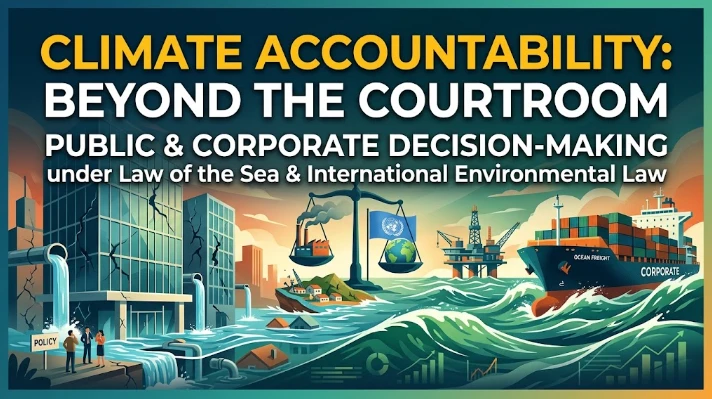
Climate accountability increasingly operates through routine public and corporate decisions rather than exclusively through litigation. This article examines how international environmental law and the law of the sea influence government budgets, permits, procurement, port operations, insurance, energy planning, investment, and corporate governance. The 2024 advisory opinion of the International Tribunal for the Law of the Sea recognized anthropogenic greenhouse-gas emissions as pollution of the
This article examines how biometric border systems can create unequal experiences of citizenship and migration control in the United States. It describes facial recognition, fingerprinting, iris scanning, and interconnected identity databases as technologies that may improve verification and reduce fraud while also expanding surveillance and distributing errors unevenly. The article mentions false matches, failed identification, secondary inspection, questioning, detention, and weak appeal proce