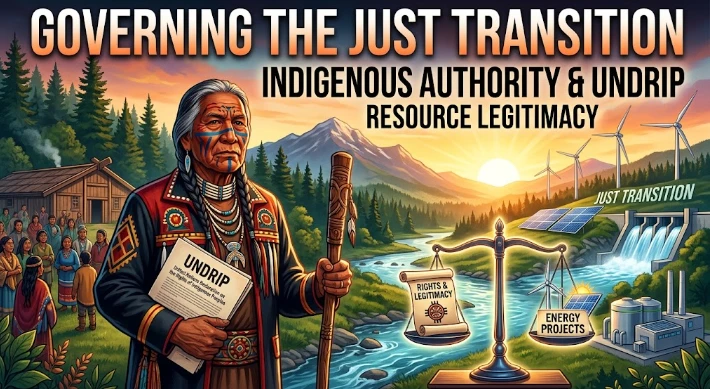
A just environmental transition cannot be achieved when Indigenous peoples bear local costs while governments and industries retain control over resources and benefits. This article examines the relationship between Māori authority, resource legitimacy, UNDRIP, and New Zealand’s transition toward a low-emission economy. Renewable energy, conservation, forestry, mining, coastal protection, and infrastructure projects can affect Indigenous land, cultural relationships, employment, and community development. Consultation conducted after central decisions have already been made does not provide meaningful authority. The article advocates Indigenous participation from problem definition through planning, financing, implementation, monitoring, and remedy. Free, prior, and informed consent, co-governance, fair benefit-sharing, Māori data authority, culturally grounded impact assessment, and accessible dispute resolution are essential institutional safeguards. The transition must also recognize varied priorities among iwi, hapū, and communities rather than treating Māori interests as uniform. Resource decisions become legitimate when Indigenous institutions possess continuing authority and when environmental goals advance, rather than weaken, self-determination and intergenerational wellbeing.
Consultation only is not a fair system of governance for a just transition. The activities of energy, mining, conservation, forestry, transport and climate adaptation impact land, water, livelihood, culture and political power. As countries around the world contribute to the commitments to the rights of Indigenous peoples in January 2026, one thing becomes more evident: decisions with Indigenous authority from the start, lend credibility to transition policy. The UNDRIP provides a basis for self-determination, participation, land rights and FP&IC.
There are no exceptions for rights in the climate emergency. Demand for minerals, transmission is growing rapidly with more renewable sites and forest carbon projects and coastal adaptation. A large number of projects are on or in proximity with Indigenous territories. A project able to cause a reduction in global emission can be causing a corresponding of extraction, displacement or exclusion locally. Evaluation of both the climate benefit and institutional relationship is essential for the justice.
Legitimacy of resources is not the only issue relating to legal title. Communities look at indicators of whether decision-makers have the right to make decisions, whether they are following Indigenous law, if Indigenous knowledge is respected or taken seriously, and if all the benefits and burdens are equal. Even a permitting process under the national law could be socially discredited if those people impacted by the process were left out. When there is conflict then there is delay in the project, rise in the cost and break up in the trust.
There is no mechanical formula for UNDRIP. For Free, Prior and Informed Consent, there has to be good faith processes that are adapted to the context. Freedom is noncoercion, passing or being free from pressure, force, or pressure.
Prior – engagement before commitments & irrevocable decisions. Informed: Evidence on risks and long term effects is accessible. Consent is decision making processes of the collective through relevant Indigenous institutions.
Authority needs to be put in Governance design areas - not just stakeholder lists. Jurisdiction can be recognized in a joint boards, the Indigenous regulatory body, the delegated powers, treaty-based arrangements and in co-management. Being on an advisory committee provides limited amount of influence, when the final authority remains the same. Good structures, among other things, define where decisions get made, how to handle disputes, financial and other budgets, how to get data, and community accountability.
Share the benefits shall need depth as well. Occasionally, one-off quick payments and jobs don't really equate to what it takes to make permanent, structural changes to land and resources. Equity investments, percentage on revenues, community ownership, local procurement, skills development and long term environmental funds are all ways of creating sustainable value. Communities should continue to have visibility of any agreements, as long as there is legitimate commercial confidentiality.
By providing another basis of authority, environmental knowledge. Indigenous knowledge systems include local knowledge of ecosystems and seasons, and the presence of species, and of cumulative changes. Knowledge shouldn't be extracted to external and un-governed databases through integration. There is a need for consent, attribution and limits on reuse and community control of protocols. The autonomy of one knowledge system is not required to be given up for scientific knowledge to be able to inform Indigenous knowledge.
“Cumulative impacts” are noteworthy. Overall impact of roads, mines, traction, conservation restrictions and climate damage can be overlooked in individual project reviews. At the regional scale, ecological limit and threshold, cultural landscape and social pressure should be identified. Any multi-scale analysis should involve indigenous institutions in helping to determine the scale of analysis. Restricting project boundaries may obscure the true philanthropy of a community.
Transition finance can help promote or undermine self-determination. Rights due diligence, governance plan and accessible grievance options for both public banks, climate funds, and private lenders. Self-reporting in the company should not be the basis for compliance. Proper monitoring, community involvement and implementation of corrective action increases the credibility. Money must also go to indigenous-led projects as well as to provide protections for third-party development projects.
Resolution of disputes should be in keeping with legal pluralism. Though courts are important, the litigation process can be slow, costly and foreign to culture. Earlier conflict resolution through negotiation, mediation, Indigenous forum and hybrid bodies. Agreements should be formulated and it is the applicable law that should be specified and for what purpose. Grievance process which is under the control of the project developer is non-independent.
Within governments there is a need for internal coordination, as Indigenous right issues are integrated within the different actors and agencies of environment, energy, finance, local government and development. Different instructions are causing delay and inconsistent treatment. There can be a basic structure in place that sets basic requirements and provides for national arrangements. Training is needed for officials, but it shouldn't be a substitute for statutory powers or good resources.
Measurement needs to be done for effectiveness and production. Only partial evidence from megawatts installed, emissions avoided and jobs created. It is important to monitor the consent mechanisms, indigenous ownership, the extent of governance, distribution of revenues, cultural effects, dispute resolution and environmental restoration. Communities should have an equal voice with the national performance targets through community suggested measures.
Political narratives matter. The claims that Indigenous rights hinder climate action are based on a clarifying thought, and they are false because they present the choice as either or: either Indigenous rights or climate action. Much of the conflict and delay attributed to rights is brought about by exclusion. Share leadership early to increase site selection success, mitigate harm to ultimately create lasting support. Justice can enhance implementation by recognizing indigenous peoples as governments and rights holders and not as interest groups.
Not all projects go through. Just transition is also involved with the latter. Requiring refusal, relocation, redesign and slower development can be expressions of respect for rights. Targeted planning and research on climate change should not give points for being met. Governments can seek to seek a variety of technologies, efficiency, reduction in demand, or alternative sites. There's not a lot of consent when rejection is a non-institutional topic.
A combination of authority, benefit, knowledge and remedy increases the legitimacy of resources. UNDRIP sets forth minimal standards which must be put in place through domestic legislation and negotiated institutions. Without the participation and the governance of Indigenous peoples, a just transition could result in the repetition of the same patterns that were constructed and enjoyed a green label is at risk. A legitimate transition acknowledges political relations, along with technological change, as a result of decarbonisation. Both reduced emissions and greater self-determination and participatory control over land, resources and future developments are a measure of success.
Protecting rights and investments can be done by project sequencing. Land status, authority and consent should be cleared up prior to tendering by government. Competitive processes will start, and will seek to approve a preferred site later. Avoiding stranded cost and conflict needs to be done early in the right assessment process.
There is a need for direct support to the community capacity. Resources have to be devoted to carrying out technical studies, legal advice, meetings, translation and internal deliberation. Don't allow for pressure to consent when funding. Developers must have clear rules in place that will not allow for them to control advisers or give unrealistic deadlines.
Closure and restoration to be considered part of transition agreements. Changes of infrastructure, energy facilities, and mines. Abandoned liabilities can be a problem for communities if the project is not decommissioned with bonds and a restoration plan with longterm monitoring. Acceptable future land use and the restoration outcomes should be mutually agreed upon by Indigenous authorities.
There is an intersection between labour rights and Indigenous rights. Careless breadth of construction projects can offer work opportunities, and introduce labour that is colloquially referred to as "temporary" when there is not actually opportunity for local progression. Training and Workplace standards and career pathways should be integrated into benefit agreements. Data on employment needs to differentiate between temporary construction jobs, and permanent skilled jobs.
Authority is needed for Climate adaptation, as well. Sacred Places and continuity of communities can be impacted by relocation, coastal protection, water allocation and ecosystem restoration. Defining risks and determining adaptation priorities should be based upon indigenous governance. An emergency framework run by a state can dispose of consent where there is a sense of emergency.
Through regional cumulative planning it can be determined where more development is unacceptable. Autour is not a good word and doesn't belong in the law, and ecologic and cultural limits are not something that should be imposed at the discretion of the relevant officials. Periodic review is needed with respect to changes in conditions in strategic plans. With such planning, developers have a better idea about what to expect and communities have more protection.
Marine and freshwater governance is a linkage between a climate transition and a food system and cultural practice. Change in customary access and health of the ecosystem by dams, offshore energy, irrigation and conservation rules. Indigenous-led monitoring should impact permit renewal and enforcement, rather than solely be used for creating advisory reports.
Prior to development, details of insurance and liability should be negotiated. Communities may be left with costs due to accidents, damage to the environment or failure of the project(s). Long term protection of both the legitimacy and the long term restoration is provided through financial assurance, clarity of liability and accessibility of claims processes.
Internal agreements must be reached in the case of transparency. It is important for the community to be informed about the distribution of benefits, and governance and conflict issues, but in terms they can understand. Specifics of business should be kept confidential, but this should not take the place of internal accountability and shared decisions based on information.
Rights risk(s) should be published in the plans for a government transition in addition to emissions benefits.
CITE THIS ARTICLE
Amin, M. R. (2025). Governing the Just Transition: Indigenous Authority, Resource Legitimacy, and Indigenous Peoples’ Rights and UNDRIP. https://www.ruhulresearchhub.com/article/7c72ec01-8650-5d22-b75a-f4139974317a
M. R. Amin, “Governing the Just Transition: Indigenous Authority, Resource Legitimacy, and Indigenous Peoples’ Rights and UNDRIP,” 2025. [Online]. Available: https://www.ruhulresearchhub.com/article/7c72ec01-8650-5d22-b75a-f4139974317a
Amin, M. R. (2025) ‘Governing the Just Transition: Indigenous Authority, Resource Legitimacy, and Indigenous Peoples’ Rights and UNDRIP’. Available at: https://www.ruhulresearchhub.com/article/7c72ec01-8650-5d22-b75a-f4139974317a
Amin, Mohd. Ruhul. “Governing the Just Transition: Indigenous Authority, Resource Legitimacy, and Indigenous Peoples’ Rights and UNDRIP.” 2025, https://www.ruhulresearchhub.com/article/7c72ec01-8650-5d22-b75a-f4139974317a.
Mohd. Ruhul Amin. “Governing the Just Transition: Indigenous Authority, Resource Legitimacy, and Indigenous Peoples’ Rights and UNDRIP.” (2025). https://www.ruhulresearchhub.com/article/7c72ec01-8650-5d22-b75a-f4139974317a.
Amin MR. Governing the Just Transition: Indigenous Authority, Resource Legitimacy, and Indigenous Peoples’ Rights and UNDRIP. 2025. https://www.ruhulresearchhub.com/article/7c72ec01-8650-5d22-b75a-f4139974317a
@misc{article_7c72ec0186505d22b75af4139974317a,
  title = {Governing the Just Transition: Indigenous Authority, Resource Legitimacy, and Indigenous Peoples’ Rights and UNDRIP},
  author = {Mohd. Ruhul Amin},
  year = {2025},
  url = {https://www.ruhulresearchhub.com/article/7c72ec01-8650-5d22-b75a-f4139974317a},
}
TY  - GEN
AU  - Mohd. Ruhul Amin
TI  - Governing the Just Transition: Indigenous Authority, Resource Legitimacy, and Indigenous Peoples’ Rights and UNDRIP
PY  - 2025-11-17
UR  - https://www.ruhulresearchhub.com/article/7c72ec01-8650-5d22-b75a-f4139974317a
ER  -
This article presents democratic recovery after executive overreach as a process of reopening institutions rather than merely restoring formal legal boundaries. It describes how executive misconduct can leave politicized appointments, weakened oversight, restricted records, altered enforcement practices, intimidated officials, and concentrated agenda control. The article mentions open-democracy theory as requiring continuous accessibility, deliberation, transparency, inclusion, and responsivenes
Climate accountability increasingly operates through routine public and corporate decisions rather than exclusively through litigation. This article examines how international environmental law and the law of the sea influence government budgets, permits, procurement, port operations, insurance, energy planning, investment, and corporate governance. The 2024 advisory opinion of the International Tribunal for the Law of the Sea recognized anthropogenic greenhouse-gas emissions as pollution of the
This article examines how biometric border systems can create unequal experiences of citizenship and migration control in the United States. It describes facial recognition, fingerprinting, iris scanning, and interconnected identity databases as technologies that may improve verification and reduce fraud while also expanding surveillance and distributing errors unevenly. The article mentions false matches, failed identification, secondary inspection, questioning, detention, and weak appeal proce