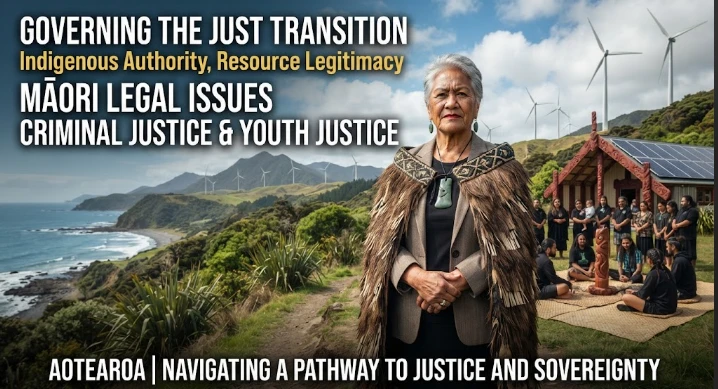
There is renewed focus on Māori governance in a just transition in April, 2026. The central issue is very clear: there can be a transfer of the costs of resource and climate change decisions to Māori communities, without devolving decision making to those communities. However, there is a challenge that doesn't lend itself to a legal solution, since cycles of institutional action decide on how to make power reach everyday life. The Relations between Rules, Evidence, Participation and Remedy relationships are all credible components of a response.
The principles of Te Tiriti o Waitangi, the principles of UNDRIP (United Nations Declaration on the Rights of Indigenous Peoples) environmental law, youth justice obligations, governance informed by tikanga are also included within the governing framework. Historically, those have determined standards without specifying institutions to interpret, implement and review those standards. A range of key actors, such as iwi, hapū, Māori landowners, councils, ministries, energy companies, the court and youth-justice structures are involved. There needs to be coordination within that group and independence cannot be sacrificed or responsibility confused.
Maori law matters are tangled to institutional power. The consideration of tikanga, whenua, whakapapa, and collective responsibility alters the types of questions asked of processes of justice and policy. Narrow approach to service delivery is one which views Māori institutions as contractors. According to the self-determination model, a person has the authority to set problems, provide the resources for their problem solving, control the data they are to work with, and answer the question of their own success.
Te Tiriti relationships are not something that can be done once in a while, but must be done continually as a part of institutional practice. Early involvement is important as options reduce when budgets, legislation or designs of projects are finalised. Access to information needs to be available and time limits realistic; Māori areas of institutions need to be resourced properly for Māori to be involved. Enfowments are also reciprocal so even in case of disagreement, explanations are required.
Rangatahi Māori suffer not only from dis-aligned leadership of the various agencies from incoming marae to schools, care and protection to health, polic and courts, but also because of the absence of leadership in marae. There is less reassessment and duplication of plans with shared rule. The outcomes of whānau continuity and cultural connection, and of locally based support, should be core not optional. For Māori providers, by maintaining stable funding, they can maintain their capability and relationship.
Data sovereignty – this is the main element of accountability. Administrative data sets might reveal disparity, and states status and limited performance measures might bring about control. Collect, access, interpret, link, retain, publish – Governance structure should define. Conventional justice measures can be complemented by indicators that are important for Māori and capture a sense of belonging, mana, whānau strength, cultural continuity and community safety.
You need more than just a regular contract management to have dispute resolution. Shared governance should have mutually agreed deadlock, breach, funding conflict and jurisdiction overlap procedures. Relationships can be safeguarded by independent mediation, tikanga-based processes, right of review rights and public reporting. These mechanisms if not present make it easy for formal partnership to fall apart the first time there is a disagreement.
Those tools and principles of tangata kokiri and wāhikona should give focus to a practical reform agenda, which should include: Shared governance; early consent processes; benefit agreements; tikanga-based assessment; and; community- defined safeguards. These elements cover each failure point: Authorization: before action, Documentation: while the action is taking place, Review: after the action is taken and Remedy: when there is harm. The order is important – if there is no record or rationale before a particular event, there is less accountability for the event.
Resource, benefit, ownership, participation and youth outcomes and evidence of environmental impacts should be included. It is these types of "material" that enable comparison between agencies, between regions, over time and also affected groups. Publication is the way to preserve confidentiality while providing information of the patterns, disparities, delays and repeated institutional failure.
The focus of equity analysis needs to be rangatahi Māori (young Māori), Māori in flight-path areas or areas with extraction, Māori land trusts, and communities impacted by climate risk. The formal neutrality cannot resolve the question of whether there is a predictable burden of taxation, or whether there are income, status, geographic, disability, ethnic, age, language or any other disparities in access to review. There should be an influence of distributional evidence on design and resources allocation.
Do ask formal rules to be related to incentives (institutional analysis). Workloads, targets, budgets, professional norms, political signals and expected scrutiny are all factors which shape official's responses. Reform is effective if those forces drive towards lawful and fair behavior. A 'safeguard' that is present in a 'man' only shows up when you are in a state of manual control.
There are risks associated with measurement. Indicators will help to reduce the complexity in the outcome and allow for strategic reporting. Thus quantitative information should be placed alongside any qualitative information, independent verification and clear definitions. Disaggregated reporting is of importance as it can mask particular local or group failures.
The other sphere of public communication, likewise, has an impact concerning legitimacy. The semantic tricks of the trade cloud the true meaning of administrative decisions, and the drama make the uncertainties more pronounced. Objectives, evidence, trade-offs, rights affected, opportunity to challenge should be clearly explained. Sometimes, it's important to admit we don't have everything figured out, which can be more symbolic of a strong confidence than saying that we do.
Implementation requires resources. The review bodies must have staff, it must have expertise, must have bonds and forbearance, it must have the right to see the records, to demand a response. Funding, interpretation, accessible venues and enough time is needed to facilitate community participation, as well. Undocumented rights and participation duties can turn into to be merely symbolic commitments.
Developed institutional reforms should be neither 'one size fits all' nor context-sensitive. In general, the guarantees of core protections, like legality, equality, notice, review and remedy, are applicable. In practice, the protections are on-going and are taken in light of local knowledge. Durability design brings together the common features and safeguards with being culturally, geographically and lived experience responsive.
Money is a sign of depth of institutional commitment. Noised up thinking by agencies or short-term contracts may encourage Māori groups to stick to a community agenda to match the agency agenda. Support of capability through multi-year funding and flexible outcomes with transparent cost recognition. There can be a strong sense of accountability with locally determined ways of working.
Processes should be informed by tikanga and impact not only by way of ceremony, but substance too. Referral, hearing, remedy and evaluation can be reimagined in terms of concepts of relationship, collective responsibility, restoration and mana. There's a need for ongoing capacity building of the institutional sector as opposed to one-off cultural training. Where tikanga is a part of a governing framework it should be interpreted in consultation with Māori authority.
Comprising shared authority, workforce development. Proper institutional structures are required for Māori-led institutions to have pathways for legal, policy, data, clinical and youth-justice expertise. There is also a need for state agencies to have staff that are vibrant in relational and tikanga processes. Joint capability plans can mitigate when a small group of people are doing the same thing and have the same requests for consultation.
Cumulative effects should be taken account of when making land and resource decisions. Repeated Loss, Limited access, cultural loss or environmental loss over generations can be overlooked by a single project assessment. Evidence can be used at a catchment level and Whakapapa-based evidence to widen the frame. Decision Records: reasons for the decisions should be included that involve cumulative Māori interests.
There is need for institutional-weighting of youth participation. It can be revealing of barriers not seen by adult governance to consider rangatahi panels, peer research and youth led panel evaluations. Safeguards to protect privacy, safety and informed participation. Official responses need to include details of which of the recommendations resulted in a change in services, funding or justice practice.
Responsibility should be identified at each and every Governance step. While decisions regarding authorization, delivery, monitoring, and remedy should be traceable, Māori land owners, councils, ministries, energy developers, the courts, and youth-justice institutions need to be able to work together effectively without losing the ability to trace these processes. Means for overlapping mandates should be designated in writing along with escalation paths. It is this ambiguity that has the power to govern the boundaries of institutions, as opposed to people who have been affected in some way.
Risk assessment should be both and inaction. Too much intervention can be a violation of rights and the late or incomplete provision of intervention can mean that significant harm is not dealt with. Records of decisions should contain information to support the balance of alternatives driven by evidence and less-restrictive alternatives. Then reasoning can be critically assessed which may not have been stated and there is no need to reconstruct unstated assumptions.
Independent research can help fill the gap between official reports and what's experienced in the community. Secure Data Management, ethical use and publication rights enable testing of institutional claims. Confidentiality and authority of local communities should be maintained in partnerships. When it comes to findings, it's not enough just to passively acknowledge them – they need to be responded to formally.
Success needs to be measured by actual decision making, fair pay, protected whenua and wai, diminished inequalities in the justice system, and on-going consent. These interventions are intended to be used in conjunction and include outcomes, procedure and institution capacity. Targets ought to be made public, definitions ought to be stable and when they fall short – reasons ought to be given and corrective plans ought to be drawn up.
An institutional model that has good levels of legality, capability, participation, transparency and correction are the strongest. While iwi, hapū, Māori landowners, councils, ministries, energy developers, courts, and youth-justice institutions have authority, how those authorities are applied is important in ensuring that practical protection is put in place, building on an ongoing conversation and the principles of Te Tiriti o Waitangi, UNDRIP, environmental law, youth-justice obligations, and tikanga-informed governance. A lens on evidence from resource consents could reveal the gap between formal compliance and lived outcomes, in terms of ownership, distribution and participation (in and for the resource), and youth outcomes, and environmental impacts. A transition is just when Māori voice their control over environmental decisions and the associated institutions that deal with social impacts.