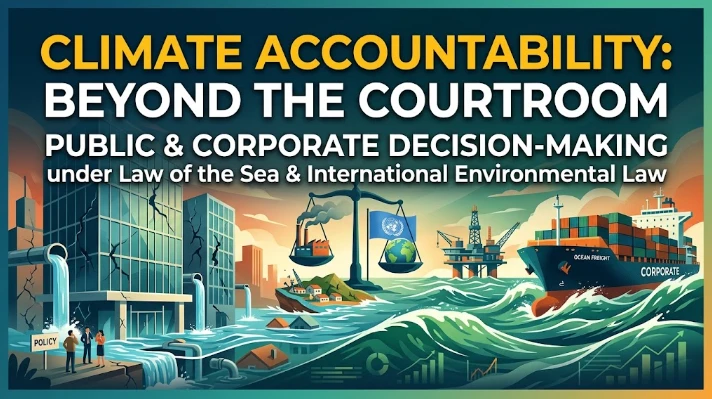
Climate accountability increasingly operates through routine public and corporate decisions rather than exclusively through litigation. This article examines how international environmental law and the law of the sea influence government budgets, permits, procurement, port operations, insurance, energy planning, investment, and corporate governance. The 2024 advisory opinion of the International Tribunal for the Law of the Sea recognized anthropogenic greenhouse-gas emissions as pollution of the marine environment under UNCLOS, strengthening obligations to prevent, reduce, and control climate-related marine harm. The International Court of Justice’s 2025 climate advisory opinion further clarified the legal landscape surrounding state conduct and climate damage. These developments affect how regulators, public banks, export agencies, corporate boards, and investors assess proposed activities. The article argues that climate science, marine impacts, due diligence, and vulnerable communities must be integrated into everyday decisions. Effective accountability requires transparent emissions analysis, documented reasoning, credible transition planning, public participation, corporate disclosure, and remedies for communities disproportionately exposed to environmental harm.
The fight for climate accountability is no longer restrict to court-rooms. Duties are expressed more through the budgets and permits, the boardrooms, the procurement systems, insurance models, port operations, energy planning and the investment process than they are through judicial decisions and advisory opinions. Those everyday decisions are increasingly influenced by law of the sea and international environmental law in November 2025, with the very survival of vulnerable coastal communities being at stake due to ocean warming, acidification, sea-level rise, fisheries, and coastal infrastructure being affected by climate change. The legal issue is shifting from one of "does global warming impact harm" to "how do institutions respond.
In 2024, the International Tribunal for the Law of the Sea gave a trailblazing ruling on an advisory opinion. Tribunal took anthropogenic emissions of GHGs as a source of pollution of the marine environment, as enshrined in the UN Convention on Law of the Sea, and discussed the obligations to prevent, reduce and control it. The opinion made links to climate science, best available knowledge, and protection of marine ecosystems and the concept of due diligence. This argument has significance beyond legal procedures, however, because ocean damage can no longer be regarded as an externality to regulators and firms.
In July 2025, the International Court of Justice (ICJ) lent more credibility with the climate advisory opinion. Although advisory opinions are not a damage award against a specific defendant, advisory opinions nonetheless help to illuminate the law's landscape in relation to state actions. Ministries, public banks, export agencies and corporate counsel now need to think differently about climate decisions – with a more dense set of international requirements. Even if the project does not have a serious emissions analysis, there is legal, financial and diplomatic (and reputational) risk while the case is still in its very genesis.
Marine impacts, then, need to be considered through public decision making at an early stage. EIAs shall work to look at cumulative emissions and downstream use as well as the impacts of construction in the immediate area, ocean acidification and transboundary effects. Strategic assessment may be used to make comparisons between whole policy pathways which include (taking a few examples) port development, offshore energy resources, shipping lanes, coastal defence. Vigilant waiting may delay decision-making until the closing stages of a permit process and overlook decisions which are already built into infrastructural plans.
Budget policy is of course not without significance either. Governments influence emissions by means of subsidies and tax preferences, public procurement, sovereign guarantees and development finance. Public financing and assistance should be moved to a climate accountability framework to recognize when public funds are being used in ways that are incompatible with marine protection mandate. Explicit climate assumptions, sensitivity analysis, and explanations - when short term economic goals and long term ecological risks tend to be in conflict - are needed in budget documents. It then no longer has to be about general pledges, but about measurable fiscal decisions, in the course of parliamentary scrutiny.
There are related responsibilities for corporate boards. Directors evaluate risk associated with material, strategy and disclosure, and long-term value. The climate impacts on oceans can impact supply chains, ports, fisheries, tourism and insurance, as well as property and regulatory risks. Board papers should capture the assumptions with respect to carbon prices and the pathway and about the physical risk and legal obligation. Another source of concern is the often ambiguous nature of the use of generic sustainability terms, when internal investment models have been based on high emissions scenarios, which differ from the public commitments and to some extent also differ from the emerging legal requirements.
Direct link between law of the sea and business in shipping. The emissions are dependent on vessel efficiency, fuel, routing, port facilities, cargo volumes and vessel renewals. While international regulation establishes common standards, there is still strategic choices in companies and ports in addition to the minimum regulation. Pollution can be locked in through long-lived assets as well as transition accelerated. Procurement contracts and financing covenants can incentivize clean technology and prevent making unbacked claims.
Accountability can be passed on through insurance and finance without any formal court orders. Environmental covenants are imposed by the lending, with physical risk a factor in insurance pricing, and the investors focussing on plans for transition. There are advantages and disadvantages to these mechanisms, which would work towards improving discipline. When designing a model, vulnerable communities may be excluded; adapting the model may come at a higher cost for coastal communities; and capital may shift away from regions where it is needed for adaptation. Public oversight needs to look at reduction of risk and fairness, transparency and access, however.
Distributional challenge: Coastal adaptation. Protecting some things while altering risks elsewhere involve sea walls, retreat programs, restoring wetlands, zoning and relocating. Community engagement is necessary in formulating lawful decision making involving impacted communities, indigenous governance, local governments and ecological experts. Don't leave additions of compensation and livelihood protection until late. It is important to note that the 'legitimacy' of 'adaptation' depends on what is considered 'acceptable loss', who is offered protection, and who makes the decision on relocation.
This accountability also applies to the supply chain of the business. Marine impacts can exist at the final products, but be invisible due to contaminants of seafood, minerals, fuels, construction materials, or agricultural commodities. Due-diligence systems should include dealing with origin, environmental damage, working conditions, and redevelopment of sites. With suppliers having incentives to understate loss (audit provides little value). T tie up to the long-term agreements, grievance system and traceability, purchasing practices can make commercial behaviour meet with environmental commitments.
Overall, data quality will be the key factor in whether accountability is at work. What is needed is a regular emissions inventory by governments and companies and ocean indicators, asset-level exposure and scenario analysis. When hazards are great, the risk involved cannot justify holding back from action. Uncertainty, rather, should be represented in terms of Ranges, Assumptions, and Precautionary Choices. Open data allows the scientific community, communities, investors and regulators to scrutinize the authorities' claims.
Remedy is vital even when it is not a part of a lawsuit. Correction can be achieved through administrative complaints, ombuds institutions and shareholder resolutions, procurement challenges, lender covenants and community agreements. Clear standing & evidence access, timelines, follow up to each mechanism. Establishing a grievance mechanism, which lacks any power to alter a permit, contract or investment decision, is another layer of reputation management.
Corporate influence on policy should also be included in the part of accountability. Rules governing the application of climate risks can be influenced through lobbying, political donations, industry-funded research and by engaging in ‘standard' setting. Transparency can guide the astute separation of Truth from Delaying Tactics. Decisions, conflict of interests, protocol of meetings and evidence presented to public agencies should be publicly disclosed. Climate leadership should be reflected in companies' political involvement in relation to their transition commitments.
The best institutionalization is to combine international norms and domestic practices. The Planning Guide, financial regulation, training of directors, procurement templates, Public-Bank mandates and auditing standards should all be affected by the work of protecting the marine environment. Even though these systems are in place, the courts will still play a pivotal role when the systems break down, but litigation is a last and expensive resort. Integrating early helps to set out the expectations more clearly, and narrows the gap between international obligation and action.
That is not 'softer accountability,' however, for climate accountability that takes place outside of a courtroom. It accesses “where emission and adaptation pathways actually are selected.” The principles exist through law of the sea and international environmental law, and these principles become projects, contracts and budgets with the implementation of public and corporate institutions. The key question is if decision makers can answer what they did to take into account ocean harm, what were the alternative options, who was consulted and whose rights have been considered, and how the results of implementation will be monitored. However, when those responses are there before the crisis, before the scandal or judgment, then you can believe the accountability.
Better enforcement strategies are required by environmental regulators that are commensurate with the size of the marine risk. An element of measurable thresholds, reporting requirements, independent verification, and consequences for not meeting the standards should be included in permit conditions. Repeated administrative waivers can make laws with robust text completely empty. A public list of exemptions and enforcement action provides some indication of whether standards limit or restrict the power of powerful actors.
Ports and other cities along the coast require adaptation funding to not pass all expenses on to their local communities. There can be a national framework which links grants, risk-based investment and social protection. The distribution of funds must be based upon ecological value, critical infrastructure, cultural sites and vulnerability in addition to property value. Distributional review makes sure that adaptation does not ensure the protection of the ‘haves’ at the cost of the ‘have nots'.
Climate claims must be disciplined, corporate ones will require even more so in future. Terms like “net zero” and “climate positive” or “ocean friendly” might convey false information if offsetting, boundaries and timelines are ambiguous. If regulators (consumer or securities) demand substantiation. Credible communication between the claims and audited inventories planning and interim targets not resolved and declared.
When a board member's performance is tied to the circumstances, remuneration can enhance accountability in the event of climate performance or quality of climate information reporting. Targets should be safeguarded against gaming and incorporate not only headline intensity targets, but also absolute emissions and capital alignment, as well as remediation.
CITE THIS ARTICLE
Amin, M. R. (n.d.). Climate Accountability Beyond the Courtroom: Public and Corporate Decision-Making Under Law of the Sea and International Environmental. https://www.ruhulresearchhub.com/article/3eca515d-84a3-5ede-875e-57210e207ee9
M. R. Amin, “Climate Accountability Beyond the Courtroom: Public and Corporate Decision-Making Under Law of the Sea and International Environmental,” n.d.. [Online]. Available: https://www.ruhulresearchhub.com/article/3eca515d-84a3-5ede-875e-57210e207ee9
Amin, M. R. (n.d.) ‘Climate Accountability Beyond the Courtroom: Public and Corporate Decision-Making Under Law of the Sea and International Environmental’. Available at: https://www.ruhulresearchhub.com/article/3eca515d-84a3-5ede-875e-57210e207ee9
Amin, Mohd. Ruhul. “Climate Accountability Beyond the Courtroom: Public and Corporate Decision-Making Under Law of the Sea and International Environmental.” n.d., https://www.ruhulresearchhub.com/article/3eca515d-84a3-5ede-875e-57210e207ee9.
Mohd. Ruhul Amin. “Climate Accountability Beyond the Courtroom: Public and Corporate Decision-Making Under Law of the Sea and International Environmental.” (n.d.). https://www.ruhulresearchhub.com/article/3eca515d-84a3-5ede-875e-57210e207ee9.
Amin MR. Climate Accountability Beyond the Courtroom: Public and Corporate Decision-Making Under Law of the Sea and International Environmental. n.d.. https://www.ruhulresearchhub.com/article/3eca515d-84a3-5ede-875e-57210e207ee9
@misc{article_3eca515d84a35ede875e57210e207ee9,
  title = {Climate Accountability Beyond the Courtroom: Public and Corporate Decision-Making Under Law of the Sea and International Environmental},
  author = {Mohd. Ruhul Amin},
  url = {https://www.ruhulresearchhub.com/article/3eca515d-84a3-5ede-875e-57210e207ee9},
}
TY  - GEN
AU  - Mohd. Ruhul Amin
TI  - Climate Accountability Beyond the Courtroom: Public and Corporate Decision-Making Under Law of the Sea and International Environmental
UR  - https://www.ruhulresearchhub.com/article/3eca515d-84a3-5ede-875e-57210e207ee9
ER  -
This article presents democratic recovery after executive overreach as a process of reopening institutions rather than merely restoring formal legal boundaries. It describes how executive misconduct can leave politicized appointments, weakened oversight, restricted records, altered enforcement practices, intimidated officials, and concentrated agenda control. The article mentions open-democracy theory as requiring continuous accessibility, deliberation, transparency, inclusion, and responsivenes
This article examines how biometric border systems can create unequal experiences of citizenship and migration control in the United States. It describes facial recognition, fingerprinting, iris scanning, and interconnected identity databases as technologies that may improve verification and reduce fraud while also expanding surveillance and distributing errors unevenly. The article mentions false matches, failed identification, secondary inspection, questioning, detention, and weak appeal proce
Integrating international legal and economic obligations into domestic governance is a political and institutional process, not a simple act of legislative adoption. This article examines how treaties, international standards, trade rules, and institutional decisions move through national legislatures, ministries, regulators, courts, local authorities, and private contracts. Different actors may reinterpret obligations according to political priorities, administrative resources, commercial inter