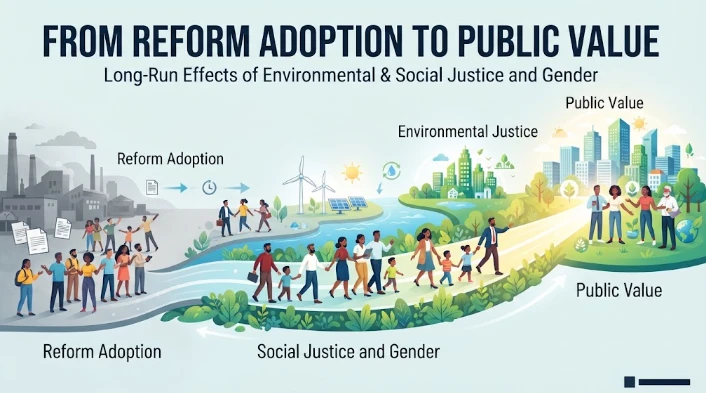
The article evaluates public-sector reform over the long run by asking whether adopted changes generate durable public value across environmental, social, and gender dimensions. It defines public value as more than efficiency, incorporating environmental quality, equal treatment, democratic voice, cultural integrity, trust, wellbeing, and intergenerational stewardship. The article calls for long-term monitoring, public dashboards, community-defined indicators, independent review, and adaptive correction after implementation. Evidence should track environmental conditions, household costs, health, labor effects, gender impacts, compliance, and institutional learning, especially for communities facing cumulative pollution, climate vulnerability, precarious employment, care burdens, or weak political voice. It also emphasizes distribution-sensitive budgeting, co-production, enforcement capacity, procurement, place-based governance, complaint analysis, and formal responsibility across institutions. Reform should not be judged by initial adoption or favorable rhetoric. Its value appears over time when inequalities narrow, environmental outcomes persist, wellbeing improves, institutions remain compliant, and communities continue to trust the systems governing them.
A long-run perspective on public value, taking into account both the environmental and social dimension of public value, is a question on law, administration and public legitimacy. June 2026 is especially significant because, in the process of enactment, there is often a favorable discourse around the reforms, but the impact and the challenges throughout the implementation process and in terms of inequalities become apparent over time. Goodwill can't be the sole foundation for good institutions. Safeguards need to be maintained at times of pressure, differing views and changing politics.
The system of governance involves public sector stewardship and environmental responsibilities, equality obligations, financial oversight, and democratic oversight. Standards are set by those sources but do need the institutions to interpret, implement and review them. Ministries, councils, regulators, providers of service, community groups and researchers, as well as oversight institutions are the key actors. That group needs to maintain independence in coordination and not to encase responsibility.
There is no single definition of public value, and it goes beyond efficiency. Administrative performance includes environmental quality, equal treatment, democratic voice, cultural integrity, trust and future. Using a "narrow" cost measure can act as an incentive for the shifting of costs to households, communities, or future generations. Those transfers will be apparent on a broader evaluation.
The Public Service Act 2020 incorporates principles like those of political neutrality, free and frank advice, appointments based on merit, open government and stewardship into the administration of New Zealand. These principles help to defend legitimacy, when a policy clash heats up. Indeed, in the context of environmental decision making in particular, stewardship is of critical importance since the impacts go beyond elections and the lifetime of organisations.
Gender analysis needs to consider: Exposure, income, and unpaid care, transport, safety, housing, employment and participation. The household level is still one important level in which data serves as a blunt tool that can mystify unequal access to resources and time. Disaggregated evidence that is more robust to form a basis for policy design. Intersectional analysis also refrains from considering gender to be an homogenous category.
Environmental justice raises the questions: where is the damage taking place, who is benefiting, who is deciding, and what are the remedies? Climate risk and conservation policy, pollution and infrastructure have highly local impacts. The economic assessment should then be done in a distributional manner as well. Community knowledge can identify challenges or issues that surveys during the project may not uncover.
There's need for institutional memory for the accountability mechanisms. Lessons can be lost and long-term commitment can be undermined by reorganisations, change of leadership, short-contracts, etc. Continuity is supported through clear records, transparency via a public dashboard, lasting indicators, and an independent review. These also enable other governments to tell the difference between real failure and implementation challenge and complexity.
Long-term monitoring of and adjustments to, public dashboards of community set indicators, independent review, should be top priorities for a sensible reform agenda. Each of the elements covers a specific failure point: Authorize before acting, document while acting, review after the act, remedy if any harm occurred. Order is important; accountability is reduced if there lacks documentation and rationale for earlier accountability.
Factors to specify are environmental quality, household costs, health outcomes, effect in labour, gender impacts, compliance and institutional learning. Such information makes it possible to compare between agencies, regions, over time and with regard to impact on various groups. Even though publication of information can enable confidentiality to be maintained, this process can still expose trends, inequities, delays and recurring institutional failure.
Communities at risk of chlorophenol exposure and vulnerable to other related impacts should be at the heart of equity analysis, such as those with a history of exposure to multiple forms of pollution, climate vulnerability, precarious employment, care responsibilities, and lack of political voice. The formal neutrality cannot be used to answer the questions on the leveling off of burdens or inconsistencies in access to review, by income, by status, by geography or any other of the various factors relating to disability, ethnicity, age, language etc. Evidence should be collected about the distribution and be used to guide design and resource allocation.
There is also an impact on legitimacy as a result of the public communication. Technical jargon can conceal the proximate issues at stake in administrative-emanating decisions, and dramatic tones can remove all elements of uncertainty. Clear explanation should identify objective, evidence, levels of compromise and rights impacted, and opportunities for challenge. Acknowledging limits is more effective and is often a more honest approach to bolstering confidence than pretending to have a bit of control.
Implementation requires resources. Staffing, expertise, secure tenure, record access, and a requirement for responses are all key to review bodies. One also needs to think about the feasibility of community participation with the point of funding, interpreting and the venues offering space to do it and the time. Undocumented rights and participation obligations can evolve into 'symbolic commitments.
It is important to avoid taking a approach to institutional reform in the face of universal standards and context. Broad protections include the rights of core treatments (legality, equality, notice, review and remedy). Protections are effective in practice based upon local knowledge. Durable design leverages roughly normal protection mechanisms and culturally, geographically, and experientially-indexed procedures.
Evaluation of policies beyond the launch should be long term. When compliance is done early on, it can go astray as leadership changes, crises arise or budgets are cut. Pressure for continuity in the form of scheduled review, public reporting and independent research. This corrective process can be carried out without being dependent upon complete policy failure.
Informal rules are not to be linked to formal rules; the institutional analysis should connect formal rules and incentives. Official reactions to workload, targets, budget, professional norms and political signals, and to expected scrutiny. Reform succeeds when those forces direct behaviour which is lawful and fair. Safeguards which are only printed in a manual, may be overlooked during operation.
There should be historical trends of distribution when doing a budget analysis. Initial savings may result in subsequent health gains or losses, losses in disasters, unserved necessities or costs of unpaid care. A sensitivity analysis and explicit treatment of uncertainty is required for fiscal appraisal. Breakthroughs should be counted toward intergenerational effects even if those effects are down the line - and discounted in standard accounting.
Co-production can mean enhancements in legitimacy and effectiveness. Community groups understand the barriers and informal supports and how harm can build up. Co-production is not consultation where design, delivery and evaluation are decisions that are made after key decisions. Roles and fair compensation defuse participation to prevent it serving as unpaid administration.
Outcomes are determined by the capabilities of regulation and enforcement. Under-resourced inspection, monitoring and follow-up leads to an inability to drive up standards through the strength of the statutory framework. There is a need to not give up on communities that suffer from chronic low-visibility harm with risk-based enforcement. Priorities can be conveyed through public reporting – keeping flexibility for new emerging threats!
Environmental and social objectives can be promoted with the design of the procurement. Evaluation factors may include emission, working conditions, accessibility, the gains to the community and gender impacts. Contract management should not trust supplier assurances, but should make sure that the work is performed. There must be a progression from using correction plans to penalties or termination.
By highlighting the connections that may be overlooked through national averages, place-based governance claims that it can also assess systemic challenges and opportunities. Australia's experiences of environmental susceptibility, service access, employment, transport and housing varies from state to state. As for central funding, it should take into account local information and the knowledge of the community. National standards are important, but so too is that delivery that takes into consideration geographic conditions.
There needs to be a point of responsibility for every step of the governance system. That authorization, provision, oversight and redress have to be traceable for, but ministries, councils, regulators, service providers, community groups, researchers, and oversight agencies to cooperate effectively. If multiple mandates are in place, there needs to be written protocols and escalation routes in place. If there is any ambiguity, then, it is in favour of protecting the institutional boundaries and not the affected people.
Both ‘do' and ‘muster' need to be considered for risk assessment. Too much intervention can infringe rights but too late or too little or too disjointed intervention can be inadequate to deal with less common, but serious, harm. The decision records need to explain with existing evidence and less restrictive parts why the balance needs to be done. It's then possible, in later review, to assess reasoning instead of making assumptions not expressed in the text.
Official reporting may not capture the community's practical knowledge, which can be obtained through independent research. Access to such data, ethical management and rights for publication enable researchers to verify institutional claims. Partnerships must safeguard confidentiality and authority of the community. The findings should be responded to and not just passively acknowledged.
A complaint system provides a valuable source of information to help capture operational intelligence. Repeated complaints may help prevent lawsuits by alerting us to troubling rules or to inequalities or difficulty in access to services or poor supervision before the issue becomes serious. Agencies should not be classified with a theme, if doing so will diminish the extent to which harms are represented. Use the Trend Analysis to lead to Corrective Work assigned and Follow Up published.
The success must be assessed by means of lasting environmental achievements, through a shrinking inequality, enhanced wellbeing, continuous compliance and trusted institutions. The measures include both outcomes and procedure as well as institutional capability. Targets to be made public, failure definitions to be fixed, and failures with explanations and corrective plans.
While the legality, capability, participation, transparency and correction in public-sector stewardship, environmental duties, equality commitments, fiscal accountability, and democratic review establishes a compulsory and important base, in practice, the level of protection is determined by the exercise of authority by the various state and non-state bodies. Evidence based on environmental quality, household costs, health results, impacts on labor, gender impacts, compliance, and institutional learning can reveal the reality of formal compliance and lived experiences. Public value can be also seen in the years when public opinion of reform drives change in the conditions, capabilities and relationships, not just statute.
CITE THIS ARTICLE
Amin, M. R. (2026). From Reform Adoption to Public Value: Long-Run Effects of Environmental and Social Justice and Gender. https://www.ruhulresearchhub.com/article/8732b73a-ec9c-5ae2-b5ef-d93e026e1613
M. R. Amin, “From Reform Adoption to Public Value: Long-Run Effects of Environmental and Social Justice and Gender,” 2026. [Online]. Available: https://www.ruhulresearchhub.com/article/8732b73a-ec9c-5ae2-b5ef-d93e026e1613
Amin, M. R. (2026) ‘From Reform Adoption to Public Value: Long-Run Effects of Environmental and Social Justice and Gender’. Available at: https://www.ruhulresearchhub.com/article/8732b73a-ec9c-5ae2-b5ef-d93e026e1613
Amin, Mohd. Ruhul. “From Reform Adoption to Public Value: Long-Run Effects of Environmental and Social Justice and Gender.” 2026, https://www.ruhulresearchhub.com/article/8732b73a-ec9c-5ae2-b5ef-d93e026e1613.
Mohd. Ruhul Amin. “From Reform Adoption to Public Value: Long-Run Effects of Environmental and Social Justice and Gender.” (2026). https://www.ruhulresearchhub.com/article/8732b73a-ec9c-5ae2-b5ef-d93e026e1613.
Amin MR. From Reform Adoption to Public Value: Long-Run Effects of Environmental and Social Justice and Gender. 2026. https://www.ruhulresearchhub.com/article/8732b73a-ec9c-5ae2-b5ef-d93e026e1613
@misc{article_8732b73aec9c5ae2b5efd93e026e1613,
  title = {From Reform Adoption to Public Value: Long-Run Effects of Environmental and Social Justice and Gender},
  author = {Mohd. Ruhul Amin},
  year = {2026},
  url = {https://www.ruhulresearchhub.com/article/8732b73a-ec9c-5ae2-b5ef-d93e026e1613},
}
TY  - GEN
AU  - Mohd. Ruhul Amin
TI  - From Reform Adoption to Public Value: Long-Run Effects of Environmental and Social Justice and Gender
PY  - 2026-04-13
UR  - https://www.ruhulresearchhub.com/article/8732b73a-ec9c-5ae2-b5ef-d93e026e1613
ER  -
This article presents democratic recovery after executive overreach as a process of reopening institutions rather than merely restoring formal legal boundaries. It describes how executive misconduct can leave politicized appointments, weakened oversight, restricted records, altered enforcement practices, intimidated officials, and concentrated agenda control. The article mentions open-democracy theory as requiring continuous accessibility, deliberation, transparency, inclusion, and responsivenes
Climate accountability increasingly operates through routine public and corporate decisions rather than exclusively through litigation. This article examines how international environmental law and the law of the sea influence government budgets, permits, procurement, port operations, insurance, energy planning, investment, and corporate governance. The 2024 advisory opinion of the International Tribunal for the Law of the Sea recognized anthropogenic greenhouse-gas emissions as pollution of the
This article examines how biometric border systems can create unequal experiences of citizenship and migration control in the United States. It describes facial recognition, fingerprinting, iris scanning, and interconnected identity databases as technologies that may improve verification and reduce fraud while also expanding surveillance and distributing errors unevenly. The article mentions false matches, failed identification, secondary inspection, questioning, detention, and weak appeal proce